
Image Overlap: Why 80% Front and Side Overlap Is Important
You want clean, usable maps and models. Image Overlap: Why 80% Front and Side Overlap Is Important means your drone images cover the same ground many times from different angles. That heavy overlap gives photogrammetry software lots of common points to match, producing stronger 3D models and orthomosaics with fewer holes.
When planning a flight, aim for 80% front overlap (images along the flight line) and 80% side overlap (between adjacent lines). This creates a dense web of coverage—like weaving a net—so the software can tie images together even when lighting, texture, or GPS jitter is weak. You’ll face trade-offs: more images, longer flights, and heavier processing. For surveys that need dependable measurements, however, this overlap is the practical sweet spot.
What 80% front and side overlap means
- Front overlap: each photo shares 80% of its area with the previous shot, keeping vertical continuity and reducing gaps from speed or GPS variations.
- Side overlap: adjacent flight lines overlap by 80%, so each ground point is seen from many angles, improving height and shape estimation and reducing occlusions.
| Overlap type | What it is | Main benefit |
|---|---|---|
| Front overlap (80%) | Overlap along a flight line | Smooth tie between sequential images; fewer forward gaps |
| Side overlap (80%) | Overlap between flight lines | Multiple viewing angles; better 3D reconstruction |
| Result | Dense coverage | More match points and redundancy for surveys |
Why 80% overlap matters in surveys
For surveys, accuracy is paramount. 80% overlap increases the chance every ground point appears in many images, letting software triangulate positions with higher precision and lowering horizontal/vertical errors. High overlap also guards against wind, GPS jitter, moving shadows, or a few blurry frames—redundant views let the software ignore bad frames and rely on the good ones.
80% improves match points
With 80% overlap, each ground feature appears in numerous images, increasing the number of match points the software finds and producing stronger tie networks, denser point clouds, and fewer mesh holes.
How overlap improves orthomosaic accuracy
Overlap provides the repeated viewpoints photogrammetry needs to find matching points across photos. More front and side overlap yields many tie points that act like pins, holding the mosaic together so the orthomosaic has fewer gaps and less warping. For tall structures, complex urban scenes, or any project requiring high geometric accuracy, follow the rule: Image Overlap: Why 80% Front and Side Overlap Is Important.
| Overlap (Front × Side) | Typical use | Effect on accuracy |
|---|---|---|
| 60% × 30% | Quick surveys, flat areas | Fewer tie points, faster processing, lower accuracy |
| 70% × 60% | General mapping | Balanced speed and quality, moderate accuracy |
| 80% × 80% | Detailed inspection, building models | Maximum tie points, best alignment, highest accuracy |
Orthomosaic basics and overlap
Two overlap types matter: front overlap (along a line) and side overlap (between lines). Front overlap keeps vertical continuity; side overlap links lines across the area. Overlap creates multiple measurements of the same ground point so the software can average errors, reduce noise, and sharpen geometric accuracy.
Overlap reduces alignment errors
Insufficient overlap means the software can’t find enough matches and alignment fails. Overlap also helps combat parallax from variable heights and oblique angles—crucial for buildings, trees, and slopes.
Overlap needs for 3D reconstruction
Overlap is the glue for clean 3D models. Target high overlap and slower speeds for tight detail: more shared views yield denser, more accurate point clouds. A useful phrase to remember on-site is “Image Overlap: Why 80% Front and Side Overlap Is Important”—that level ensures many shared viewpoints.
| Overlap Setting | Typical Use | Result for 3D |
|---|---|---|
| 60–70% front / 40–60% side | Agricultural or wide-area mapping | Good basic geometry, faster coverage |
| 70–80% front / 60–80% side | Architecture, archaeology, forest canopy | Denser point cloud, fewer gaps |
| ~80% front and side | High-detail inspections, heritage work | Very dense, robust models (more battery/time) |
More views give denser point clouds
Every additional angle increases opportunities for matches. Add oblique passes, cross-hatch patterns, or different altitudes to turn a sparse sketch into a solid sculpture.
Prevent holes in models
Holes form where overlap is lacking or surfaces face away from the camera. Raise overlap, add oblique angles, and use short cross-lines or ground control to patch occluded zones.
Tie point detection and redundant coverage
Tie points are the shared features that let software stitch images. Redundant coverage—capturing the same ground from different angles and passes—gives many observations of each tie point, improving triangulation and allowing the software to reject outliers. Plan flights to repeat tie points across images: use grid and cross-hatch patterns, maintain consistent GSD, and keep camera settings fixed.
| Overlap (%) | Tie point reliability | When to use |
|---|---|---|
| 60% | Low to moderate — many points appear only twice | Fast surveys in textured urban areas |
| 70% | Moderate — most points appear 2–3 times | General mapping with mixed textures |
| 80% | High — points commonly appear 3 times | Homogeneous surfaces, elevation models, critical projects |
Tie points need repeats
Aim for at least three observations per tie point in difficult areas. Treat repeats like votes—the more votes, the more confident the model.
Drone flight overlap best practices
Overlap is the mortar that holds your model together. Keep overlap high for textured or flat surfaces, moderate it for well-featured terrain, and balance coverage, battery, and processing time. Remember: Image Overlap: Why 80% Front and Side Overlap Is Important—at 80% each point is seen many times, building strong tie points and cleaner meshes.
| Use case | Frontlap | Sidelap |
|---|---|---|
| High-detail 3D model | 80% | 70–80% |
| Standard orthomosaic | 70–80% | 60–70% |
| Quick inspection | 60–70% | 60% |
Plan grid, altitude, and sidelap
Pick a grid that follows site shape, set altitude for the GSD you need, and compute line spacing from camera footprint and desired sidelap. Keep the grid spacing steady so overlap stays even.
Adjust speed for consistent frontlap
Ground speed and trigger rate set front overlap. Many flight apps compute trigger interval from desired frontlap—use them. Do a short test run and check frame coverage of a known feature.
Preflight overlap checklist
- Record altitude, grid spacing, frontlap, sidelap, flight speed.
- Lock camera exposure or use manual mode.
- Check batteries and memory; do a quick sample run.
Photogrammetry overlap guidelines
How much overlap depends on terrain, sensor resolution (GSD), and flight conditions. Low GSD (fine detail) can allow slightly less front overlap; low-contrast surfaces or tall structures demand more. Plan missions so camera interval and speed match your overlap choice. For hard-to-match surfaces, remember: Image Overlap: Why 80% Front and Side Overlap Is Important—this level gives heavy redundancy.
| Survey Type | Front Overlap | Side Overlap | Quick Note |
|---|---|---|---|
| Open fields / crops | 60–70% | 30–40% | Fast, lower processing |
| Urban / mixed terrain | 75–85% | 50–70% | Capture facades, details |
| Dense vegetation / orchards | 80% | 60–80% | More tie points needed |
| Inspection / vertical surfaces | 85–90% | 70–80% | Max redundancy for details |
When to use 80% front and side overlap
Use 80% front and side overlap when ground features are sparse or precision matters—forests, sandy beaches, repeating roof tiles, or tower inspections. You trade flight time and storage for confidence that the model will be complete and accurate.
Image stitching and processing demands
Image stitching requires matching many features across photos. High-resolution files and many frames increase demands on CPU, RAM, GPU, and disk speed. Control quality pre-flight with consistent exposure, good overlap, and steady flight. Post-flight, decide between full RAWs or proxies to manage processing load.
| Overlap (%) | Typical image increase | Processing impact | Accuracy benefit |
|---|---|---|---|
| 60% | Baseline | Low | Moderate |
| 70% | 25–40% | Medium | Good |
| 80% | 50–100% | High | Very good |
| 90% | 100% | Very high | Marginal gains |
Higher overlap increases processing load
More overlap multiplies pairing and matching work—expect longer runtimes, larger temporary files, and heavier RAM/CPU usage. Use SSD scratch disks, enable GPU acceleration, or tile projects to keep turnarounds reasonable.
Ground sampling distance and overlap
GSD (the ground size of one pixel) is set by altitude, sensor pixel size, and focal length. A fine GSD reveals many features per image and can allow slightly lower overlap; a coarse GSD reduces distinct features and requires higher overlap. Match overlap to sensor and altitude: small consumer sensors or higher altitudes usually need higher overlap.
| Sensor / Setup | Approx. GSD (cm/px) | Recommended Front Overlap | Recommended Side Overlap |
|---|---|---|---|
| Small consumer sensor, high altitude | 5–15 | 75–85% | 60–80% |
| Consumer sensor, moderate altitude | 2–5 | 70–80% | 50–70% |
| Large survey sensor, low/medium altitude | 1–3 | 60–70% | 30–50% |
Match overlap to sensor and altitude
Pick a GSD target, then set overlap to protect that target. Run a short test flight and inspect tie points to confirm whether to raise front or side overlap.
Tradeoffs: accuracy, time, and storage
Choose a point on the tradeoff line between accuracy, time, and storage. More overlap yields denser point clouds and cleaner models, but demands more flight time, batteries, and storage. Define deliverable accuracy first, then pick overlap that meets that target without wasting resources. Test a small block when possible.
| Overlap | Typical Result | Flight Impact | Storage Impact | Best Use |
|---|---|---|---|---|
| ~60% | Basic orthomosaic | Faster | Small | Quick checks, simple mapping |
| ~70% | Better continuity | Moderate | Moderate | General mapping |
| ~80% | Dense point cloud | Longer flight | Large | Photogrammetry, surveys |
| ~90% | Very dense data | Much longer | Very large | Critical inspections |
Why 80% overlap matters for quality
Image Overlap: Why 80% Front and Side Overlap Is Important is the practical reliability point: each ground point appears in many images, giving redundancy so the software can match features and build clean models. Expect fewer holes, sharper edges, and better vertical detail at this overlap.
Frequently asked questions
- How does Image Overlap: Why 80% Front and Side Overlap Is Important help your 3D models?
You capture every angle, giving fewer gaps and a cleaner mesh. - Why should you use Image Overlap: Why 80% Front and Side Overlap Is Important for surveys?
You increase accuracy, reduce errors, and get more repeatable results. - What mistakes will you avoid with Image Overlap: Why 80% Front and Side Overlap Is Important?
You avoid blurred areas, missing faces, and misaligned point clouds. - How do you plan flights to meet Image Overlap: Why 80% Front and Side Overlap Is Important?
Fly tighter lines, lower speed, raise camera trigger rate, and run a small test block. - Can you lower Image Overlap: Why 80% Front and Side Overlap Is Important and keep good results?
You can reduce overlap for quick, low-detail maps, but quality drops—do so only when precision isn’t required.
Quick checklist before takeoff
- Set target GSD and compute altitude.
- Choose frontlap and sidelap (80% where precision or low texture demands it).
- Configure flight app with grid pattern and trigger interval.
- Lock camera exposure; check batteries and memory.
- Run a short test flight and inspect tie points.
Treat overlap as an investment: Image Overlap: Why 80% Front and Side Overlap Is Important—pay in flight minutes and storage to buy reliable, high-quality outputs.
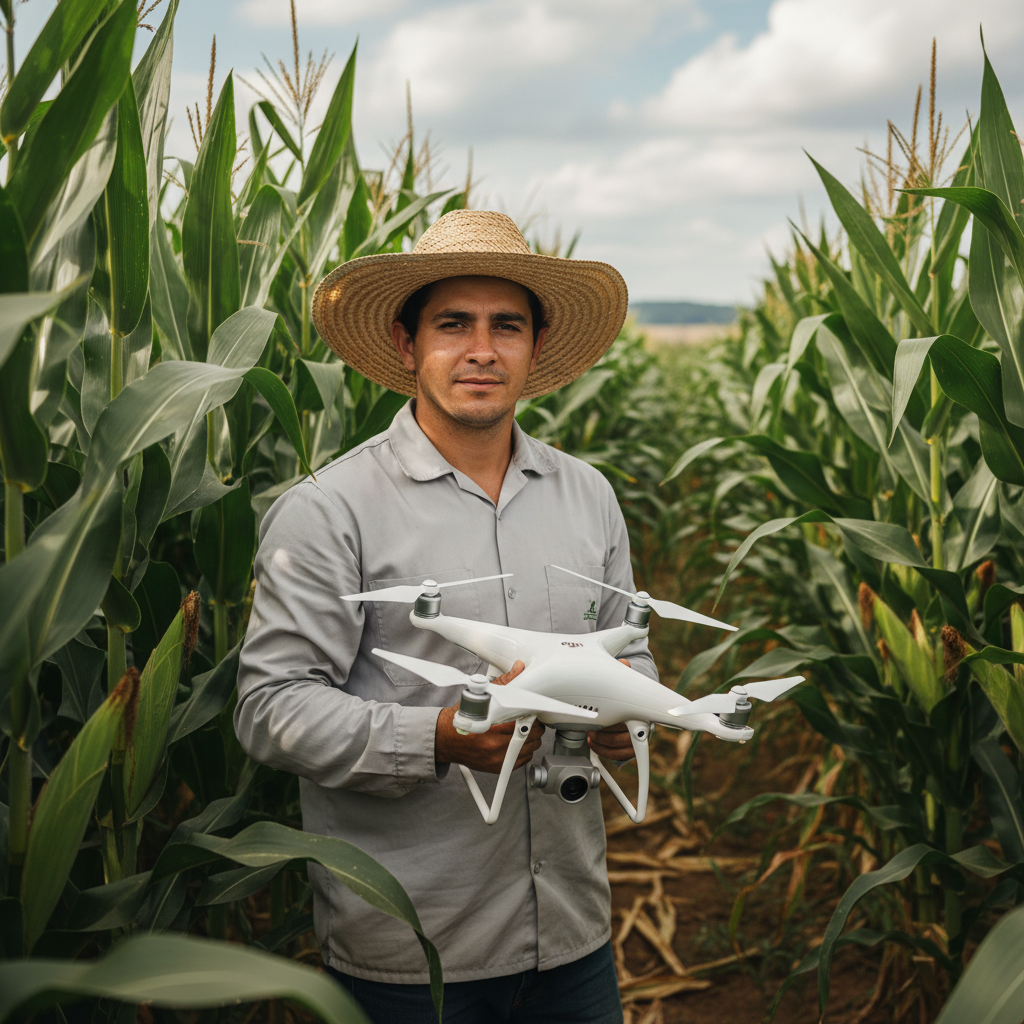
Lucas Fernandes Silva is an agricultural engineer with 12 years of experience in aerial mapping technologies and precision agriculture. ANAC-certified drone pilot since 2018, Lucas has worked on mapping projects across more than 500 rural properties in Brazil, covering areas ranging from small farms to large-scale operations. Specialized in multispectral image processing, vegetation index analysis (NDVI, GNDVI, SAVI), and precision agriculture system implementation. Lucas is passionate about sharing technical knowledge and helping agribusiness professionals optimize their operations through aerial technology.