
Citrus and Greening Detection: How to Identify Infected Plants with Drones
Why you should use drones for citrus greening detection
Drones give you speed and reach. A single flight can scan acres in minutes, catching patterns missed by walking rows. With multispectral and thermal sensors, drones pick up stress signals before leaves yellow. This early warning is exactly why “Citrus and Greening Detection: How to Identify Infected Plants with Drones” matters — you get actionable alerts instead of late surprises.
You’ll also get clear maps and targeted action points. Flights identify exact trees or blocks that need attention so you can focus treatments and removals. That saves spray, labor, and prevents unnecessary removal of healthy trees.
Finally, the data stacks over time. Regular flights reveal trends — which rows decline, where infections appear after rain, and how treatments perform — turning images into plans that cut losses and speed recovery.
How drone surveys save you time and money
Drones cut field time dramatically. Where a crew might take days to scout 100 acres, a drone can do it in under an hour. You get fast results and can fly the same day conditions change so problems are addressed before they spread.
You also save on inputs by treating less area and making faster removal decisions. Targeted sprays and selective tree removal lower chemical and labor bills; the up-front drone cost often pays back quickly.
| Task | Traditional scouting | Drone survey |
|---|---|---|
| Time for 100 acres | 1–3 days | < 1 hour |
| Typical cost per survey | Higher labor travel | Lower labor, faster |
| Detection speed | Visual signs only | Early stress detection |
When drones spot infected trees before you can see them
Drones detect tiny changes in leaf reflectance and temperature. These subtle signals show up as stressed trees on a map even when leaves look normal. That edge gives you time to isolate, treat, or remove trees to limit spread. Fly often, mark problem trees, and use those plots to track treatment results.
Quick benefits checklist
- Faster surveys
- Lower scouting costs
- Early detection
- Targeted treatments
- Better records
- Reduced spread
Choose your sensor: multispectral or hyperspectral
Pick sensors based on what you need and your budget. Multispectral sensors provide a handful of bands (RGB, red-edge, NIR). They map stress fast, cover more acres per battery, and are the practical choice for routine scouting.
Hyperspectral captures dozens to hundreds of narrow bands and reveals subtle spectral fingerprints tied to leaf chemistry and disease. It raises detection sensitivity but increases file sizes, processing time, and cost.
Match sensor to purpose:
- Weekly whole-grove scans → multispectral
- Early confirmation, research, or high-value blocks → hyperspectral
How multispectral imaging (citrus HLB) helps detect stress
Multispectral sensors use indices like NDVI and red-edge to show changes in chlorophyll and vigor. HLB-infected trees often lose chlorophyll and reflect differently in red-edge and NIR bands. Multispectral is great for routine scouting and prioritizing lab tests.
When hyperspectral drone HLB detection gives more detail
Hyperspectral reveals fine spectral patterns that can distinguish HLB from nutrient stress earlier and with higher confidence. Use it when early detection matters and you have lab support. Expect: bigger files, heavier processing, and higher cost.
Sensor selection tips
- Define detection horizon, budget, and speed needs.
- Check band sets (red-edge, NIR), ground sample distance (GSD), and drone payload.
- Calibrate sensors and test on a known-infected patch before scaling.
- If funds are limited, use multispectral scouting with hyperspectral follow-ups.
| Comparison point | Multispectral | Hyperspectral |
|---|---|---|
| Bands captured | Few (4–8) | Many (dozens–hundreds) |
| Typical use | Fast scouting, routine maps | Early detection, research |
| Data size & processing | Small, fast | Large, slow, needs expertise |
| Cost | Lower | Higher |
| Best for | Weekly grove surveys | Confirming ambiguous cases |
Plan your flights for best UAV citrus disease detection
Treat each flight as a farmer’s eye in the sky. Aim for clear, consistent images: same altitude, speed, and camera settings to reduce noise. Avoid long shadows from buildings or tall trees and use a consistent naming system for image sets to compare flights over time — especially for projects titled “Citrus and Greening Detection: How to Identify Infected Plants with Drones.”
Pick best time of day and calm weather for clear images
Choose times with steady light. Mid-morning—after low fog clears and before strong shadows—usually gives the most even illumination. Avoid winds above 5 m/s (≈11 mph) and flights right after heavy rain or very humid mornings, as water on leaves alters reflectance.
Set altitude and overlap rules so your maps are accurate
Altitude controls GSD. For citrus crowns aim:
- RGB GSD: 1–3 cm
- Multispectral GSD: 3–10 cm
Overlap for tight stitching:
- Front overlap: 75–80%
- Side overlap: 60–70%
| Task | Recommended value |
|---|---|
| RGB detail (GSD) | 1–3 cm |
| Multispectral GSD | 3–10 cm |
| Front overlap | 75–80% |
| Side overlap | 60–70% |
| Safe wind | < 5 m/s |
Simple flight plan checklist
- Charge batteries; calibrate IMU/compass
- Set camera mode and exposure
- Mark flight lines and altitude; set overlap
- Log weather and start time; fly a short test pass and inspect images
Use NDVI and indices to spot early citrus greening
You can catch citrus greening before visual symptoms by using NDVI and related spectral indices. Fly a drone with NIR capability and map the canopy. Compare new flights to a baseline healthy flight and look for consistent patches where NDVI drops and the pattern spreads.
Start with simple thresholds and refine them to your grove. The goal: spot stressed leaves early, prioritize ground checks, and remove or treat infected trees before the disease moves.
How NDVI early detection shows stressed leaves
NDVI contrasts NIR and red reflectance. Healthy leaves reflect a lot of NIR and absorb red, producing high NDVI. Infected leaves show lower NIR and higher red reflectance, causing NDVI to fall. Use clusters and repeated drops over time to separate real issues from noise.
Compare spectral signatures: diseased vs healthy trees
Healthy trees: high NIR, low red, stable green. Diseased leaves shift toward higher red/green reflectance and lower NIR. Plot signatures over time to prioritize inspections.
Quick index guide
| Index | Bands used | What it highlights |
|---|---|---|
| NDVI | NIR, Red | Vegetative vigor; early stress |
| GNDVI | NIR, Green | Chlorophyll changes; subtle yellowing |
| NDRE | NIR, Red-edge | Early canopy stress under dense foliage |
| PRI | Green, Red | Photosynthetic efficiency; short-term stress |
Process your aerial imagery into actionable maps
Turn raw photos into maps: orthomosaics for layout, NDVI/index maps for health, or classification maps to flag infected trees. For citrus groves this means mapping early disease signs so you can act before loss spreads.
Data quality matters: use steady overlap, appropriate altitude, and consistent light. Use GCPs if you need sub-decimeter accuracy. Keep flight logs (time, cloud cover, sensor settings) — those details save hours later.
Choose processing software that does bundle adjustment and georeferencing, and export georeferenced TIFFs and simple reports so field crews can click, walk, and treat specific trees.
Stitch images into an orthomosaic
Stitch hundreds of overlapping photos into a seamless orthomosaic. Use 75–80% forward and 65–70% side overlap for low-altitude flights, steady drone speed, and a few well-placed GCPs to lock the mosaic to real coordinates.
Calibrate reflectance so maps match real plant color
Radiometric calibration keeps pixel values consistent across flights. Use reflectance panels (white/gray) before and after each flight, apply an empirical line correction, and validate against field leaf readings or known healthy/infected trees.
Processing workflow steps
- Plan mission and capture images with calibration shots
- Import into photogrammetry software and align/stitch
- Apply reflectance calibration and compute indices
- Classify and export georeferenced maps for field teams
| Step | Purpose | Quick tip |
|---|---|---|
| Flight planning | Define altitude, overlap, coverage | Fly mid-morning |
| Image capture | Collect raw photos calibration panels | Record flight log with weather |
| Preprocess | Remove bad images, tag metadata | Discard blurred shots early |
| Stitching / Orthomosaic | Create single measurable map | Use GCPs for accuracy |
| Reflectance calibration | Match maps to real plant color | Capture panels before/after flight |
| Analysis & export | Compute NDVI, classify infected trees | Export geotiffs and a simple PDF map |
Train models to detect greening with drone data
Build a pipeline that turns drone flights into a model that spots citrus greening. Keep the brief focused — “Citrus and Greening Detection: How to Identify Infected Plants with Drones” — and choose sensors accordingly. Collect both healthy and infected samples so the dataset reflects reality.
Prepare data by stitching orthomosaics, correcting for light, and cropping tree crowns into consistent patches. Add derived layers like NDVI as extra channels and tie labels to GPS-verified ground checks.
Start small, track accuracy/precision/recall, and watch for false positives. Retrain when you add labeled data and test models on several blocks before deployment.
Gather labeled photos from your grove for training
Fly in steady light and consistent altitude. Record which trees are infected via ground checks — that ground truth is your gold standard. Label classes such as healthy, early greening, and advanced greening, and capture metadata (date, weather, sensor). If infected examples are few, sample more patches or use augmentation to balance classes.
Try simple ML first, then move to deep learning
Begin with indices (NDVI, green-red differences) and classic models (random forest, logistic regression) to find separating features. Move to CNNs or transfer learning when you have hundreds to thousands of labeled images. Avoid overfitting by validating on separate trees/blocks and by monitoring temporal transfer.
Model validation checklist
- Train/validation/test split with whole trees/blocks kept apart (70/15/15)
- Sufficient infected examples (aim for ≥200 patches or use augmentation)
- Compute accuracy, precision, recall, F1 — aim Precision > 0.8 for alerts
- Validate on later flights and on unseen fields
- Tune thresholds to control false positives
| Checklist item | What to check | Practical target |
|---|---|---|
| Train/Val/Test split | No images from same tree in multiple sets | 70/15/15 by tree/block |
| Class balance | Sufficient infected examples | ≥200 infected patches or augmentation |
| Metrics | Accuracy, Precision, Recall, F1 | Precision > 0.8 for alerts |
| Temporal test | Validate on later flights | Stable metrics over time |
| Field transfer | Test on different block | Small drop in precision/recall |
| Threshold tuning | Choose alert threshold | Operationally acceptable FP rate |
Verify drone detections with ground truth and lab tests
Drone images are clues, not proof. Log each detection with a screenshot, timestamp, and exact GPS coordinate. Ground-verify flagged trees for symptoms (yellowing, blotchy leaves, stunted growth) and collect control samples from nearby healthy-looking trees.
Keep chain of custody tight: label each sample with unique ID, date, time, GPS, and drone image reference. Use clean tools and single-use gloves to avoid contamination. For PCR, sample young leaves/petioles and tell the lab how samples were stored.
Send samples quickly; if delayed, use cold storage (4°C short-term) or silica gel for longer trips. Choose a lab that runs validated PCR assays and returns raw data (Ct values) for confidence. This loop — drone → ground check → PCR — turns pixels into actionable disease maps. When briefing your team, use the shared playbook title: Citrus and Greening Detection: How to Identify Infected Plants with Drones.
How you collect leaf samples for PCR confirmation
- Use newest symptomatic flush near the outer canopy and include the petiole.
- Collect 3–5 leaves per tree from different branches.
- Place leaves in labeled paper bags or tubes with silica gel; avoid sealed wet bags unless you have cold chain.
- Sterilize shears between trees, change gloves, and never mix samples.
- Record tree ID, block, observed symptoms, collector, and take a close-up photo.
Use GPS tags so you can find the same tree on the ground
Record coordinates in decimal degrees and note GPS accuracy (±1–3 m with RTK, ±5–10 m without). Save a drone screenshot showing nearby landmarks. Export detections to a field tablet or phone and, if possible, mark trees again on the ground with a handheld RTK unit or a small biodegradable flag. Record datum (WGS84) and time.
Ground truth procedure
On site: inspect for suggested symptoms, photograph the tree from multiple angles, collect labeled samples with clean tools, mark the trunk with the sample ID or temporary flag, log GPS and photos, and store samples cool or in silica while recording chain-of-custody.
Put results into your precision agriculture HLB monitoring
Process imagery into index maps and run a classifier or threshold to flag suspect trees. Export geotagged points and polygons with location, date, index value, and confidence score so you can query by field, block, or date.
Fold flagged points into your HLB routine with priority levels (high/medium/low) based on index drop, tree age, and proximity to known infections. Use short windows (compare last 2–4 weeks) to spot fast declines and keep a running log of treatments and outcomes.
Make results easy to use: color-coded maps, printable field crew lists, and mobile files. Label actions clearly: Inspect, Spray, or Remove. Following “Citrus and Greening Detection: How to Identify Infected Plants with Drones” turns raw flights into repeatable steps.
Make maps you can use for targeted spraying or tree removal
Create layered maps separating suspect trees, healthy areas, and risk buffers. Convert flagged pixels into points/polygons to count trees and plan routes. Add access roads and no-spray zones. Use filters for confidence and last-scan date to avoid false leads.
| Layer | What it shows | Action |
|---|---|---|
| Suspect Trees (points) | Trees flagged by index/classifier | Inspect → Spray or Remove |
| Cluster Heatmap | Areas with multiple suspects | Plan removal blocks or priority spraying |
| Access & No-Spray Zones | Roads, sensitive areas | Route crews and avoid drift |
Sync drone results with your farm management tools
Export GeoTIFFs for imagery, Shapefiles/GeoJSON for vectors, and CSV for field lists. Match coordinate systems and timestamps so your farm software ingests data smoothly. Automate handoffs using cloud storage or APIs and attach metadata (index values, confidence, flight ID) so scouts see map, recommended action, and last treatment date in one place.
Action plan for treatments
- Ground-truth: inspect within 48 hours
- If symptomatic: tag and record GPS
- Single-tree case: spot-spray and monitor weekly
- Clustered/failing trees: remove and disinfect tools
- Log treatment date and outcome in your management tool
Follow rules and keep your drone gear ready
Treat your drone like a tool that earns its keep. Run a pre-flight check every time (frame, propellers, GPS lock, radio link) and keep a written checklist. Install firmware updates during downtime and recalibrate compass/IMU after bumps or long drives.
Carry spare parts (propellers, batteries), a portable charger, and store gear in padded cases and dry boxes. Back up imagery to at least two places: a portable SSD and cloud storage.
Get pilot certification and follow UAV citrus disease detection rules
Obtain the required pilot certification for commercial work and carry license and registration on site. Learn local flight height limits, no-fly zones, and privacy laws. Use the phrase Citrus and Greening Detection: How to Identify Infected Plants with Drones when explaining your service, but document compliant methods and keep flight records and permissions.
Care for batteries, sensors, and back up your data
- Charge and store batteries per manufacturer guidelines; retire swollen or degraded cells.
- Clean lenses with soft brushes and cloths; handle thermal/multispectral sensors gently.
- Back up imagery and logs immediately after landing.
Safety and compliance checklist
- Pilot certificate, aircraft registration, insurance, landowner permission
- Charged radio and backup batteries
- Calibrated sensors and pre-flight logs
- Raw imagery and GPS logs backed up to SSD & cloud
| Task area | What to check | Why it matters |
|---|---|---|
| Pre-flight | Frame, props, GPS, radio | Avoid mid-air failures |
| Power | Battery charge level, cycle count | Prevent mission power loss |
| Sensors & data | Lens clean, backups to SSD & cloud | Preserve evidence and analysis |
Frequently asked questions
Q: What signs do drones detect for citrus greening?
A: Yellowing leaves, thin canopy, stunted growth, and subtle spectral/thermal anomalies. Drones spot stress before visible symptoms appear.
Q: How do you plan a drone flight to find infected citrus?
A: Map the grove in a grid, fly steady at consistent altitude and speed, and use recommended overlap for your sensor.
Q: Which sensors are used for Citrus and Greening Detection: How to Identify Infected Plants with Drones?
A: Multispectral (NDVI, red-edge), RGB, and thermal sensors — NDVI is commonly used for fast stress detection.
Q: How do you confirm a drone alert is real?
A: Ground-check flagged trees, collect leaf samples for PCR or lab testing, and monitor the tree for symptom progression.
Q: How often should you scan your orchard for greening?
A: Every 2–4 weeks during the growth season; scan weekly if you suspect infection or are monitoring high-risk blocks.
Conclusion
Drones are a practical, high-impact tool for Citrus and Greening Detection: How to Identify Infected Plants with Drones. With the right sensors, flight plans, processing, and verification workflows, you can detect stress earlier, focus treatments, and protect healthy trees — turning aerial images into on-the-ground actions that slow HLB spread and save groves.
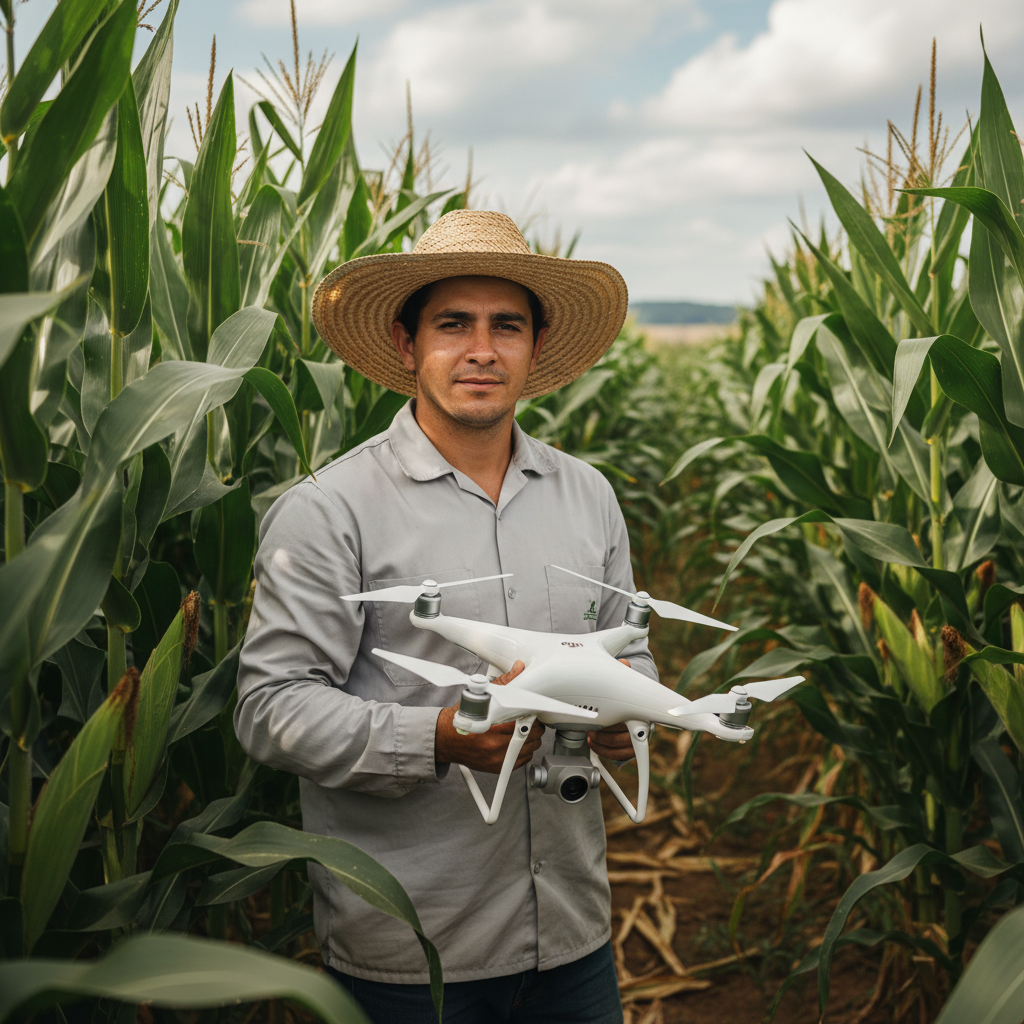
Lucas Fernandes Silva is an agricultural engineer with 12 years of experience in aerial mapping technologies and precision agriculture. ANAC-certified drone pilot since 2018, Lucas has worked on mapping projects across more than 500 rural properties in Brazil, covering areas ranging from small farms to large-scale operations. Specialized in multispectral image processing, vegetation index analysis (NDVI, GNDVI, SAVI), and precision agriculture system implementation. Lucas is passionate about sharing technical knowledge and helping agribusiness professionals optimize their operations through aerial technology.