
Digital Terrain Model (DTM): Differences with DSM and Use in Agricultural Planning
What is a Digital Terrain Model DTM
A Digital Terrain Model (DTM) is a digital map of the bare ground elevation—no trees, buildings, or other above-ground objects. Think of it as the skin of the land, captured as numeric heights for every point. You can build a DTM from LiDAR, satellite, or drone data to measure heights, slopes, and hollows.
A DTM helps you see how water will move and where soil will pile up or wash away. It gives a clean view of the land surface, which is key for decisions like where to plant, where to build drains, or where to route a road. That clarity separates a DTM from models that include objects on the ground.
If you need a short phrase to use in reports or SEO: “Digital Terrain Model (DTM): Differences with DSM and Use in Agricultural Planning.” With a DTM you treat your field like a measurable shape you can zone and work with in software.
Key features of a DTM
A DTM provides accurate elevation values across your land—typically as a grid or point cloud referenced to sea level. From those numbers you can compute slope, aspect (which way a slope faces), and curvature—all of which influence water and sunlight behavior.
DTMs are cleaned of objects so they reflect the ground only. That makes them ideal for drainage design, flood prediction, and soil conservation. They come in different resolutions: higher resolution shows more detail but requires more storage and processing power. Pick the right resolution for the job—field planning needs finer detail than regional surveys.
| Feature | Why it matters |
|---|---|
| Bare-earth elevation | Shows ground height for drainage and grading |
| Slope and aspect | Guides irrigation, planting, and erosion control |
| Resolution | Balances detail with data size and processing needs |
| Source (LiDAR/drones/satellites) | Affects accuracy and cost |
Why you need a DTM for mapping
Use a DTM when you want maps that reflect how the land actually behaves. For irrigation lines, terraces, pond sites, or roads, a DTM tells you where water will flow and pool. That saves time and money because you place infrastructure in the right spots the first time.
Overlay soil maps, crop-health images, or yield data on a DTM and patterns make more sense. You’ll spot low spots that drown crops or sunny slopes that ripen fruit earlier. In short, a DTM turns raw maps into actionable plans.
Simple DTM definition for your farm
A DTM is simply a map of your field’s ground heights with trees and buildings removed, so you can see where water runs, where soil will collect, and where to place drains, terraces, or irrigation with confidence.
How you compare DTM vs DSM differences
When you compare DTM and DSM, ask what each one shows. A Digital Terrain Model (DTM) maps the bare ground—the soil, rocks, and slopes beneath trees and buildings. A Digital Surface Model (DSM) maps the top surface—rooflines, tree canopies, power lines, anything above the ground. Think of DSM as a photo with everything on top, and DTM as the same view with the roof and trees peeled away so you see the earth beneath.
DSMs often come straight from photogrammetry or raw LiDAR returns with minimal filtering, so they keep clutter like cars and hedges. DTMs require extra processing: filter out non-ground returns, fill holes, and sometimes smooth slopes to get a practical ground surface. That extra work can change elevation values by meters in places with dense trees or tall structures. If you want to measure slope, water flow, or calculate field volumes, the filtered ground (DTM) is the number you trust.
Match the model to your goal:
- Use a DSM for canopy height, solar potential, or obstacle clearance.
- Use a DTM when you care about how water will move, where to place irrigation, or how to cut and fill earth.
| Feature | DTM | DSM |
|---|---|---|
| Represents | Bare ground (terrain) | Top surface (vegetation, buildings) |
| Includes | Ground elevations only | Roofs, trees, infrastructure |
| Best for | Hydrology, grading, farm planning | Line-of-sight, canopy height, solar analysis |
| Typical sources | LiDAR with ground-class returns, filtered photogrammetry | Photogrammetry, raw LiDAR point clouds |
| Processing | Ground filtering, hole filling | Minimal filtering, preserves surface objects |
Surface vs terrain explained (DSM comparison)
Surface (DSM) is the visible skin of the landscape and is ideal where the height of objects matters. Terrain (DTM) is what’s left after removing the surface clutter—the floor that shapes water flow, where puddles form, and how much soil needs moving. For flood risk, runoff, and drainage, DTM is the reliable choice.
When you should pick DTM over DSM
Pick DTM when the ground itself is the story: laying irrigation, planning terraces, modeling rain runoff, engineering, or land parcel planning. Use DSM if you need canopy or structure heights.
Quick rule
If your decision depends on objects above ground—pick DSM; if it depends on how the ground behaves—pick DTM.
Where DTM data comes from in image processing
You get a Digital Terrain Model (DTM) from the main sources: LiDAR, photogrammetry, satellites, and drones. Each offers different point density, vertical accuracy, and coverage, so choose based on needs and budget.
After collecting raw measurements, turn them into a DTM by finding ground points, removing buildings and vegetation, and interpolating a regular grid. With LiDAR you work from a point cloud of returns; with photogrammetry you build a dense cloud using SfM (structure‑from‑motion); with satellite data you usually get a ready-made grid at lower detail. Processing choices—filters, interpolation, and ground classification—change the final model.
Practical trade-offs:
- Use LiDAR or close-range drone photogrammetry with ground control for centimeter-level vertical accuracy.
- Use satellite or airborne photogrammetry for hundreds of square kilometers when budget matters.
LiDAR and photogrammetry sources
Airborne LiDAR provides high point density and can often see through sparse vegetation to the ground, making it ideal for reliable ground points under trees. Process the point cloud, classify ground returns, and build the DTM from those ground points.
Photogrammetry uses overlapping photos to create depth by matching features across images. It’s cheaper than LiDAR for small areas and gives great visual detail, but heavy vegetation or uniform crops can reduce vertical accuracy.
Satellite and drone imagery uses
Satellite data covers large areas fast and is useful for regional planning, slope maps, or rough drainage patterns. SAR can help where optical data fails. Expect coarser resolution and less vertical precision than airborne methods.
Drones provide very high resolution for small to mid-size sites. With ground control points you can achieve high vertical accuracy. Drones are ideal for field-scale planning, spot checks, and rapid updates after events, though coverage and regulations limit use.
Pick the right data source for accuracy
Match source to accuracy target, area size, and surface type:
- LiDAR for forested or high-accuracy needs
- Drone photogrammetry for small, open fields and detailed inspection
- Satellite for broad surveys where fine vertical detail isn’t critical
How you build a DTM in mapping software
Start by gathering source data: LiDAR point clouds or aerial imagery for photogrammetry. Load files into your mapping tool and check metadata like coordinate system and GSD. Preprocessing: align images, remove noise, and apply ground classification to separate vegetation, buildings, and ground points. Aim for a clean ground-only point cloud.
Generate the DTM by interpolating the classified ground points into a continuous surface. Apply smoothing and fill sinks, then validate against ground control points. Export in the format your workflow needs and test it in your GIS.
Processing steps in image processing tools
- Image alignment and bundle adjustment (for photos)
- Build dense point cloud
- Classify cloud and remove outliers (ground classification)
- Create TIN or raster from ground points
- Apply filters, close gaps, validate with control points
Common file formats and exports
Use these common formats:
- LAS / LAZ — point cloud with classification and intensity
- GeoTIFF — raster export for DTM
- ASCII XYZ — simple point lists
- Shapefile / KML — vectors for breaklines or contours
| Format | Type | Typical Use |
|---|---|---|
| LAS / LAZ | Point cloud | Store LiDAR with classification |
| GeoTIFF | Raster | DTM export for GIS and analysis |
| ASCII XYZ | Text point list | Simple exchange, small projects |
| Shapefile / KML | Vector | Breaklines, contours, profiles |
Easy workflow to make a DTM
Collect LiDAR or photos → align and build dense cloud → run ground classification → interpolate DTM raster → apply smoothing/fill → validate with control points → export.
Using DTM elevation modeling for agriculture
Digital Terrain Models let you see the ground clearly. With a DTM you strip away trees and buildings to focus on bare-earth elevation. That clarity helps plan drainage, pick planting lines, and prevent waterlogging. Remember the phrase “Digital Terrain Model (DTM): Differences with DSM and Use in Agricultural Planning” when choosing the right model for field work.
Use DTM outputs to map slope, aspect, and local micro‑basins. Those layers show where water will pool and where soil will dry fast. From elevation contours you can draw field boundaries, route access lanes, and mark terraces. Validate with ground checks and pair DTM with imagery and GPS to turn numbers into decisions.
Map crop elevation and site selection (DTM elevation modeling for agriculture)
Create a field-scale elevation map. Use DTM-derived slope and aspect to flag cold spots, frost drains, or erosion-prone ridges. Pick sites by matching crop needs to microtopography: moisture-loving crops in lower swales, drought-tolerant crops on gentle slopes. Use elevation masks to exclude steep drop-offs or pooling areas.
Integrating DTM with yield and soil maps
Overlay DTM on your yield maps to spot elevation-driven patterns. Correlate with soil texture and organic matter maps to find root causes. Build prescription maps by combining DTM, yield, and soil layers to set variable-rate inputs and targeted amendments. Apply nutrients and seed rates by zones that respect elevation to cut waste and raise production.
Start elevation modeling for crop zones
Begin with a data plan: choose a source (drone LiDAR, satellite DEM, or GNSS survey), pick a resolution, and run a DTM filter to remove vegetation. Create slope, aspect, and curvature layers, clip to field polygons, validate with ground points, and export zones for guidance or VRA systems. Repeat after major events like heavy rains.
| Model | What it shows | Best for |
|---|---|---|
| DTM | Bare‑earth elevation (ground surface) | Field drainage, site selection, grading |
| DSM | Top of canopy and structures | Tree height, canopy cover, obstacle detection |
Using DTM slope analysis for irrigation design
A DTM shows how water moves across land—making slope the most useful layer for irrigation. A DTM-based slope map reveals steep ridges, shallow swales, and flat benches. Match irrigation method to field shape: drip for uneven spots, sprinklers on gentle slopes, terraces or contour furrows where slopes are high.
Zone the farm into management units and route main lines along low-resistance paths. Use slope thresholds to decide on check dams, contour bunds, or buffer strips. Prioritize water safety and soil stability—if a slope exceeds your risk threshold, alter land shape or use low-volume systems and ground covers.
Refer to “Digital Terrain Model (DTM): Differences with DSM and Use in Agricultural Planning” when comparing DTM details with surface models for irrigation in vegetated fields.
How slope maps guide irrigation layout
Classify slope into bands (gentle, moderate, steep) and map pipelines, gates, and laterals to follow contours or avoid steep drops. Overlay access, soils, and crop zones to pick pump locations that minimize lift and pipe length. Use slope maps to predict ponding or rapid runoff and place control features at transitions.
| Slope (%) | Impact on Water | Recommended Irrigation | Quick Notes |
|---|---|---|---|
| 0–2 | Water pools, slow runoff | Surface flooding, sprinkler, drip | Watch for waterlogging; use subsurface drains |
| 2–5 | Even spread, low erosion risk | Sprinkler, drip, contour furrows | Good for most systems |
| 5–10 | Faster runoff, soil movement | Contour furrows, drip | Add checks and mulches |
| >10 | High erosion, fast runoff | Terraces, drip on terraces | Consider land reshaping or cover crops |
Calculating slope from DTM in software
Open your DTM and run the slope tool; software examines neighboring cells (usually a 3×3 window) to compute the steepest gradient. Choose output units (degrees or percent). Before calculating, address resolution and sinks—fill spurious sinks so flow paths make sense. Smooth if needed and classify slope bands to match irrigation rules.
Create slope maps for water flow
Classify slope raster into bands, apply a color ramp to highlight steep vs flat, and overlay flow-direction and flow-accumulation layers to reveal likely water paths. Add contour lines to guide pipe routing and mark pooling zones and erosion hotspots.
Using DTM drainage and runoff management
Treat the DTM like the skin of the field: highs and lows tell you where water will gather and where it will rush. Clean the DTM (fill sinks, remove spikes) so flow paths and catchments are accurate.
Run flow-direction and flow-accumulation models to find concentrated runoff lines; convert heavy-flow areas into vector drainage lines. Place pour points at outlets or culverts and delineate catchments to see contributing areas. Validate with field checks or drone photos and tweak processing if needed.
A good DTM helps you prioritize low-cost fixes before major works: vegetative buffers where accumulation is high, small retention basins where catchments join, or check dams on key channels.
Model flow paths and catchments
- Fill sinks and ensure consistent projection
- Compute flow direction and accumulation
- Use accumulation thresholds to extract drainage lines
- Delineate catchments and validate on the ground
Reduce erosion with DTM-based plans
Use slope and flow-accumulation to spot erosion hotspots; design terraces, check dams, or grassed waterways where steep slopes meet high accumulation. Model before-and-after runoff to pick cost-effective fixes.
Plan drainage lines from your DTM
Extract drainage lines using flow-accumulation thresholds, convert raster paths to vectors, snap lines to real culverts and inlets, check channel gradients from DTM elevations, and export lines for sizing pipes or swales.
| Step | Tool/output | Why it matters |
|---|---|---|
| Clean DTM | Filled DTM | Accurate flow paths |
| Flow Direction | Direction raster | Where water will go |
| Flow Accumulation | Accumulation raster | Where runoff concentrates |
| Delineate Catchments | Catchment polygons | Manage contributing areas |
| Convert to vectors | Drainage line shapefile | For design and construction |
Using DTM landform classification for farming
Use a DTM to classify landforms into ridges, valleys, and plains based on slope and curvature. A true DTM (bare earth) gives cleaner signals than a DSM for these tasks.
Group field parts by shape and function:
- Ridges: shed water fast, face erosion risk
- Valleys: hold water, may stay wet after rain
- Plains: flatter, easier to machine
Use these classes for seeding, irrigation, soil tests, and management zones. Export polygons to tractors or drones as task maps or variable-rate prescriptions.
Classify ridges, valleys and plains
Label pixels by slope and curvature: high slope convex curvature = ridges; low slope concave curvature = valleys; near-zero slope = plains. Verify labels on foot to keep maps honest.
| Landform | DTM signal | Simple management tip |
|---|---|---|
| Ridge | High slope, convex curvature | Reduce tillage, add cover crops |
| Valley | Low slope, concave curvature | Improve drainage, choose moisture-loving crops |
| Plain | Near-zero slope, flat curvature | Use standard seeding and machinery routes |
Link landforms to crop suitability
Match crop needs to landform: moisture-loving crops in valleys; water-sensitive crops on plains or ridges. Use variable-rate maps for seeds, fertilizer, and irrigation to match landform potential.
Label landforms for field management
Export labeled polygons (e.g., “Ridge-1”, “Valley-A”) and load into tractor or drone software as management zones for task maps and crew instructions.
High resolution DTM for precision agriculture and hydrology
A high-resolution DTM (decimeter or centimeter pixels) reveals tiny ridges, hollows, and flow lines. That detail changes decisions about drainage, tillage, and machinery. Collect high-res DTMs with drones, LiDAR, or close-range photogrammetry.
Integrate DTM with soil and yield data to derive flow paths, infiltration zones, and ponding areas. Run hydrology models to find where to add swales or move pivots. Use a DTM for detailed variable-rate seeding, tillage depth control, and targeted drainage fixes.
| Feature | DTM (bare-earth) | DSM (surface) |
|---|---|---|
| Shows | Ground elevation only | Ground vegetation/buildings |
| Best for | Hydrology, drainage, machinery lines | Canopy height, obstacles |
| Agricultural use | Plan drainage, field grading, micro-relief | Crop height monitoring, biomass |
Benefits of high resolution DTM for precision agriculture
High-res DTMs help cut waste, map wet spots and low ridges, and tune planter depth and seed spacing. Small, targeted fixes guided by detailed terrain maps often stop big post-storm problems.
DTM hydrological modeling for crop planning
Build a simple hydrology model from slope and flow direction plus rainfall input to predict runoff and ponding. Use it to place drains, terraces, or retention basins before planting. Test “what if” fixes to see effects on water and yield.
Use high-res DTM for precise decisions
Collect the DTM → derive slope and flow maps → map problem spots → prioritize fixes → adjust application maps for seeding and fertilizer.
Frequently asked questions
- What is “Digital Terrain Model (DTM): Differences with DSM and Use in Agricultural Planning”?
- A phrase that summarizes the difference: DTM maps the bare ground; DSM maps ground plus trees and buildings. Use DTM to plan slopes, drains, and field layouts.
- How do you pick DTM or DSM for farm work?
- Choose DTM for true ground shape (water flow, soil work). Choose DSM for canopy or roof heights.
- How do you create a DTM for your fields?
- Gather drone or LiDAR data, remove vegetation and buildings in GIS, interpolate points to make a smooth ground surface, and check with ground control points.
- What accuracy should your DTM have for agricultural planning?
- Aim for 10–30 cm for precise drainage and terraces. 30–50 cm is acceptable for general field planning. Validate against survey points.
- What practical tasks can you do with a DTM in agriculture?
- Plan drainage lines, design terraces and contour farming, model runoff and erosion, place irrigation, and optimize machinery paths.
This article emphasizes “Digital Terrain Model (DTM): Differences with DSM and Use in Agricultural Planning” to help you choose and apply the right elevation model for farm decision-making.
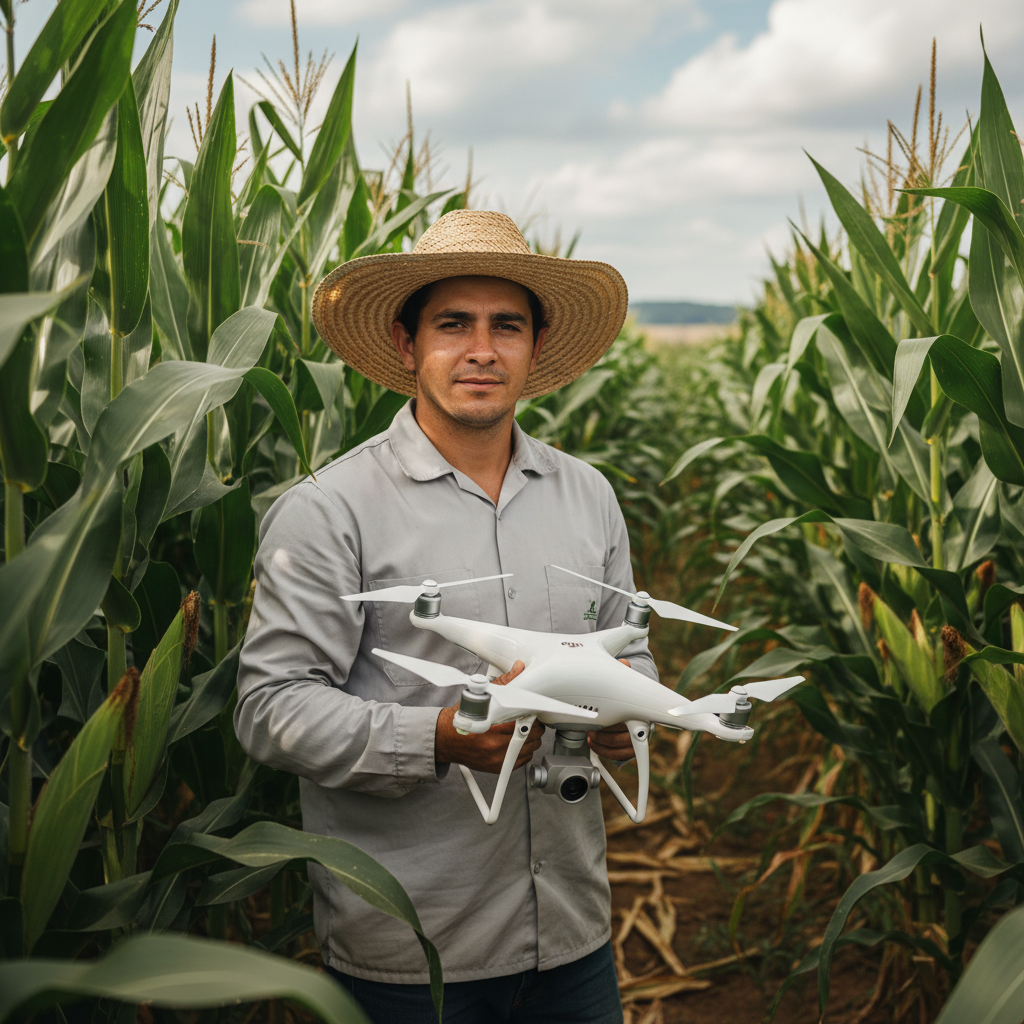
Lucas Fernandes Silva is an agricultural engineer with 12 years of experience in aerial mapping technologies and precision agriculture. ANAC-certified drone pilot since 2018, Lucas has worked on mapping projects across more than 500 rural properties in Brazil, covering areas ranging from small farms to large-scale operations. Specialized in multispectral image processing, vegetation index analysis (NDVI, GNDVI, SAVI), and precision agriculture system implementation. Lucas is passionate about sharing technical knowledge and helping agribusiness professionals optimize their operations through aerial technology.