
- Citrus Greening: How to Identify Infected Plants Before Visual Symptoms Appear
Use PCR testing for citrus greening
PCR is your best bet to catch infections before trees show decline. With PCR you detect bacterial DNA in tiny amounts of phloem tissue, so you can act early. A positive PCR result tells you the pathogen is present even when leaves look fine — you can pull, treat, or isolate trees sooner and save the rest of the grove.
Collect evidence, then test it. Keep an eye on Ct values and include positive and negative controls so results mean something. Set up a plan that fits your operation: use a trusted lab or a field qPCR rig for faster turnaround, and track samples, costs, and response steps in a simple log. Early, bold moves beat big losses later.
How you collect phloem samples
Pick the right tissue: young flush shoots and leaf midribs are where the bacterium hides. Cut a 2–3 cm piece of the midrib or gently scrape the phloem with a clean blade. Use sterile tools and gloves to avoid contamination.
Label each tube clearly and record tree ID, date, and location. Place samples on ice or in a preservative like silica gel, then get them to the lab quickly. If you pool samples, limit to 3–5 trees per sample when you must save costs; pooling can dilute weak infections.
When to test for early detection
Test during new leaf flushes and before vector seasons peak — the bacteria are most detectable in young shoots. If psyllid numbers rise, increase testing frequency. Also test asymptomatic trees near any suspect tree, after buying new plants, and after grafting. In high-risk areas, plan monthly checks in season or quarterly at minimum.
Quick PCR workflow
Collect labeled phloem → extract DNA → set up qPCR with primers/probes → run → read Ct values against controls → report results for action. Keep everything clean, use a positive control and a no-template control, and document every step.
| Step | Typical Time | Quick Tip |
|---|---|---|
| Sampling | 10–20 min per 10 trees | Pick young flush; keep samples cool |
| DNA extraction | 30–60 min | Use a kit or simple CTAB method |
| qPCR setup | 15–30 min | Prepare master mix and controls first |
| Run & analysis | 45–90 min | Check Ct and replicate agreement |
Use drones for remote sensing detection (HLB)
Drones can spot plant stress before leaves yellow. Fly multispectral or RGB sensors on a schedule and watch maps for odd patches — the drone becomes your early-warning eye so you can prioritize ground checks and lab tests.
Start by matching flight plans to grove size and budget. Small orchards use lower altitude, high-resolution flights; large farms use higher altitude and faster flights. Balance resolution, cost, and how quickly you want answers.
Process data into indices like NDVI and thermal maps, and compare week to week. Use those maps to prioritize ground checks and lab tests so you’re not chasing every red flag.
How you set flight patterns
Set a regular grid with at least 70% forward overlap and 60% side overlap for mapping. Fly at an altitude that gives you the GSD (ground sample distance) you need — lower for detail, higher for speed. Plan flight speed to match shutter speed and light. Fly in stable light — early morning or late afternoon — and reuse the same flight plan for consistent comparisons.
How you choose sensors and resolution
Pick a sensor based on needs: multispectral for vigor indices (NDVI/NDRE), thermal for water/root stress, RGB for quick scouting, and hyperspectral for leaf-level chemistry (higher cost and more data work).
Match GSD to decisions: 2–5 cm GSD finds tree-level issues; 10–20 cm GSD works for block trends.
| Sensor type | Best for | Typical bands | Recommended GSD |
|---|---|---|---|
| RGB | Visual scouting, canopy shape | Red, Green, Blue | 2–10 cm |
| Multispectral | Vigor indices (NDVI/NDRE) | NIR, Red, RedEdge, Green | 5–15 cm |
| Thermal | Water stress, root problems | LWIR | 10–30 cm |
| Hyperspectral | Early biochemical changes | Many narrow bands | 2–10 cm |
Preflight checklist
Check battery levels, propellers, firmware, GPS/RTK, memory cards, flight permissions, weather, and sensor calibration. Use GCPs or PPK/RTK for accurate maps.
Apply hyperspectral imaging to detect infected citrus trees
Hyperspectral imaging can detect infection before leaves look sick. Mount a sensor on a drone or tractor; aim for ~1–5 cm/pixel on leaves for small orchards or 10–30 cm/pixel for larger surveys. Use visible-to-shortwave infrared coverage (~400–2500 nm) to capture chlorophyll, red-edge, water, and structural signals. Plan surveys in clear light, same time of day, and repeat weekly to detect early changes.
After data collection, do radiometric and atmospheric correction, remove noisy bands, and reduce dimensions with PCA or band-selection. Build models (random forest, SVM, simple neural nets) using vegetation indices and spectral features as inputs; label samples with your field tests. Start simple — complex models can hide errors.
Make the system practical: combine random and targeted sampling, automate the pipeline from flight to decision, and feed alerts into your management tool so flagged trees get lab testing or targeted treatment.
How you pick spectral bands
Start with biology: chlorophyll absorption (430–680 nm), red edge (680–740 nm), NIR (740–900 nm), and SWIR (1000–2500 nm) for water and biochemical signals. Use separability metrics (Jeffries–Matusita, ANOVA) and feature selection to narrow to a few strong bands. Pilot flights help you choose a minimal routine band set.
| Band group | Wavelength (nm) | What it shows | Typical use |
|---|---|---|---|
| Visible (B/G/R) | 430–680 | Chlorophyll and pigment loss | Early stress signals |
| Red edge | 680–740 | Shift with leaf structure and chlorophyll | Sensitive early marker |
| NIR | 740–900 | Leaf cellular structure and biomass | Health vs defoliation |
| SWIR | 1000–2500 | Water content and biochemical changes | Advanced stress and water status |
How you validate with ground truth
Design ground truth to match your flight plan: mark trees with GPS, label leaves, and collect tissue for lab tests like PCR for CLas. Sample random trees and suspect ones; match sampling to flight time (within a day). Hold out 20–30% of trees as a blind test and report accuracy, precision, recall, and AUC. Validate across seasons and orchards.
Calibration steps
Begin each flight with white and dark references and a calibrated reflectance panel. Run radiometric and spectral calibration periodically, correct for BRDF effects, and log temperature and sun angle. Recalibrate after any sensor shock or firmware update.
Train machine learning for early plant disease detection
Collect the right sensor data: multispectral, thermal, and high-resolution RGB, combined with ground probes. Build labeled datasets that link images to plant status using lab tests (PCR) or expert scouting as ground truth. Automate data pipelines, quality checks, and metadata capture (date, sensor, weather).
How you label training data
Label samples as healthy, stressed non-disease, or disease-confirmed, and attach lab test IDs when possible. Keep labels consistent with short codes and a written protocol; run spot audits.
| Data type | Label method | Best use |
|---|---|---|
| RGB images | Expert visual GPS tag | Quick scouting and pattern spotting |
| Multispectral | Spectral signature lab confirmation | Early stress detection before visible change |
| Thermal | Temperature anomaly time series | Water stress vs. disease differentiation |
| Ground truth | PCR / lab test | Final confirmation for training labels |
How you test models to reduce false alarms
Split data into training, validation, and a field holdout set. Tune thresholds for precision when false alarms cost money or recall when missing infections is worse. Use human review in pilots to cut false positives and build grower trust.
Model update plan
Retrain quarterly or when sensors/regions change. Track model drift, version models, and pilot updates before full deployment.
Monitor volatile organic compound (VOC) markers for citrus greening
Infected trees change the mix of airborne chemicals they release. Monitor VOCs like methyl salicylate and terpenes by comparing a tree’s VOC profile to baselines and healthy neighbors. Use the goal: identify a scent-signature of infection so you can act before visual symptoms appear.
Combine passive samplers for lab confirmation with real-time sensors for alerts. Record VOC data with tree ID, location, and weather. When flagged, inspect and confirm with lab testing.
How you collect VOC samples
Choose passive (sorbent tubes/SPME) or active sampling (pump). Place samplers at canopy height, sample in the morning, and avoid windy or rainy windows. Label and seal samples, store cool, and send to GC-MS. Run blanks and duplicates.
How you set up VOC sensors for alerts
Pilot a small grid of sensor nodes using e-nose arrays or tuned metal-oxide sensors; use LoRaWAN or cellular for connectivity. Build a rolling baseline per zone and tiered alerts (soft flag → high flag). Add a short confirmation delay to reduce false alarms and trigger inspection tasks with photo and sample orders.
Sampling protocol
Use a consistent time (early morning), consistent sampler placement and direction, fixed pump intervals (e.g., 10 minutes at 200 mL/min), log tree ID/GPS/weather, include blanks, and ship samples promptly.
| Step | Key Action | Why it matters |
|---|---|---|
| Equipment | SPME or sorbent tubes pump | Captures target VOCs reliably |
| Placement | Canopy height, consistent side | Reduces variability |
| Timing | Morning, calm weather | More stable emissions |
| Handling | Seal, cool, label, blanks | Preserves sample integrity |
| Confirmation | Lab GC-MS field sensors | Combines accuracy with speed |
Run sap-based rapid tests in the field
Sap-based rapid tests detect the pathogen in sap before leaves show problems. Collect young flush shoots and test the same day. Use PPE, sterile blades, pipettes, buffer, labels, and a field log or app. Test one tree at a time and confirm positives with lab testing.
How you extract sap safely
Pick a young shoot, wipe with 70% alcohol if possible, cut a small section of petiole or midrib, collect sap with a capillary or pipette, and mix immediately with kit buffer. Keep cuts shallow and avoid dilution. Change gloves or sanitize between trees.
How you read rapid tests and log results
Read within the kit window (usually 10–20 minutes). Check the control line: if missing the test is invalid. Control test line = positive; control only = negative. Photograph strips with tree ID and timestamp, and note GPS, kit lot, and sampler.
| Strip Lines | Meaning | Action |
|---|---|---|
| Control Test | Positive | Retest, send lab sample, isolate tools, notify extension |
| Control only | Negative | Record, monitor |
| No Control | Invalid | Repeat test with fresh kit and new sample |
Field test kit care
Store kits at recommended temperature, keep dry, check expiration dates, and keep desiccants in pouches. Clean reusable tools and treat kits like a small lab.
Test phloem biomarker detection (HLB)
Focus on the phloem because Candidatus Liberibacter asiaticus (CLas) lives there. Use qPCR or LAMP to detect CLas DNA, and pair with plant-response markers (PR proteins, metabolites) for confidence. Act on clear thresholds: green = monitor, yellow = quarantine and re-test, red = remove and notify extension.
Which phloem biomarkers to target
Target the pathogen DNA (CLas 16S rRNA gene) first. For evidence of active bacteria use pathogen mRNA (RT-qPCR). Plant signals include PR proteins, callose deposition, salicylic acid shifts, and specific miRNAs.
| Biomarker | Why it matters | Sample type | Detection method |
|---|---|---|---|
| CLas 16S rRNA DNA | Direct proof of pathogen | Phloem-rich leaf midrib, root | qPCR, LAMP |
| CLas mRNA | Shows active infection | Fresh tissue, preserved RNA | RT-qPCR |
| PR proteins | Early plant immune response | Leaf tissue, sap | ELISA, lateral flow |
| Salicylic acid / metabolites | Metabolic shift after infection | Leaf/fruit tissue | LC-MS, targeted assays |
| miRNAs | Early regulatory change | Young leaves | RT-qPCR, small RNA-seq |
How you transport samples to the lab
Package samples to keep phloem intact and biomolecules stable. Label clearly, use cold packs for DNA tests if shipping > a few hours. For RNA/metabolite work use RNAlater or dry ice; these markers fade fast. Ship to arrive within 24–48 hours when possible and fill lab forms fully.
Sample preservation
Use RNAlater or ice for short term, freeze at -80°C for long-term RNA. For DNA, keep cool (4°C) and process within 48 hours or freeze at -20°C. In the field, silica gel can preserve midribs for DNA if you can’t freeze.
Set an asymptomatic HLB identification plan
Map your orchard, mark high-risk zones, and set a regular sampling cadence. Train your team with short practice sessions and a simple reference like this guide. Establish a decision tree for actions after a positive test so roles are clear and responses fast.
How you schedule pre-symptomatic diagnostics
Set a fixed calendar based on vector activity and season. Increase testing in spring and fall when psyllids are active. Stagger sampling to cover different zones each visit — quality over quantity.
| Block risk | Frequency | Method |
|---|---|---|
| High-risk (young trees, border rows) | Biweekly in peak months, monthly otherwise | PCR on pooled leaf midribs |
| Moderate-risk | Monthly in peak months, quarterly otherwise | Rapid assay spot PCR |
| Low-risk | Quarterly | Rapid assay |
How you prioritize high-risk blocks
Flag blocks with recent introductions, grafted nursery trees, or nearby positives as hotspots. Prioritize high-yield and export blocks if budget is tight.
Recordkeeping steps
Keep a single log for every sample with date, GPS point, block ID, sampler name, test type, and result. Use a spreadsheet or mobile app so you can filter by block and date.
Integrate sensors into your precision ag system
Use a mix of sensors: drones for high-res canopy views, satellites for broad trends, soil probes for root-zone status, and weather stations for microclimate. Choose complementary signals (NDVI, soil EC, leaf wetness) and match cost/frequency to goals.
| Sensor | Typical Use | Key Output |
|---|---|---|
| Drones | Spot trouble, maps | High-res NDVI, RGB, thermal |
| Satellites | Field-wide trends | Weekly NDVI, moisture proxies |
| Soil probes | Root zone status | Moisture, EC, temp |
| Weather station | Disease risk & irrigation | Temp, humidity, rainfall |
| Lab samples | Confirm diagnosis | PCR, nutrient assays |
Hook sensors to a data flow: upload via gateways, tag every reading with GPS/time, store raw and cleaned copies, and push cleaned streams to edge/cloud processors for quick alerts and deeper models. Build dashboards that link a map point to sensor lines, lab notes, and past actions.
How you fuse sensor and lab data for alerts
Align timestamps and GPS, create rolling profiles per tree/plot, and use simple readable rules at first (e.g., NDVI drop lab positive = high alert). For tougher problems, use a scoring approach that weights spectral anomalies, moisture stress, and lab confirmations to trigger alerts and suggested actions.
How you automate scouting with maps and ML
Turn maps into ranked work lists and GPS tracks. Train simple ML models on labeled outcomes (was disease found?) to prioritize scouting. Retrain seasonally and keep models explainable.
Maintenance and updates
Quarterly sensor checks: clean lenses, check batteries, update firmware, re-calibrate soil probes. Version and test models before production deployment.
Frequently asked questions
- What is Citrus Greening and why detect it before visual symptoms appear?
It’s a bacterial disease (HLB/CLas) that hides early in the phloem. Catch it early with qPCR or rapid assays on young leaf midribs and by monitoring psyllid activity. - How do you collect samples for early testing?
Pick young tender leaves near new growth, cut the midrib (2–3 cm), place in a clean tube or bag, label, keep cool, and send to a certified lab quickly. - Can you spot infection by watching insects?
Yes. Trap Asian citrus psyllids (ACP), check traps weekly, and test psyllids for CLas. Infected psyllids are a red flag to increase tree sampling. - What portable tools can you use in the field?
Use LAMP or portable PCR kits, handheld chlorophyll meters, fluorescence sensors, and sap-based rapid test strips. Always confirm positives with lab tests. - What should you do if a test shows early infection?
Isolate the tree, retest, notify extension, and follow local regulations — often removal of confirmed trees and intensified psyllid control around the site. Keep good records.
(Repeat this title as needed for internal references: “Citrus Greening: How to Identify Infected Plants Before Visual Symptoms Appear”)
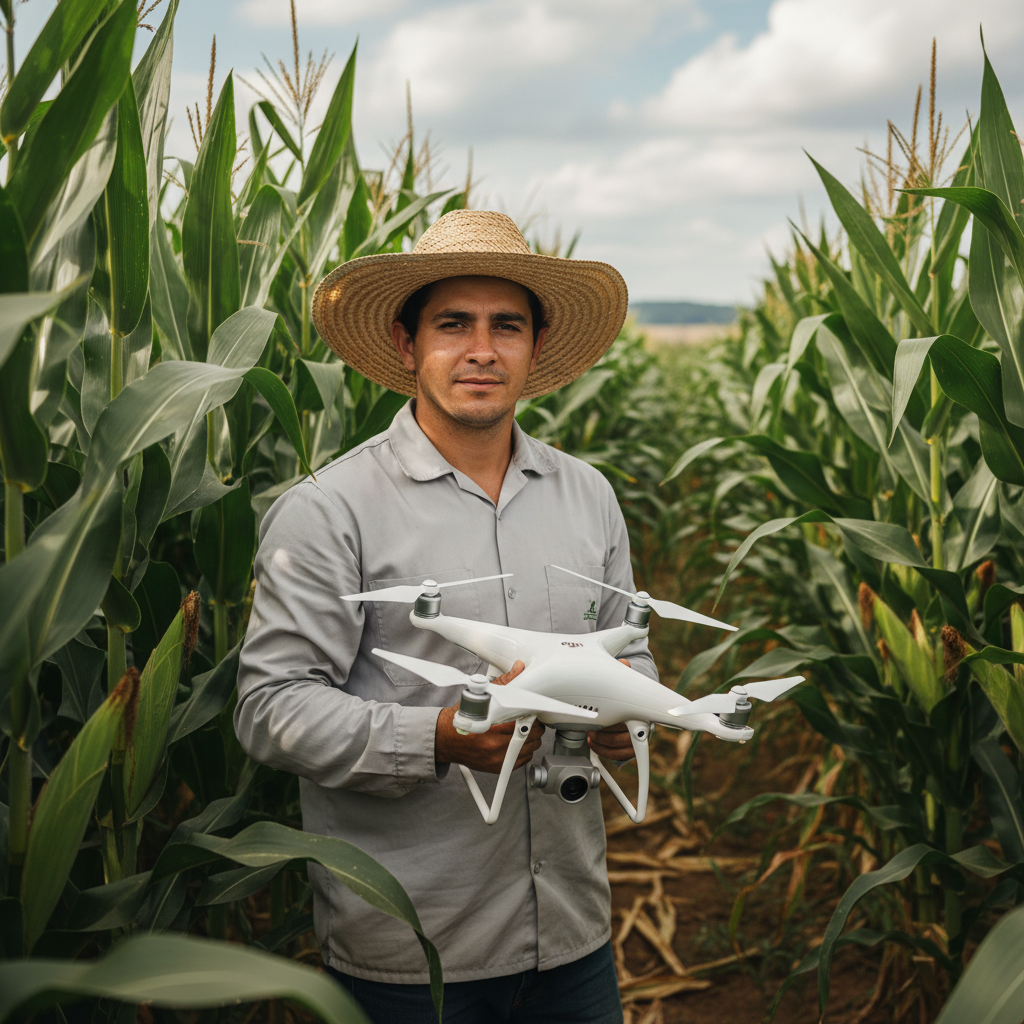
Lucas Fernandes Silva is an agricultural engineer with 12 years of experience in aerial mapping technologies and precision agriculture. ANAC-certified drone pilot since 2018, Lucas has worked on mapping projects across more than 500 rural properties in Brazil, covering areas ranging from small farms to large-scale operations. Specialized in multispectral image processing, vegetation index analysis (NDVI, GNDVI, SAVI), and precision agriculture system implementation. Lucas is passionate about sharing technical knowledge and helping agribusiness professionals optimize their operations through aerial technology.