
Know GNDVI vs NDVI basics
You use GNDVI and NDVI to judge plant health from imagery. Both compare near-infrared (NIR) reflectance to a visible band to reveal greenness — like two lenses: one shows broad leaf cover, the other teases out chlorophyll details.
When you ask, “GNDVI vs NDVI: Which Index to Use for Nitrogen Detection in Plants?”, the short answer is: GNDVI often wins for nitrogen sensitivity because it listens to leaf chlorophyll more closely, so small drops in nitrogen show up sooner than with NDVI. Still, NDVI remains useful for overall biomass and stress detection. In practice, run both if possible, compare maps, ground-check a few spots, and use the index that matches your goal: biomass or nitrogen-driven chlorophyll.
What each index measures
- NDVI — general vegetation vigor and canopy density. Good for separating bare soil from dense crop and spotting large-scale stress. Reacts to leaf area and overall green cover.
- GNDVI — sensitive to chlorophyll content and therefore often more responsive to nitrogen changes inside leaves. Useful for early nutrient-stress detection.
Which spectral bands they use
- NDVI: Red (~660 nm) and NIR (~800 nm). Red is absorbed by chlorophyll, so NDVI separates green from non-green effectively.
- GNDVI: Green (~550 nm) and NIR (~800 nm). The green band interacts differently with chlorophyll and gives a finer read on leaf pigments and nitrogen.
| Index | Visible Band | NIR Band | Typical Strength |
|---|---|---|---|
| NDVI | Red (~660 nm) | NIR (~800 nm) | Good for biomass and canopy cover |
| GNDVI | Green (~550 nm) | NIR (~800 nm) | Better for chlorophyll / nitrogen sensitivity |
Quick formula check
- NDVI = (NIR – Red) / (NIR Red)
- GNDVI = (NIR – Green) / (NIR Green)
Values typically range from about -1 to 1.
How you compute each index
Spectral indices turn reflectance values into a simple score. Workflow essentials:
- Convert raw DN to reflectance.
- Mask clouds, shadows, and non-vegetation.
- Align bands and ensure units match.
- Apply the per-pixel normalized-difference formula (use a small epsilon to avoid divide-by-zero).
These prep steps (radiometric correction, masking, band alignment) make your index meaningful in maps and time series.
NDVI: red and NIR formula
NDVI = (NIR – Red) / (NIR Red). Apply radiometric correction for comparability across dates/sensors. NDVI is a solid broad-view metric but can saturate in dense canopies.
GNDVI: green and NIR formula
GNDVI = (NIR – Green) / (NIR Green). Use GNDVI when you want finer detection of nitrogen stress or subtle chlorophyll shifts. When asking “GNDVI vs NDVI: Which Index to Use for Nitrogen Detection in Plants?” lean toward GNDVI for nitrogen signals, but validate on your data.
Code-ready formulas
Use these in raster calculators or arrays:
- NDVI -> (nir – red) / (nir red 1e-6)
- GNDVI -> (nir – green) / (nir green 1e-6)
Use GNDVI for chlorophyll
Use GNDVI to map chlorophyll across fields or plots. Swapping red for green increases sensitivity to leaf greenness, so GNDVI often shows small pigment changes earlier than NDVI. GNDVI can stay sensitive where NDVI flattens (saturates) in dense canopies.
To run GNDVI you need sensors that capture green (~550 nm) and NIR. Collect data consistently (same sun angle, similar conditions) and ground-truth with leaf tests.
| Feature | GNDVI | NDVI |
|---|---|---|
| Bands used | Green NIR | Red NIR |
| Formula | (NIR – Green)/(NIR Green) | (NIR – Red)/(NIR Red) |
| Sensitivity to chlorophyll | Higher in many crops | Good, but can saturate |
| Best when | Mapping chlorophyll / nitrogen | General vegetation vigor |
Why the green band tracks chlorophyll
Chlorophyll absorbs mostly blue and red; leaves reflect green. When chlorophyll declines, leaves reflect more green — a change the green band detects. Green reflectance also shifts with pigment amount and leaf structure, so watching the green band over time reveals chlorophyll trends.
How chlorophyll links to remote sensing plant nitrogen content
Nitrogen is a major component of chlorophyll and leaf proteins. Nitrogen deficiency typically reduces chlorophyll, which alters reflectance and is seen by GNDVI or other green-sensitive metrics. The relationship is useful but not perfect — water stress, pests, or leaf age also affect chlorophyll — so pair GNDVI with spot leaf tests, SPAD meters, or time-series analysis.
Understand NDVI limitations for nitrogen sensing
NDVI is quick and useful for greenness, but know its limits:
- Saturation in dense canopies — NDVI can stop increasing even as chlorophyll or N continues to rise.
- Soil, weeds, or moisture can bias NDVI where canopy is thin.
- Atmospheric effects and sun angle shift values across dates.
Treat raw NDVI maps as a sketch: useful, but not the final word for nitrogen decisions. Combine NDVI with ground samples or other indices (e.g., GNDVI, red-edge) and apply radiometric correction or consistent flight timing.
NDVI issues and practical fixes
| Issue | How NDVI reacts | Practical fix |
|---|---|---|
| Dense canopy | Saturates — little change with added N | Use GNDVI or red-edge; ground sample |
| Bright or wet soil | NDVI skewed near edges and thin spots | Mask soil, use soil-corrected indices |
| Atmosphere / sun | Values shift across dates | Radiometric correction; consistent flight time |
| Weeds or senescence | High NDVI despite low crop N | Ground truth; use complementary indices |
See advantages of GNDVI for nitrogen detection
Because GNDVI uses the green and NIR bands, it often provides a clearer signal tied to leaf chlorophyll and therefore nitrogen status. GNDVI reduces background noise from soil and shadows and retains more dynamic range in heavy canopies, so small N differences stand out.
| Factor | NDVI | GNDVI |
|---|---|---|
| Sensitivity at high chlorophyll | Low (saturates) | High (retains detail) |
| Soil/background influence | Higher | Lower |
| Best for nitrogen detection | Good in sparse canopies | Better in dense, high-biomass canopies |
| Typical use case | General vegetation health | Nitrogen mapping, dense crops |
Choose GNDVI for variable-rate nitrogen maps, drone scouting, and guiding spot sampling in dense, green crops.
Compare GNDVI and NDVI accuracy
GNDVI and NDVI target slightly different plant properties. Many studies show GNDVI correlates better with measured leaf nitrogen or chlorophyll in crops like wheat, maize, and rice, especially early–mid season. NDVI remains valuable where canopy is sparse or when green-band sensitivity is weak.
Sensor spectral response, lighting, and view angle affect both indices. Test them on your fields to determine which gives the most reliable results.
Use ground truth and validation metrics
Pair index values with leaf samples, lab N content, or SPAD readings. Collect samples across zones, dates, and N levels.
Key metrics:
- R² — strength of relationship (higher is better)
- RMSE — average prediction error (lower is better)
- MAE — robustness to outliers (lower is better)
- Bias — systematic over/under prediction (close to 0 is ideal)
Do cross-validation or holdout tests to avoid overfitting. If GNDVI shows higher R² and lower RMSE for your crop/stage, it likely helps nitrogen decisions more than NDVI. Otherwise adapt: use GNDVI early and NDVI later, or feed both to a regression model.
| Metric | What it shows | Desired direction | How you use it |
|---|---|---|---|
| R² | Strength of relationship with ground truth | Higher | Prefer index with larger R² for N prediction |
| RMSE | Average prediction error (same units as N) | Lower | Compare errors to management thresholds |
| MAE | Median-like average error | Lower | Check robustness to outliers |
| Bias | Systematic over/under prediction | Close to 0 | Adjust calibration if biased |
Apply drone-based nitrogen mapping
Use drones to map where crops need nitrogen. Fly a drone with the right sensor, process images into orthomosaics, compute indices (NDVI, GNDVI), and translate maps into prescriptions.
- Plan flights during consistent light (near solar noon on clear days).
- Choose sensors that include green and NIR if you want to use GNDVI.
- Fly at a height that gives the resolution you need (2–5 cm/pixel for detailed scouting; 5–15 cm/pixel for larger areas).
- Use strong overlap (75–85% forward, 60–70% side) for clean stitching and GCPs if survey-grade accuracy is required.
| Topic | Short guide |
|---|---|
| Index choice | NDVI = red & NIR (general). GNDVI = green & NIR (better in dense canopies). |
| Flight time | Fly on clear days near solar noon for stable light. |
| Resolution | 2–5 cm/pixel = detailed; 5–15 cm/pixel = larger area faster. |
| Overlap | 75–85% forward, 60–70% side for clean stitching. |
| Calibration | Use reflectance panels or sensor radiometric tools for consistent maps. |
Prepare drone data for analysis
Download raw images, logs, and calibration photos. Run radiometric correction using reflectance panels or sensor tools, stitch images into an orthomosaic, compute index layers (NDVI, GNDVI), clip to field boundaries, and export georeferenced rasters.
Set up image processing and mapping software
Pick tools (QGIS, SNAP, OpenDroneMap, Pix4D, Agisoft), create a project, choose CRS, and organize inputs (images, EXIF, calibration panels, flight logs). Tune camera parameters and desired pixel size, and save processing templates for repeat missions.
Radiometric and geometric correction
- Radiometric: convert DN to reflectance, correct vignetting, apply sensor gains, and use reflectance panels for consistency.
- Geometric: fix lens distortion, run bundle adjustment, use GCPs, and check orthomosaic alignment.
Calculate vegetation indices for nitrogen assessment
Compute indices using band math on reflectance images. The question “GNDVI vs NDVI: Which Index to Use for Nitrogen Detection in Plants?” belongs here: run both indices on your processed reflectance maps, mask non-vegetation, and calibrate maps with leaf tests or SPAD readings. Build regressions to predict N, and select the index (or combination) that best matches ground truth.
| Index | Bands used | Sensitivity | Best when |
|---|---|---|---|
| NDVI | Red NIR | Good for structure and general greenness | Canopies with moderate biomass |
| GNDVI | Green NIR | Better for chlorophyll / nitrogen changes | High biomass or late-season monitoring |
Export GeoTIFF rasters and include metadata (date, bands, processing steps, CRS).
Turn index maps into precision-agriculture nitrogen monitoring
- Load index layers and view them over time. Look for consistent patterns (persistent low strips or recurring hot spots).
- Create actionable zones using thresholds (low/medium/high). Keep rules simple for applicator use.
- Produce variable-rate prescriptions (ISO XML, shapefile, or machine-specific formats), translate zones into application rates, add buffer rules, and test on a small strip before full-field application.
- Validate maps with soil and leaf samples at GPS-matched points, adjust thresholds, and retest to refine the model.
| Index | Typical Range | Meaning | Quick Action |
|---|---|---|---|
| NDVI | 0.2–0.4 (low) | Sparse or stressed | In-season test & small sidedress |
| NDVI | 0.4–0.7 (medium) | Moderate vigor | Monitor; hold larger inputs |
| NDVI | 0.7–0.9 (high) | Dense, healthy | Maintain or reduce N |
| GNDVI | 0.15–0.35 (low) | Early N deficiency | Targeted N boost |
| GNDVI | 0.35–0.6 (medium) | Mixed health | Split applications |
| GNDVI | 0.6–0.85 (high) | Strong N signal | Limit extra N |
Frequently asked questions
- GNDVI vs NDVI: Which Index to Use for Nitrogen Detection in Plants?
- Use GNDVI when you need more sensitivity to leaf chlorophyll and nitrogen, especially in dense, green canopies. Use NDVI for general vigor and where canopy is sparse or sensors lack a green band.
- When should you use GNDVI instead of NDVI?
- Use GNDVI for dense canopies, late-season crops, or when early detection of N issues is critical. Use NDVI for broad health mapping, simple biomass estimates, or when only redNIR bands are available.
- How do sensors affect GNDVI vs NDVI results?
- Sensors must include the required visible band (green for GNDVI, red for NDVI) plus NIR. Spectral band center/widith, radiometric calibration, and sensor noise all affect accuracy.
- Can you use drone or satellite data for GNDVI vs NDVI comparison?
- Yes. Drones give fine detail and higher resolution; satellites give broader coverage and repeatability. Keep flight/sensor timing and radiometric corrections consistent for fair comparison.
- How do you validate GNDVI vs NDVI for nitrogen management?
- Ground-truth with leaf N tests or SPAD meters, run regression comparisons (R², RMSE, MAE), and perform cross-validation. Set local thresholds and update them as the crop grows.
(Repeat the core question as needed in reports: “GNDVI vs NDVI: Which Index to Use for Nitrogen Detection in Plants?” — in most dense, high-chlorophyll crops, GNDVI is the better starting point; validate locally before operational rollout.)
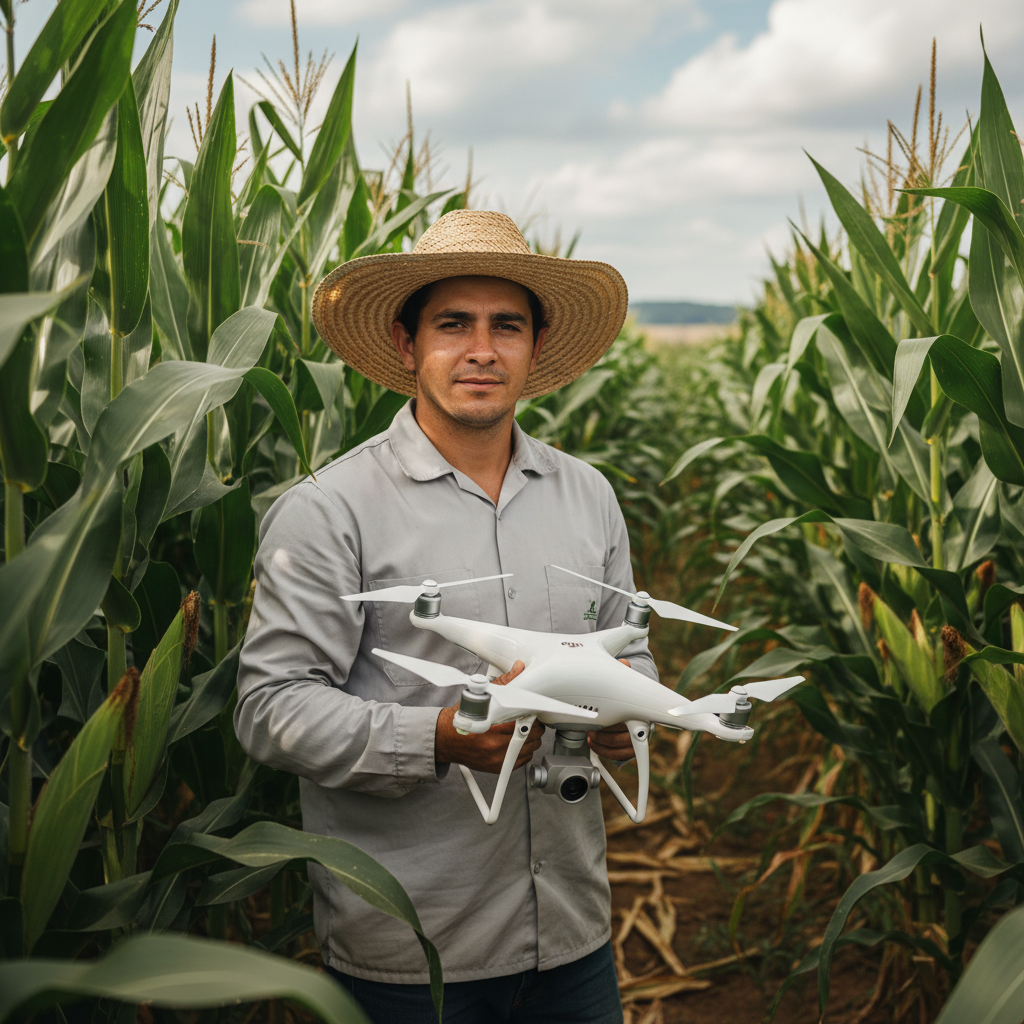
Lucas Fernandes Silva is an agricultural engineer with 12 years of experience in aerial mapping technologies and precision agriculture. ANAC-certified drone pilot since 2018, Lucas has worked on mapping projects across more than 500 rural properties in Brazil, covering areas ranging from small farms to large-scale operations. Specialized in multispectral image processing, vegetation index analysis (NDVI, GNDVI, SAVI), and precision agriculture system implementation. Lucas is passionate about sharing technical knowledge and helping agribusiness professionals optimize their operations through aerial technology.