
How SAVI helps you correct soil influence
SAVI (Soil-Adjusted Vegetation Index): Correcting Soil Influence in Images gives a simple fix for a common headache: soil masks the plant signal when vegetation is sparse. Feed Red and NIR bands into SAVI and it pulls the soil background down so the plant signal stands out. Think of soil as static on a radio; SAVI turns up the music—your vegetation—by lowering the static.
When you apply SAVI you use an L factor that mutes soil impact based on cover. Higher L reduces soil influence more; lower L lets vegetation dominate. Compute SAVI pixel-by-pixel after preprocessing (atmospheric correction, coregistration, cloud masking) and adjust L until maps match ground truth.
Basic idea and how the algorithm works
SAVI modifies the classic vegetation index by adding a small constant L to the numerator and denominator to reduce the effect of soil brightness in mixed pixels. It’s cheap to compute, runs per pixel, and keeps results in a familiar -1 to 1 range like NDVI.
You set L to tune how much soil is removed from the signal: low L for dense canopies, higher L for sparse vegetation. Use SAVI to classify vegetation, track recovery after rain, or flag stressed areas faster than NDVI alone.
SAVI formula and the L soil factor
Core formula:
SAVI = (1 L) (NIR − Red) / (NIR Red L)
- NIR = near-infrared reflectance
- Red = red-band reflectance
- L = soil brightness factor (choose based on cover)
Typical guidance:
- L ≈ 0 → behaves like NDVI (dense cover)
- L ≈ 0.5 → default for moderate/mixed cover
- L ≈ 1 → for very sparse cover or bare soil
When to use SAVI (Soil-Adjusted Vegetation Index): Correcting Soil Influence in Images
Use SAVI when vegetation is patchy or the ground is bright: early spring fields, dry grasslands, recently harvested fields, orchards or vineyards with bare rows, and arid regions. As a rule of thumb, if vegetation cover is under ~40% try SAVI first and run NDVI side-by-side for a few tiles.
| Index | Best when… | Typical vegetation cover | Suggested L |
|---|---|---|---|
| NDVI | Dense, continuous canopy | > 60% | 0 |
| SAVI | Sparse/mixed pixels, bright soil | < 40% | 0.5 (start), up to 1 |
Quick fact: SAVI reduces soil bias by adding the L factor, lowering how much bright or dark soil skews vegetation values.
How you pick the SAVI normalization factor (L)
- Inspect cover: Is vegetation thick, patchy, or thin?
- Compare NDVI histogram and soil brightness: if NDVI cluster is low and close to soil, increase L; if high, decrease L.
- Test values (0, 0.25, 0.5, 1) on a sample area and pick the one that best separates vegetation from bare soil. Use field notes or high-res imagery as a reality check.
Common anchors: 0 (dense), 0.25 (dense to moderate), 0.5 (moderate), 0.75 (sparse), 1 (very sparse). For mixed soils, consider segmenting the scene and assigning an L per zone or deriving adaptive per-pixel L from local vegetation fraction.
Tip: if unsure, start with L = 0.5.
Preparing images for SAVI processing
- Align projection and pixel size; resample/reproject if needed.
- Convert DNs to reflectance early (TOA → surface reflectance with Sen2Cor, 6S, DOS when possible).
- Clip to AOI, pick clean Red and NIR bands, and apply cloud/water masks.
- Keep metadata: sensor, acquisition time, sun elevation, calibration constants.
Radiometric steps:
- DN → Radiance → TOA reflectance (always first)
- Atmospheric correction (DOS/6S/Sen2Cor) for surface reflectance when accurate comparisons are needed
- Dark object subtraction as a quick fix if full model unavailable
- Validate with field spectra or invariant ground targets
Ensure NIR and Red are on the same scale and grid before computing SAVI.
SAVI vs NDVI — when to choose which
- Use NDVI for dense, continuous vegetation (forests, mature crops).
- Use SAVI (Soil-Adjusted Vegetation Index): Correcting Soil Influence in Images when soil brightness bleeds into pixels and vegetation is sparse or patchy.
- Test both on sample tiles and compare against ground truth or high-res imagery.
Differences in math:
- NDVI = (NIR − Red) / (NIR Red)
- SAVI = (1 L) (NIR − Red) / (NIR Red L)
SAVI lowers false low values over bare ground; NDVI can saturate in very dense canopies.
Using SAVI for crop monitoring
- Compute SAVI near emergence with an appropriate L to reveal true green cover.
- Map values and use color ramps/thresholds tuned to crop type and stage to make actionable maps.
- Overlay SAVI with yield zones, soil tests, or irrigation to guide sampling and interventions.
- Build biomass models by relating SAVI to field-measured biomass or LAI.
Index quick tips:
- SAVI: reduced soil sensitivity, best for early growth/sparse canopies
- NDVI: fast and clear for dense canopies, watch for soil bias at emergence
- EVI: use for high biomass/complex scenes (needs blue band)
Running SAVI in tools (GIS / Python)
Workflow:
- Load NIR and Red bands, apply cloud masking and alignment.
- Compute SAVI using the formula and chosen L. Handle nodata/divide-by-zero.
- Export results as float32 GeoTIFF, preserve CRS and nodata, add compression/overviews.
GIS: use raster calculator in QGIS or ArcGIS (set datatype float32).
Python: read with rasterio/GDAL into numpy arrays; process by windows for large scenes; write with rasterio.
Useful tools:
- QGIS SCP, Orfeo Toolbox, ArcGIS Image Analyst
- rasterio, numpy, GDAL, rioxarray, earthpy
Reading and mapping SAVI outputs
- Check metadata and rescale to standard -1 to 1 if needed.
- Clip to AOI and mask clouds/water before analysis.
- Choose a clear legend and intuitive color ramp (light browns → yellow → green). Avoid rainbow ramps.
- Use contrast stretching and overlay contextual RGB or hillshade for interpretation.
- Validate samples on the ground and adjust thresholds or preprocessing (including L) if biases appear.
Classifying SAVI (starting points):
- < 0.0 → Bare / very sparse
- 0.0–0.2 → Sparse
- 0.2–0.5 → Moderate
- > 0.5 → Dense
Always save thresholds and processing steps for reproducibility.
Common mistakes and limits
Common traps:
- Wrong L-factor: test on sample plots or use adaptive L
- Unmasked water/shadows: mask with NDWI/brightness thresholds
- Uncalibrated data: perform radiometric/atmospheric correction first
- Soil heterogeneity: segment scene or use local soil spectra
Limits:
- SAVI saturates in dense canopies (consider EVI or LiDAR)
- Water/specular reflections confuse SAVI—mask water or use radar where needed
Best practices:
- Derive L from sample plots when possible
- Prepare data (atmospheric correction, resampling) and build soil masks for variable soils
- Always validate SAVI with ground truth (compute RMSE, bias, correlation)
Frequently asked questions
Q: What is SAVI (Soil-Adjusted Vegetation Index): Correcting Soil Influence in Images?
A: SAVI adjusts NDVI with an L factor to reduce soil noise and expose real plant signals.
Q: When should you use SAVI?
A: Use it on sparse vegetation or when NDVI appears biased by soil brightness.
Q: How do you calculate SAVI?
A: SAVI = (1 L) (NIR − Red) / (NIR Red L), using reflectance values.
Q: How do you pick the L value?
A: Start with L = 0.5 for general scenes; use L ≈ 1 for very sparse cover and L ≈ 0 for dense canopy. Test and tweak for your site.
Q: What are common SAVI pitfalls and quick tips?
A: Do atmospheric correction first, mask clouds/water/shadows, and validate with ground checks. SAVI corrects soil influence but not clouds or haze.
SAVI (Soil-Adjusted Vegetation Index): Correcting Soil Influence in Images helps you cut soil bias and produce vegetation maps that better match what you see on the ground—especially in early growth, post-harvest, and arid conditions.
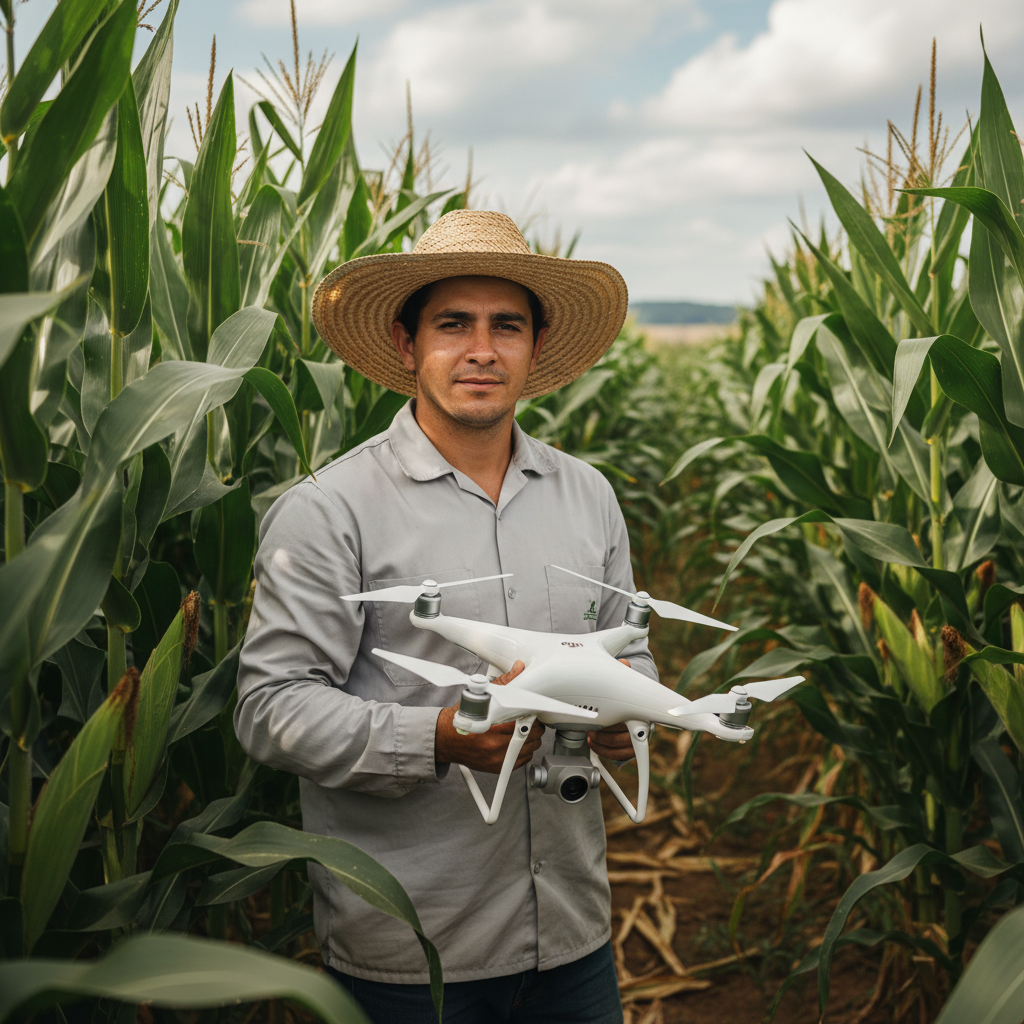
Lucas Fernandes Silva is an agricultural engineer with 12 years of experience in aerial mapping technologies and precision agriculture. ANAC-certified drone pilot since 2018, Lucas has worked on mapping projects across more than 500 rural properties in Brazil, covering areas ranging from small farms to large-scale operations. Specialized in multispectral image processing, vegetation index analysis (NDVI, GNDVI, SAVI), and precision agriculture system implementation. Lucas is passionate about sharing technical knowledge and helping agribusiness professionals optimize their operations through aerial technology.