
Understand OSAVI index
OSAVI (Optimized Soil-Adjusted Vegetation Index) is a vegetation index designed to pull plant signal out of noisy ground. In satellite or drone images, bare soil and sparse cover can hide plant responses; OSAVI adds a small soil correction so you can read the green signal more clearly—like wiping dust off a lens so plants show up sharp.
Use OSAVI when parts of your scene have low canopy or patchy crops. It uses the same bands you already use—NIR and Red—but adds a tiny adjustment (L ≈ 0.16) to reduce soil influence. That tweak keeps the index sensitive to plant health while cutting down false readings from bright dirt or dry ground.
In mapping software compute OSAVI per pixel, then style maps or run statistics. You’ll spot stressed patches earlier in sparse fields than with a plain index. If you want cleaner maps when soil shows through leaves, OSAVI is a practical tool to add to your workflow.
What OSAVI measures
OSAVI measures vegetation vigor by comparing how much near-infrared light plants reflect versus red light they absorb. Healthy green plants reflect more NIR and absorb more Red, so the index rises. Because OSAVI corrects for soil brightness, values track actual green biomass better on thin canopies.
Practical use: fly a drone over newly planted fields and run OSAVI. You’ll see where seedlings do well and where soil dominates the pixel. That makes OSAVI great for early-season scouting and fits into the broader guide Advanced Spectral Indices: OSAVI, EVI, and When to Use Them as the go-to for sparse cover.
Why soil correction matters
Soil brightness is background noise. A bright patch of soil can make a weak crop look healthier or mask stress. Soil correction makes maps comparable across ground types, dates, and sensors—important when you want reliable numbers, not just pretty pictures.
For decision-making, soil correction reduces false alarms. If you’re tracking growth, planning inputs, or measuring yield potential, OSAVI helps you trust the trends: cleaner indicators lead to better actions (replanting, irrigation) based on better information.
Optimized Soil-Adjusted Vegetation Index basics
The optimized SAVI formula uses a small soil factor (L ≈ 0.16) to keep sensitivity to plant signal while cutting soil bias. Use OSAVI on multispectral images where ground shows through and include it in your processing chain before classification or change detection.
| Index | Soil correction | Best use |
|---|---|---|
| OSAVI | small L (~0.16) | Sparse canopy, early season, patchy fields |
| NDVI | none | Dense vegetation, general greenness maps |
| EVI | aerosol & soil corrections blue band | High biomass, atmospheric noise, tropical forests |
Understand EVI index
EVI (Enhanced Vegetation Index) measures how green and healthy plants are from satellite or drone images. Unlike simple ratios, EVI includes a blue band to cut down sky haze and a correction term to handle dense leaf cover—think of it as polarized sunglasses for your camera: colors get clearer and bright forests stop looking like flat green blobs.
The formula mixes NIR, Red, and Blue bands with fixed coefficients. Each part has a role: NIR rises with leaf health, Red drops when leaves absorb light, and Blue helps remove scattering from the air.
| Component | Spectral Band | Primary Role |
|---|---|---|
| NIR | Near-Infrared | Signal for leaf internal structure and vigor |
| RED | Red | Inverse of chlorophyll absorption; detects greenness |
| BLUE | Blue | Corrects aerosol and atmospheric scattering |
| Coefficients | Numeric factors | Balance bands to reduce background and saturation |
You’ll pick EVI when you face dense vegetation or bright skies. It keeps values from flattening out in forests and works better than NDVI in high-biomass fields. Remember the guide Advanced Spectral Indices: OSAVI, EVI, and When to Use Them — EVI is one of several tools you’ll switch between depending on canopy and atmosphere.
What EVI measures
EVI measures canopy greenness and structure. When leaves are full of chlorophyll and water, NIR reflectance increases and Red decreases. The math in EVI turns those changes into a number that tracks plant health over time. Use it to spot crop stress, follow seasonal growth, or map forest biomass.
EVI resists saturation, so it reflects changes inside dense canopies better than NDVI. That means you can spot small declines in forest health or differences between thick crops that NDVI might miss. Use it for forests, high-yield fields, and wetlands where leaves pack tightly together.
How EVI reduces atmospheric effects
EVI’s clever trick is the Blue band and fixed coefficients. Air particles scatter blue light more than red or NIR; by measuring that scatter, EVI subtracts a scaled blue signal to cut haze and aerosol noise. In short: EVI looks at the sky’s interference and pulls it out so the plant signal shines through.
Those coefficients (gain and aerosol resistance factors) weigh the bands to lessen soil and atmospheric influence. You’ll see less false greenness after dust, smoke, or thin clouds. Still, EVI reduces but does not erase all problems; heavy haze or sensor mismatch can still shift values, so compare images from the same sensor and preprocessing.
Enhanced Vegetation Index overview
EVI blends NIR, Red, and Blue with correction terms so you can detect real changes in canopy health where simpler indices stall. Use EVI when canopy is thick or atmospheric scattering is a worry.
OSAVI vs EVI comparison
OSAVI and EVI are both vegetation indices that help you read plant health, but they serve different needs. OSAVI tweaks NDVI with a soil-adjustment factor—better when bare ground shows through. EVI adds a blue band and coefficients to reduce atmospheric and canopy effects—better for thick, green canopies. Think of OSAVI as a dust cloth for the soil signal and EVI as sunglasses for bright, leafy scenes.
When choosing, focus on what your images show. For patchy fields with exposed soil or young crops, OSAVI yields steadier values. For tall, dense crops or forests where leaves overlap, EVI avoids the flattening NDVI shows and gives a better range for high biomass. Also note: EVI needs a blue band and correct scaling, so sensor choice and preprocessing matter.
In practice, try both on a sample area and compare maps. Use OSAVI where soil mixes with vegetation and switch to EVI for closed canopies. A practical workflow can select the index by cover fraction to avoid bad surprises.
Key differences to know
- Formulas: OSAVI adds a small constant to NDVI’s denominator to cut soil influence; EVI uses Red, NIR, and Blue with coefficients to cancel atmospheric scattering and improve sensitivity in dense vegetation.
- Data needs: OSAVI requires only Red and NIR (good for many drones and older sensors). EVI needs a reliable Blue band and radiometric calibration to perform well.
- Behavior: EVI gives more gradation at high leaf area; OSAVI keeps low-biomass signals cleaner.
| Factor | OSAVI | EVI |
|---|---|---|
| Primary purpose | Reduce soil influence | Reduce atmosphere canopy background |
| Bands required | Red, NIR | Red, NIR, Blue |
| Best for | Sparse or mixed cover | Dense, high-biomass canopies |
| Saturation at high LAI | Higher risk | Lower risk (better dynamic range) |
| Ease of use | Simple | Needs calibration and blue band |
Performance in sparse vs dense cover
- Sparse cover: OSAVI keeps values meaningful where soil shows through—early-season crops, grazed pastures, semi-arid rangelands.
- Dense cover: EVI resists the plateau that NDVI hits at high leaf area—useful for closed-canopy forests or peak-growth crops. EVI’s advantage depends on good blue-band data and atmospheric correction.
OSAVI vs EVI quick guide
If your scene has visible soil, sparse plants, or early growth, pick OSAVI. If you map thick forest, dense crops, or need less saturation at high leaf area, pick EVI—only use EVI when your sensor provides a clean blue band and you apply basic radiometric correction.
When to use OSAVI
Pick OSAVI when your scene has sparse or patchy green cover and soil shows through. OSAVI reduces soil background effects better than NDVI in those cases, so your vegetation signal stays cleaner.
Use OSAVI when you need consistent vegetation estimates across fields with different soil brightness—dark vs pale soils—so your comparisons stay fairer. That makes maps and change detection more reliable.
Remember OSAVI is not a miracle fix for dense forests or heavy canopy; EVI or other canopy-focused indices can work better there. Keep Advanced Spectral Indices: OSAVI, EVI, and When to Use Them in mind as a short checklist: pick the index that matches the visible mix of soil and plants.
Use in low vegetation cover
When vegetation is thin, each pixel mixes plant and soil signals. Use OSAVI to lower soil-line influence and get a truer plant signal. This helps measure small growth changes that NDVI might miss (early-season crops, burned areas, grazed pastures).
Use in areas with visible soil
If images show bare earth between plants, OSAVI helps you compare areas fairly with less bias from bright or dark soils. Use it when soil reflectance varies across a project—sandy strips next to loamy patches—so thresholds don’t flip-flop because of soil differences.
When to use OSAVI simple rule
Quick rule: if more than ~10–20% of a pixel appears as bare soil, choose OSAVI; if pixels are mostly green canopy, use EVI or another canopy-focused index.
When to use EVI
EVI is the go-to index when you need a clearer signal from thick vegetation. Compared to NDVI, EVI uses the blue band to correct atmospheric scattering and reduces canopy saturation in dense forests or tall crops. Guides like Advanced Spectral Indices: OSAVI, EVI, and When to Use Them recommend EVI for scenes where leaves pile up and simple ratios lose detail.
Pick EVI when your area has heavy leaf cover or tall crops. It pulls useful variation from high Leaf Area Index (LAI) values and keeps contrast where NDVI flattens. Use EVI when imagery comes from sensors with a reliable blue band (e.g., MODIS, Landsat 8, Sentinel-2).
Also use EVI if aerosols (smoke, dust) or haze are common. Its blue-band term removes some atmospheric noise, so vegetation signals look cleaner after calculation. Always verify blue-band quality and pair EVI maps with visual checks of raw images.
| Index | Best for | Strength | Watch out for |
|---|---|---|---|
| NDVI | Open grass, sparse crops | Simple, widely used | Saturates in dense canopy |
| EVI | Dense canopy, aerosol presence | Reduces saturation, corrects aerosols | Needs reliable blue band |
| OSAVI | Bare soil influence | Reduces soil effects | Less correction for aerosols |
When to use EVI quick tip
If your site has dense canopy or you see haze/smoke, pick EVI; if ground is open or soil mixes with vegetation, try NDVI or OSAVI. Run both, compare to field notes, and trust the one that matches reality.
Implement in mapping software
When you bring imagery into mapping software, check metadata and band order. Confirm the bands you need; swap or rename if mislabeled. Convert to floating point if values are integers so formulas don’t truncate results.
Preprocessing: set correct CRS, apply scale factors, and mask clouds and no-data. Save intermediate rasters so you can backtrack if a formula fails. Then run band math and export with proper metadata. Choose an appropriate bit depth and compression for storage versus precision, and check histograms and sample pixels to confirm the math.
Band math and formula setup
Write formulas clearly and test on a small area first. Use the raster calculator or band math tool and name bands readably. Always convert inputs to float and set a rule for division by zero (e.g., add a tiny constant). Handle masks and no-data carefully—use conditional expressions to avoid extreme values. If possible, record the formula in the raster’s metadata.
Examples: QGIS, ArcGIS, SNAP
- QGIS: open Raster Calculator, reference bands by layer name, and export as GeoTIFF. Set output to Float32.
- ArcGIS: use Raster Calculator from Spatial Analyst or map algebra scripts; watch memory settings.
- SNAP: use Band Maths or Graph Processing tools—handy for Sentinel data and replayable processing graphs.
Vegetation index selection guide
Pick an index based on soil, canopy, and atmosphere: use NDVI for general greenness, EVI when canopy is dense or atmosphere is hazy, and OSAVI when soil background matters. The guide Advanced Spectral Indices: OSAVI, EVI, and When to Use Them is a practical rulebook for choosing fast.
| Index | Best use | Sensitivity | Short formula |
|---|---|---|---|
| NDVI | General greenness | Saturates in dense canopy | (NIR – Red) / (NIR Red) |
| EVI | Dense canopy, atmospheric effects | Less saturation, needs Blue | 2.5(NIR – Red)/(NIR 6Red – 7.5Blue 1) |
| OSAVI | Bare soil influence | Reduces soil effect | (1.16(NIR – Red))/(NIR Red 0.16) |
| SAVI | Low vegetation cover | Adjusts for soil brightness | (1 L)(NIR – Red)/(NIR Red L) |
Preprocess: soil and atmosphere
Preprocessing fixes soil reflectance and atmospheric effects. Skip either and your maps mislead. Convert raw digital numbers to top-of-atmosphere (TOA) reflectance, then choose between full atmospheric correction or a lighter scene method depending on accuracy and compute time.
Typical order: radiometric calibration → atmospheric correction → geometric correction → soil/background correction → index calculation. Use Level-2 surface reflectance products (Sentinel-2 L2A, Landsat SR) when possible. If processing raw TOA, document aerosol optical thickness (AOT) and water vapor values. Small choices—measured soil sample vs derived soil line—can swing index values. Be deliberate.
Soil background correction steps
Mask non-vegetation (clouds, shadows, water, built areas). Find bare-soil pixels to fit a soil line in red vs NIR space. Use that soil line to compute soil-adjusted indices (SAVI, OSAVI) or perform linear spectral unmixing. Work in reflectance units, not DN.
If vegetation is sparse, use OSAVI or a lower L factor. For mixed pixels, use unmixing and constrain fractional covers. Validate by comparing corrected index maps to field points or high-resolution imagery and visually check for removal of bright soil halos.
| Method | Purpose | Best when |
|---|---|---|
| Soil line adjustment | Remove linear soil influence in red vs NIR | You have clear bare-soil pixels |
| SAVI / OSAVI | Index that downweights soil brightness | Sparse vegetation with exposed soil |
| Spectral unmixing | Estimate fraction of vegetation vs soil | Mixed pixels, variable cover |
| Masking reference spectra | Remove non-veg and calibrate | You have ground spectra or panels |
Atmospheric correction basics
Convert TOA to surface reflectance by removing scattering and absorption. Use Dark Object Subtraction (DOS) for speed with light haze; use radiative transfer models (6S, MODTRAN) or processors (Sen2Cor, LaSRC) for accurate aerosol and water vapor correction.
Watch adjacency effects near bright surfaces and water. Inspect AOT and residual haze even with automated SR products. If comparing across sensors or seasons, do full atmospheric correction.
Soil background correction & vegetation indices
For quick choices use OSAVI when soil shows through and EVI when canopy is dense or atmosphere is hazy. A rule of thumb: OSAVI reduces soil bias with a small L constant; EVI brings a blue band to correct atmospheric effects and canopy saturation. Advanced Spectral Indices: OSAVI, EVI, and When to Use Them summarizes these choices.
Interpret values and thresholds
Treat spectral index values as relative signals, not absolute facts. A value means something compared to a local baseline, the sensor, and the season. Pick a clear baseline—recent averages, greenest pixel, or a field sample—instead of universal cut-offs.
For quick alerts, use simple cut-offs (e.g., NDVI 0.1 between dates for stress). For management, use calibrated thresholds derived from local field data. Check resources titled Advanced Spectral Indices: OSAVI, EVI, and When to Use Them to pick which index and threshold fit soil conditions, canopy density, and sensor type.
Always factor in noise—clouds, shadows, varying sun angles. Use cloud masks, temporal smoothing, and compare similar acquisition dates before applying thresholds. Treat single outliers as flags to inspect, not as proof.
Typical index value ranges
Most vegetation indices run -1 to 1; useful ranges cluster 0–1 for vegetation. Values below 0 often mean water, clouds, or bright surfaces. Rough guidance:
| Index | Typical low | Typical moderate | Typical high |
|---|---|---|---|
| NDVI | < 0.2 (sparse/stressed) | 0.2–0.5 | > 0.5 (dense) |
| OSAVI | < 0.15 (soil influence) | 0.15–0.45 | > 0.45 (healthy) |
| EVI | < 0.1 (stressed/bright) | 0.1–0.4 | > 0.4 (dense canopy) |
Different indices shift those bands. EVI is less sensitive to soil and bright surfaces and can show higher values in dense canopies; OSAVI corrects soil background and gives clearer signals in thin cover.
Detecting stress and change
Look for consistent drops rather than single-frame anomalies. Compare current values to a multi-date baseline. Sudden drops suggest events (drought, pest outbreak, harvest); gradual decline suggests chronic issues (nutrient deficiency, soil degradation). Flag areas where index falls below your local stress threshold for follow-up.
Combine indices for better insight: use OSAVI to cut soil effects and EVI to track canopy structure—if both drop, the signal is stronger. Use time-series plots to spot recovery or decline and set simple rules (e.g., if index decreases > X over Y days, trigger a field check) so maps become practical alerts.
Remote sensing vegetation monitoring tips
Mask clouds/shadows first, resample layers to the same resolution, and smooth time series before setting thresholds. Pick the index that matches your vegetation and soil: OSAVI for thin cover, EVI for dense canopies. Always ground-truth a handful of points before acting on a map.
Best practices for monitoring
Define your objective (crop health, vegetation change, soil exposure) and pick metrics that match it. Keep the plan simple: what to measure, how often, and what success looks like. That forces choices of sensor, index, and sampling cadence so results are meaningful.
Keep your workflow repeatable: standardize calibration, processing steps, and file naming so you can compare runs over time. Use the same atmospheric correction, cloud mask, and index formula across dates so differences reflect the land, not the pipeline.
Track uncertainty and document decisions. Log sensor settings, processing versions, and gaps. Run quick checks each time: histogram of index values, map of missing data, and a few known control points.
Sensor choice and spatial resolution
Pick a sensor that matches the scale of what you want to measure. For whole fields, 10–30 m sensors (Sentinel-2, Landsat) work. For single trees or rows, use high-resolution data (Planet, WorldView, UAV) with meters to centimeters resolution. Higher resolution costs more and produces larger data volumes.
Also check spectral bands. For vegetation you often need Red and NIR, and sometimes Blue or Red-edge for EVI or specialized indices. Match revisit frequency to target dynamics: fast-growing crops need more frequent images.
| Sensor type | Typical spatial res. | Typical revisit | Useful bands |
|---|---|---|---|
| Sentinel-2 | 10 m | 5 days | red, NIR, red-edge |
| Landsat | 30 m | 16 days | red, NIR, SWIR |
| Planet | 3–5 m | Daily | red, NIR |
| UAV | cm–m | On-demand | custom (can include red-edge) |
Time series and ground validation
Build a consistent time series: regular intervals, same cloud masking and smoothing, and dates aligned to phenophase. Use filters to remove clouds/shadows and smoothing (rolling median or low-pass) so seasonal trends stand out.
Ground validation anchors maps to reality. Collect a few well-located ground truth points during the same window as the satellite overpass. Measure leaf area, canopy cover, or soil fraction depending on goals. Keep notes and GPS tags, compare field to index values, and record error.
OSAVI and EVI use cases
Use OSAVI when soil background affects readings—semi-arid fields, sparse grasslands, or bare patches. Use EVI when you have dense canopy and need to reduce atmospheric and canopy saturation effects, like tropical forests or dense crops. Simple rule: if soil shows through, try OSAVI; if canopy is thick and you need atmospheric resistance, try EVI. Refer to Advanced Spectral Indices: OSAVI, EVI, and When to Use Them for a quick primer.
Frequently asked questions
- What are Advanced Spectral Indices: OSAVI, EVI, and When to Use Them?
They are tools to read plant health from satellite or drone images. OSAVI cuts soil noise; EVI reduces canopy and atmosphere effects. Use them when NDVI falls short. - When should you use OSAVI instead of NDVI?
Use OSAVI on sparse crops or bare-soil scenes. It lowers soil impact and gives clearer greenness in thin cover. - When should you use EVI for your maps?
Use EVI in dense forests or lush crops. It handles high leaf area well and helps correct atmospheric scattering. - How do you quickly calculate OSAVI and EVI?
OSAVI = (NIR – Red) / (NIR Red 0.16)
EVI = 2.5 (NIR – Red) / (NIR 6Red – 7.5Blue 1) - How do you pick between OSAVI and EVI in your workflow?
Check vegetation density first. If soil shows, pick OSAVI. If canopy is thick or haze exists, pick EVI. Test both on a sample area, compare results, and choose the best.
Conclusion
Advanced Spectral Indices: OSAVI, EVI, and When to Use Them is a practical decision framework: OSAVI for sparse or soil‑influenced scenes, EVI for dense canopies and hazy atmospheres. Use the right index for your sensor and objective, validate with ground data, and standardize your pipeline so index changes reflect the land—not processing quirks.
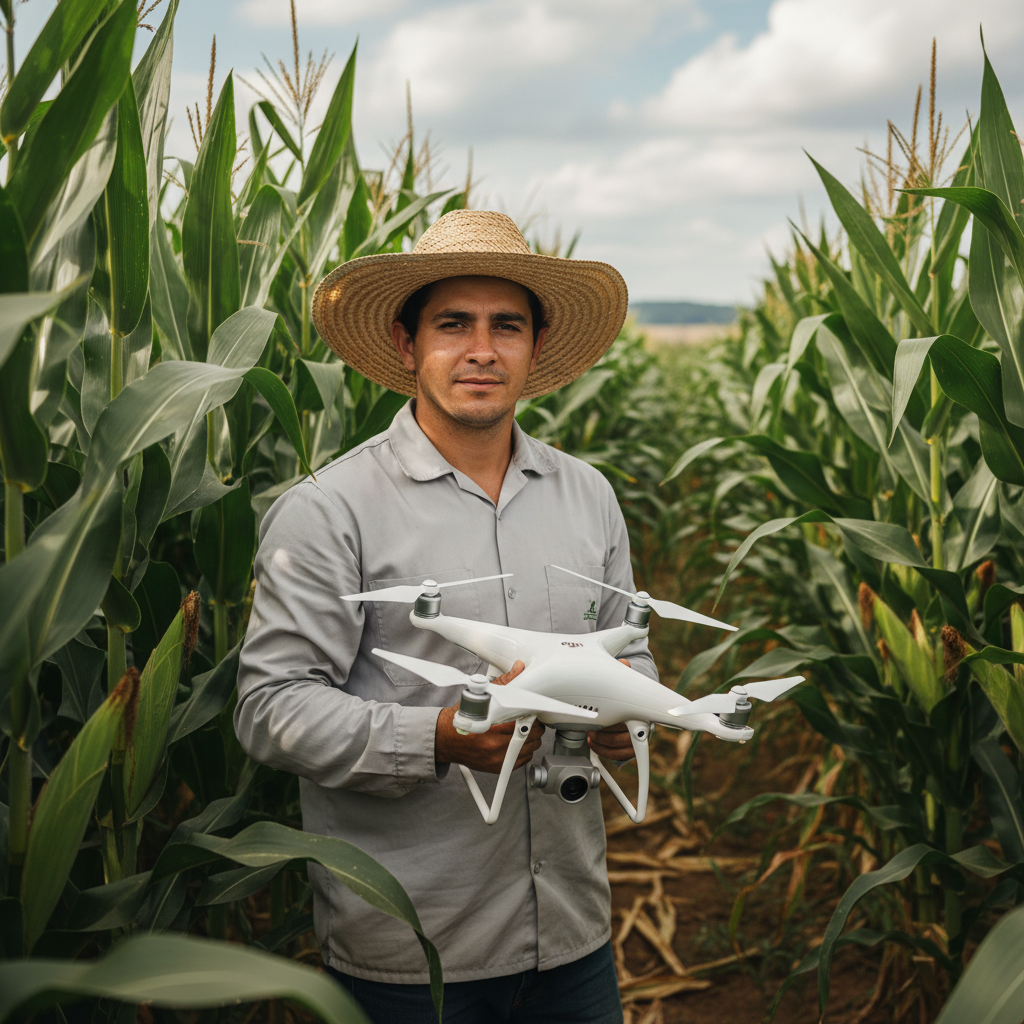
Lucas Fernandes Silva is an agricultural engineer with 12 years of experience in aerial mapping technologies and precision agriculture. ANAC-certified drone pilot since 2018, Lucas has worked on mapping projects across more than 500 rural properties in Brazil, covering areas ranging from small farms to large-scale operations. Specialized in multispectral image processing, vegetation index analysis (NDVI, GNDVI, SAVI), and precision agriculture system implementation. Lucas is passionate about sharing technical knowledge and helping agribusiness professionals optimize their operations through aerial technology.