
What camera resolution and GSD mean
Think of camera resolution as the number of pixels your camera can record. More pixels can capture finer detail, but pixels alone don’t tell the whole story — sensor size, lens focal length, and flight altitude change what those pixels represent on the ground.
GSD (Ground Sample Distance) is the real-world size of one pixel on the ground. If your GSD is 5 cm/pixel, each pixel covers a 5 cm square on the ground. GSD links camera and flight settings to the map or photo you want.
When you pick gear, think about both resolution and GSD together. The phrase “Camera Resolution and GSD: How to Choose the Right Camera for Your Application” sums this up: resolution gives raw data; GSD converts it into real-world meaning. Your choice depends on the detail you need and the area you must cover.
Camera resolution explained
Resolution is usually quoted in megapixels. A 12 MP sensor has about 12 million pixels. More megapixels can give you more detail if the rest of the system supports it — good lens, correct exposure, and stable flight.
Higher megapixels also mean larger files and more processing time. If you fly high, extra pixels may cover larger ground areas and not add useful detail. Match megapixels to your typical flight altitude and project needs.
Ground sample distance basics
GSD depends on focal length, sensor size, and flight altitude. Short focal length or higher altitude increases GSD (bigger ground area per pixel). Lower altitude or longer focal length reduces GSD (finer detail per pixel).
For mapping, think in centimeters per pixel. For inspections, you might need a GSD under 2 cm/pixel. For land surveys, 5–10 cm/pixel might be enough.
Example setups (approximate):
| Example Setup | Focal Length | Altitude | Approx. GSD |
|---|---|---|---|
| Compact camera | 20 mm | 30 m | ~1.5 cm/pixel |
| Standard survey | 20 mm | 60 m | ~3.0 cm/pixel |
| Broad area map | 20 mm | 120 m | ~6.0 cm/pixel |
How to calculate GSD
Think of GSD as the size of one camera pixel mapped on the ground. Basic formula:
GSD = (Altitude × Pixel Size) / Focal Length
That gives ground units per pixel (for example, cm/pixel). Match units before calculating. If pixel size is in micrometers, convert to millimeters; if altitude is in meters, convert to millimeters (or use consistent units throughout).
Example: 120 m altitude, 2.4 µm pixel size, 20 mm focal length → about 1.44 cm/pixel.
Use the GSD to plan flights and pick gear. If you need more detail, lower altitude or choose a camera with smaller pixel size or longer focal length. If you fly higher, GSD grows and detail drops. Treat GSD like a measuring stick when you compare cameras or set flight height.
GSD calculation inputs
Collect three core inputs: Pixel Size, Focal Length, and Altitude Above Ground. Manufacturers list pixel size (µm) and focal length (mm). Altitude should be the distance from the sensor to the ground surface you’re imaging, not sea level.
Also check image format and sensor resolution if you want to convert GSD into map scale or total ground coverage. Image height in pixels × GSD gives the vertical ground span of a single photo. If terrain varies in elevation, use average ground elevation to get realistic GSD.
Using a GSD calculator
A GSD calculator takes your inputs and does the unit conversions. Enter altitude, pixel size, and focal length, pick the output unit, and the tool returns the GSD instantly. Run a couple of scenarios to compare cameras or altitudes and verify a planned flight height will meet accuracy needs.
Check units before you calculate
Always convert units first: µm → mm, m → mm, then run the formula. A wrong unit produces wrong results.
| Input | Common unit on specs | Convert to |
|---|---|---|
| Pixel Size | micrometers (µm) | millimeters (mm): divide µm by 1000 |
| Focal Length | millimeters (mm) | millimeters (mm): keep as is |
| Altitude | meters (m) | millimeters (mm): multiply m by 1000 |
Sensor pixel size and GSD
Pixel size (pixel pitch) is the physical width of one sensor pixel. GSD is how much ground area each pixel covers. Smaller pixels can record finer detail at the same height but need more light and better optics. Camera Resolution and GSD: How to Choose the Right Camera for Your Application is a useful guide when deciding which sensor fits your mission.
Think of pixel size like floor tiles: big tiles hide small cracks; small tiles show every crack but need better grout. Larger pixels give better low-light performance and less noise. Smaller pixels give higher pixel counts in a smaller sensor area, which helps with mapping when flying low and stitching many images.
Balance altitude, focal length, and pixel size to hit the GSD you want. Test a camera on the ground first: fly a short pass, check images, then tweak height or camera to match your goal.
How pixel size changes GSD
GSD ∝ pixel size × flight height / focal length. Double the pixel size and you double the ground area per pixel (linear for one dimension). In practice, if you swap a sensor with 3 µm pixels for one with 6 µm pixels and keep height and lens the same, each pixel reports much larger ground area and fine details can vanish. Pick pixel size by the smallest object you need to see, then choose height and lens to match.
Sensor choices and image detail
You face a trade: megapixels vs pixel size. A very high-megapixel sensor with tiny pixels can give high resolution only if light and optics are good. For inspections at dawn or in shadows, favor larger pixels and wider dynamic range. For large-area maps flown low in good light, favor higher megapixels even if pixels are smaller.
Also think workflow: many small pixels produce big files and heavy mosaics. That helps mapping but costs storage and processing time. Larger pixels give cleaner single-frame detail and reduce noise, aiding object detection and visual inspection.
Pick sensors by pixel pitch
Aim for ranges matching your mission:
- < 2.0 µm — ultra-high-MP mapping at low altitudes (bright light required)
- 2.0–3.5 µm — standard photogrammetry and mapping
- 3.5–5.0 µm — mixed use and inspections with moderate light
- > 5.0 µm — low-light and high dynamic range needs
| Pixel Pitch (µm) | Typical Use | Main Advantage | Tradeoff |
|---|---|---|---|
| < 2.0 | Ultra-high MP mapping at low altitudes | Very fine sampling in bright conditions | Poor low-light performance |
| 2.0–3.5 | Standard mapping and surveys | Good balance of detail and file size | Needs decent light and optics |
| 3.5–5.0 | Inspections, structure detail | Better low-light and dynamic range | Lower raw pixel count |
| > 5.0 | Night or shadowed inspections | Strong noise control and DR | Larger sensors, heavier cameras |
How altitude affects GSD
GSD is how big each pixel is on the ground. If you fly higher, each pixel covers a larger patch — less detail. Fly lower and you get more detail.
The link between altitude and GSD is nearly linear: double the height → GSD roughly doubles. That makes altitude the fastest lever to change image detail. But camera specs (pixel size and focal length) change the scaling.
Lower flights give sharp images but cover less area and use more battery. Higher flights cover more ground faster but lose fine detail. Balance flight height, battery, and mission goals.
| Altitude (m) | Approx GSD (cm/pixel) — example camera |
|---|---|
| 30 | 1.5 cm/px |
| 60 | 3.0 cm/px |
| 120 | 6.0 cm/px |
Plan flight height for target GSD
- Pick the target GSD for the job (e.g., 1–2 cm/px for roof inspections; 5–10 cm/px for survey maps).
- Use camera specs or a calculator to find the flight height that produces that GSD.
- Make a checklist: camera, focal length, planned height, overlap.
Log altitude in your flight record. Barometer and GPS can drift; recording takeoff altitude and telemetry helps mapping software correct heights and stitch images with the right scale.
Drone camera resolution and GSD tradeoffs
When choosing a camera for aerial work, GSD and camera resolution are your main knobs. GSD tells you how much ground one pixel covers. Higher resolution and lower GSD give more detail. Start with the job: mapping, inspection, or marketing photography — that drives the GSD you need.
Higher megapixels sound attractive, but sensor size and optics matter more for image quality. A small sensor with many pixels can be noisy. A larger sensor with fewer pixels can capture cleaner detail in low light. You’ll trade off storage, processing time, and cost when increasing resolution. Think of resolution like binocular power: more helps, but support (drone stability and lens quality) must hold it steady.
Balance altitude, overlap, and resolution so you don’t exhaust batteries chasing pixels. Use your camera and sensor numbers to predict GSD before you fly.
| Camera spec | Typical GSD at 100 m | Usual payload effect | Best use case |
|---|---|---|---|
| 12 MP, small sensor | ~5–7 cm/px | Lightweight, minimal flight impact | Quick site photos, simple inspections |
| 20–24 MP, mid sensor | ~3–4 cm/px | Moderate weight, needs good gimbal | Roof and facade inspections, marketing |
| 45 MP, large sensor | ~1–2 cm/px | Heavy, shortens flight time | Precision mapping, high-detail inspections |
Balance camera resolution with payload
Treat the camera as part of the drone system. A high-resolution camera and big lens add weight and change center of gravity, requiring stronger motors and bigger batteries. A heavy camera on a light drone can cause stability problems and blur. For inspections, steady view matters; for mapping, a compact higher-pixel sensor often wins.
Flight time versus image detail
Every extra gram costs flight seconds. More detail usually means more weight, bigger batteries, or both, reducing area per battery. Trade altitude and overlap: fly higher with a higher-resolution sensor to keep GSD acceptable while covering more ground, or reduce overlap in long corridors. Test settings in a small area before committing.
Match drone limits to projects: know max payload, hover time with that load, and wind performance. If a job needs tiny GSD across acres, consider a larger platform or more batteries. For a single building, a lighter camera on a compact drone is usually best.
Spatial resolution vs GSD
Spatial resolution and GSD are related but not identical. Spatial resolution is the camera’s ability to record detail on the sensor — how small a feature the sensor can capture. GSD tells you how big each image pixel is on the ground. A high-megapixel camera can still give poor ground detail if you fly too high.
Change spatial resolution by selecting sensor and lens; change GSD by adjusting altitude and focal length. For mapping, GSD is the standard. For inspection and fine detail, spatial resolution and sensor quality matter more.
| Term | What it measures | Typical unit / example |
|---|---|---|
| Spatial Resolution | Camera/sensor detail capability | pixels/mm on sensor |
| GSD | Size of one pixel on the ground | cm/pixel (e.g., 5 cm/pixel at 60 m altitude) |
| Practical tip | How to change it | Change sensor/lens for spatial; altitude/focal for GSD |
When spatial resolution matters: tiny, low-contrast details (roof shingles, cracks, powerlines) require better optics and larger effective pixels. If lighting is poor or you plan heavy cropping, prioritize sensor quality and lens over just chasing a smaller GSD number.
Choosing a camera for mapping projects
Pick a camera with a clear goal: what map accuracy and detail do you need? Start by naming the target GSD (in cm or inches); that number drives choices for resolution, sensor size, lens focal length, and flight altitude.
Consider shutter type (global vs rolling), trigger control, and file formats. A global shutter avoids rolling artifacts; GPS/time sync keeps photos spaced for overlap. Shoot RAW for color accuracy and flexibility, and confirm geotagging or external GNSS/IMU support. Plan for ~70% frontlap and ~60% sidelap as a starting point for most mapping jobs.
Key specs for mapping
Focus on: GSD, megapixels, sensor size, pixel pitch, and lens focal length. Bigger sensors and larger pixels collect more light, giving cleaner images and better dynamic range. Check shutter type, trigger control, and file formats. Read “Camera Resolution and GSD: How to Choose the Right Camera for Your Application” for examples and calculations.
| Mapping Goal | Target GSD | Sensor Size | Suggested MP | Overlap |
|---|---|---|---|---|
| High-detail cadastral | 2–5 cm | APS-C or larger | 20–45 MP | 75% front / 70% side |
| Standard land mapping | 5–10 cm | MFT / APS-C | 12–24 MP | 70% front / 60% side |
| Large-area monitoring | >10 cm | 1″ or smaller | 12 MP or less | 70% front / 50–60% side |
Budget and operational constraints
Balance camera cost with system cost. A full-frame camera adds weight and needs a stronger drone and more processing. Factor in software licenses, storage, and person-hours. If money is tight, prioritize sensor quality and shutter type over sheer megapixels.
Operational limits shape choices: check payload capacity, hover time, weather limits, and spare parts. Renting or outsourcing high-end cameras for occasional jobs can be smart.
Create a camera selection checklist: define target GSD and accuracy, choose sensor size and MP, pick lens focal length to match altitude, confirm shutter type and triggering, verify RAW and geotag support, check payload and flight time, estimate data volume and processing needs, set budget, and plan for spares.
Match GSD to surveying accuracy
Treat GSD as the size of one pixel on the ground. If one pixel covers 5 cm, your map cannot be more accurate than that pixel size. Aim for GSD about one-third to one-half of the target horizontal accuracy to allow room for processing and control points.
Example: for a required 5 cm horizontal accuracy, choose a GSD near 1.5–2.5 cm and use good ground control. Verify sensor pixel size, megapixels, and lens focal length on spec sheets. Global shutter and low-distortion lenses help reduce motion blur and geometric error.
| GSD (cm/px) | Typical horizontal accuracy (cm) | Common use |
|---|---|---|
| 1.0–2.0 | 2–5 | High-detail surveys, roof/asset inspection |
| 2.5–4.0 | 5–10 | Construction staking, medium-detail topo |
| 5.0–10.0 | 10–25 | Broad area mapping, vegetation studies |
Field tools and workflows for GSD
Use repeatable workflows: a known drone and camera, a planning app, and a small kit (measuring tape, targets, spare batteries, GPS rover). Plan, fly a short test grid, and measure output GSD by comparing a known-length target to pixels in the image. If numbers are off, adjust and retest.
After the flight, move data to your laptop/tablet and log results: GSD, flight altitude, camera model, lens focal length, and weather notes. That makes it easy to replicate or defend results.
Use GSD calculator and planning apps
Use a GSD calculator before you fly. Planning apps (DroneDeploy, Pix4D, UgCS) lay out grids, set overlap, and estimate flight time. Use simulations where available.
| Input | Example Value | Effect on GSD |
|---|---|---|
| Focal length | 20 mm | Longer focal length → smaller GSD at same altitude |
| Sensor pixel size | 2.4 µm | Smaller pixels → finer GSD (more detail) |
| Flight altitude | 120 m | Higher altitude → larger GSD (less detail) |
Field checks with ground control
When using ground control points (GCPs) or RTK/PPK, check positions before the full flight. Place targets on stable ground, measure a few GCPs with your rover, and confirm repeatability. Verify camera focus and exposure on the first test flight and inspect images on your tablet. If targets are blurred or shadowed, adjust.
Record GSD, flight altitude, camera model, focal length, exposure, overlap, GCP coordinates, and correction type in a project log.
Frequently asked questions
- What is “Camera Resolution and GSD: How to Choose the Right Camera for Your Application” and why does it matter?
It’s a guide describing why both camera resolution (pixels) and GSD (ground size per pixel) matter together. Resolution provides image detail; GSD maps that detail to real-world size. Match both to your task. - How do you pick the right resolution for close work versus wide-area scans?
For close work, choose lower altitude and/or higher resolution (smaller GSD). For wide-area scans, choose higher altitude and/or lower resolution to increase coverage. Always check the smallest target size you must resolve. - How do you quickly calculate GSD for a mission?
Use a GSD calculator or the formula: GSD ≈ (flight height × sensor pixel size) ÷ focal length. Ensure consistent units and test with a sample shot. - Can you use any camera for mapping or inspection?
Not any camera. Use cameras with known sensor specs, stable lenses, and manual control. They must meet the GSD needed for your target size and offer reliable triggering/geotagging. - What trade-offs should you balance when choosing camera and GSD?
Trade-offs include detail vs coverage, file size vs processing speed, cost vs quality, weight vs flight time. Choose based on target size, budget, platform limits, and processing capacity.
Conclusion — Camera Resolution and GSD: How to Choose the Right Camera for Your Application
Choosing the right camera is a systems decision: sensor size, pixel pitch, focal length, shutter type, drone lift, and mission profile all matter. Start with the required GSD (the smallest feature you must resolve), then select sensor and lens to hit that GSD at a safe flight height. Use calculators and planning apps, run field tests, log results, and balance payload and processing costs. When you align resolution and GSD to the task, you get images that are useful, accurate, and efficient to produce.
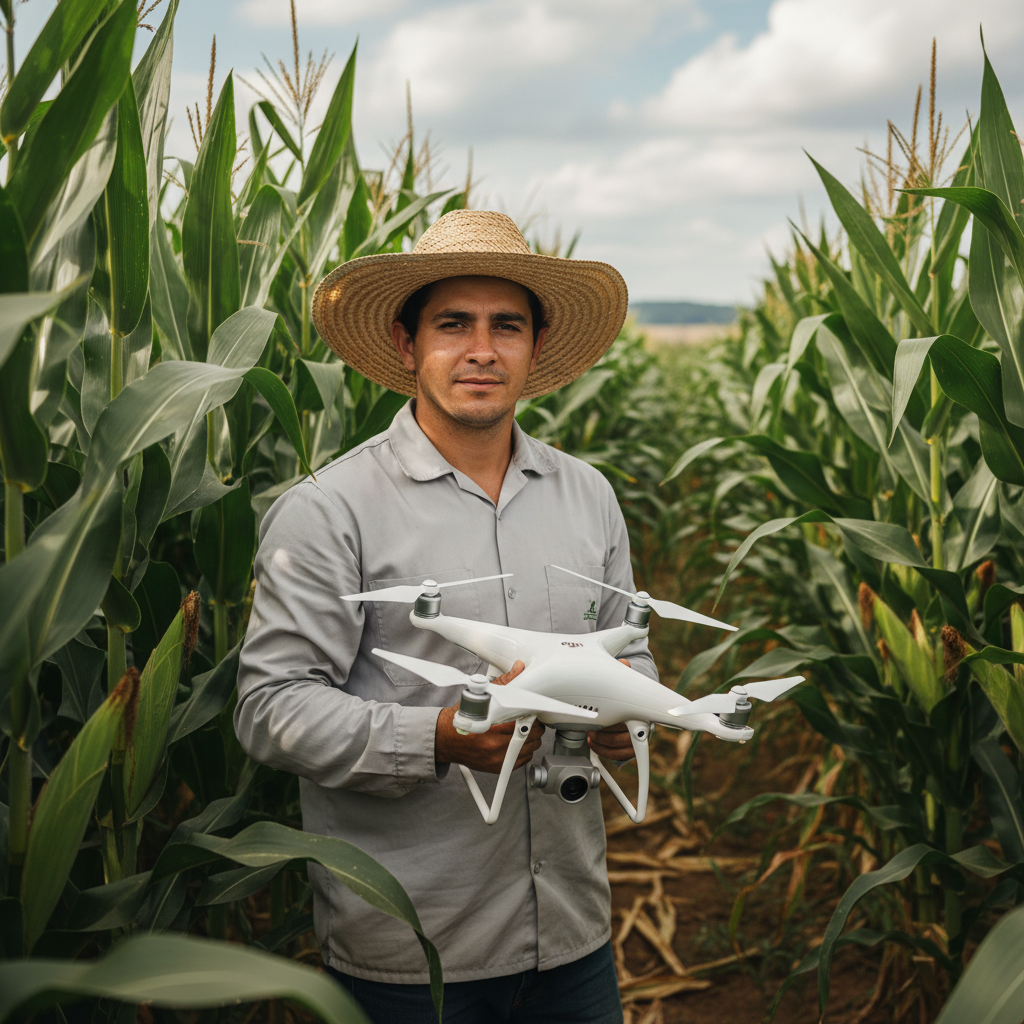
Lucas Fernandes Silva is an agricultural engineer with 12 years of experience in aerial mapping technologies and precision agriculture. ANAC-certified drone pilot since 2018, Lucas has worked on mapping projects across more than 500 rural properties in Brazil, covering areas ranging from small farms to large-scale operations. Specialized in multispectral image processing, vegetation index analysis (NDVI, GNDVI, SAVI), and precision agriculture system implementation. Lucas is passionate about sharing technical knowledge and helping agribusiness professionals optimize their operations through aerial technology.