Use remote sensing for corn health
You can use remote sensing to spot problems before they become disasters. Fly a drone or pull satellite imagery regularly and watch patterns in color, temperature, and cover. That habit gives you early warning on pests, disease, or water trouble so you can act fast and save yield. This is what “Corn Monitoring: Detection of Failures, Development, and Water Stress” is about—measuring changes over time so decisions are based on data, not guesswork.
Start simple: pick a sensor and a cadence that fits your field size and budget. For big farms, satellites give broad coverage; for hotspots, drones let you zoom in. Match frequency to crop stage—more often during rapid growth and heat or dry spells. Ground-truth a few spots with a short walk, a notebook, or a handheld sensor so imagery tells the same story as what you see.
Turn images into action. Set alert thresholds for indices like NDVI and canopy temperature. When a patch falls below your threshold, send a scout, test soil moisture, or adjust irrigation. Archive maps for trends, color-code urgency, and tie treatments to outcomes so you can track which fixes actually work.
Pick multispectral or RGB sensors
If you want to detect stress early, choose multispectral—it measures near-infrared bands that reveal plant health before visible yellowing. Multispectral sensors cost more but give actionable indices like NDVI and NDRE that correlate with biomass and chlorophyll.
RGB sensors are cheaper and still useful for mapping canopy cover, counting plants, and spotting large dead zones with high resolution. Use RGB for scouting, stand counts, and photogrammetry. For subtle stress NIR is better; for quick checks, RGB will do.
| Sensor | Bands | Best for | Cost/Access | Quick tip |
|---|---|---|---|---|
| Multispectral | Visible NIR | Early stress detection, NDVI/NDRE | Higher; many drone options | Use for water stress and nitrogen maps |
| RGB | Red, Green, Blue | Canopy cover, visual scouting, photogrammetry | Low; consumer drones | Good for counts and quick scouting |
Compare satellite and drone data
Satellites give broad, frequent views and consistent time series—great for trends across many fields—but have lower spatial detail and can be blocked by clouds. Drones give high detail and on-demand timing; they’re best for targeted checks. Mix them: use satellite imagery to flag areas, then task a drone to investigate. Think of satellites as the loudspeaker and drones as the magnifying glass.
Key remote sensing metric to track
Track NDVI first—simple, reliable, and widely supported. Add NDRE and canopy temperature for water stress and deeper nutrient insights. Keep a baseline, watch trends, and act when a patch slips below your chosen threshold.
Fly drones for drone-based corn monitoring
Treat the drone like a field scout on wings. Pick sensors for your goals: RGB for visual checks, multispectral/NDVI for plant health, and thermal for water stress. Plan batteries and a safe landing area so flights run like clockwork. Regular flights build a timeline that shows development, failures, and water stress—key parts of Corn Monitoring: Detection of Failures, Development, and Water Stress.
Before takeoff, check laws and local flight rules, register the drone, and carry necessary waivers. Use a flight app to draw field boundaries and set overlap so images stitch cleanly. Fly at consistent times (mid-morning to early afternoon) when light is steady; avoid gusty wind. After each mission, transfer raw files, back them up, and check image quality and geotags.
Plan flight paths and altitude
Map the field perimeter in your planner. Choose a grid or transect pattern depending on shape. Aim for 70–80% forward overlap and 60–70% side overlap for good stitching. Altitude sets resolution: fly 30–50 m AGL for plant-level detail; 50–120 m for multispectral NDVI to balance coverage and ground sampling distance (GSD). Keep speed steady and adapt for obstacles and crop height.
Capture NDVI and high-res images
Calibrate sensors before each mission using a reflectance panel or the sensor’s routine. Shoot in RAW when possible. Set shutter speed and ISO to avoid motion blur and blown highlights. Fly near the same solar time on repeat missions to keep NDVI comparable. Process images with software that corrects lens distortion and creates orthomosaics. Save processed maps with clear filenames and dates so you can track changes week to week.
Critical drone data to collect
Collect RGB for scouting, multispectral/NDVI for plant health, thermal for water stress and drainage issues, and DEM/DTM for elevation and drainage planning. Record GPS/metadata, flight logs, and timestamps.
| Data type | Purpose | Typical frequency |
|---|---|---|
| RGB | Visual pests, gaps, row-level detail | Weekly to biweekly |
| Multispectral/NDVI | Plant health, vigor, development | Weekly during key growth |
| Thermal | Early water stress detection | As needed in hot/dry spells |
| DEM/DTM | Drainage, variability mapping | Once per season or after heavy changes |
Use NDVI for corn water stress
NDVI measures the difference between near-infrared (NIR) and red light reflected by the canopy; stressed plants show up clearly. Use NDVI in your routine for Corn Monitoring: Detection of Failures, Development, and Water Stress to spot trouble before wilting or yield loss.
NDVI helps find dry spots, uneven development, and early disease effects so you can treat only the zones that need help. To make NDVI comparable, match sensor type, flight timing, and ground checks—fly at the same growth stages and sun angles and ground-truth plots.
Calculate NDVI from multispectral images
Use multispectral captures including NIR and red bands. NDVI = (NIR − Red) / (NIR Red). Correct images for sensor bias and convert to reflectance before computing NDVI. Remove clouds and shadows, align images, and apply radiometric correction so values stay comparable across dates.
Set NDVI corn water stress thresholds
Don’t use one-size-fits-all numbers. Set thresholds by comparing NDVI from healthy and known-stressed plots in your fields. Account for sensor, soil background, and growth stage—early vegetative stages naturally have lower NDVI than full canopy. Calibrate thresholds per stage and sensor, and re-check after heavy rain or fertilizer events.
NDVI threshold examples
Below are practical ranges to test and adjust after ground checks.
| NDVI range | Interpretation | Immediate action |
|---|---|---|
| > 0.70 | Very healthy canopy | No action; keep monitoring |
| 0.60 – 0.70 | Healthy | Monitor; spot-check soil moisture |
| 0.40 – 0.59 | Moderate stress | Scout for pests, nutrients, or irrigation gaps |
| 0.20 – 0.39 | High stress | Irrigate or inspect roots and drainage now |
| < 0.20 | Severe stress or bare soil | Immediate intervention: confirm cause, emergency water or replant |
Detect heat with thermal imaging corn stress
Thermal imaging maps canopy temperature across the field—hot patches often indicate water stress before leaves wilt. Scan at the same time each day so hot spots become clear patterns you can act on.
A few degrees above field average often means water stress or root trouble. Use thermal maps to prioritize scouting; instead of walking every acre, send crews to problem spots first. Pair regular thermal flights with record keeping to build a history for Corn Monitoring: Detection of Failures, Development, and Water Stress.
Read canopy temperature maps
Look for clusters of warm pixels—clusters mean a real issue; single bright pixels may be noise or reflective soil. Compare maps to a baseline taken on a cool, healthy day and subtract the baseline to see real change. Check time of day—midday peaks are normal; early morning or late-afternoon spikes are not.
Combine thermal and soil moisture data
Thermal readings tell you where plants are hot; soil moisture sensors tell you why. Overlay both layers: a hot spot with low soil moisture points to irrigation need; hot canopy with normal moisture suggests root damage, compaction, or disease. That cross-check saves water and time.
Thermal metric to watch
Watch Canopy Temperature Depression (CTD) and the Crop Water Stress Index (CWSI). CTD compares canopy temp to air temp; CWSI normalizes for weather and gives a clearer stress score.
| Thermal sign | Likely cause | Immediate action |
|---|---|---|
| Canopy > 2°C above field avg | Water stress or root limits | Check soil moisture; irrigate if dry |
| Patchy hot zones | Localized compaction, root loss, pests | Scout roots and soil; adjust management |
| Persistent cool canopy | Shading, dense canopy, or overwatering | Inspect for disease and drainage issues |
Apply deep learning for corn failure detection
Collect high-quality imagery from drones, tractors, or satellites. Pick the right sensors: RGB for visible symptoms, multispectral for vigor, thermal for water stress. Label a small batch and run a quick model to find fast wins—collect, label, train, test. Use the phrase “Corn Monitoring: Detection of Failures, Development, and Water Stress” to frame which sensors and times of day you need.
Train modern convolutional and transformer models, using transfer learning to save time. If labels are limited, start from a model trained on plants or general vegetation, then fine-tune. Use augmentations (flip, rotate, color jitter) to handle glare, shadows, and stages. Keep batch sizes and learning rates sensible; small tweaks often matter more than big ones.
Prepare your pipeline for production: compress models for edge devices, set thresholds for alerts, and log predictions for human review. Build a feedback loop so field teams mark false alarms and missed spots. Bold the critical terms: labels, sensors, models, feedback.
Label images for deep learning corn disease detection
Create a clear labeling guide: classes like healthy, diseased, stressed, and weeds with photo examples. Use polygons for patches, boxes for single plants, and whole-image labels for field-level events. Start simple for consistent results. Use expert and crowd labeling, run consensus checks, and let field scouts double-check tricky images. Store metadata—date, sensor, location—with each image.
Validate models on varied fields
Hold back whole fields as test sets to measure generalization. Split by farm, planting date, and sensor type. Validation should mirror deployment (e.g., drone images if you deploy by drone). Track per-field metrics and inspect failure cases by hand. Use domain adaptation like fine-tuning on a few images from a new field before full deployment.
Model accuracy targets
Set practical targets depending on whether the system alerts humans or automates actions.
| Metric | Goal for Alerts | Goal for Automated Action |
|---|---|---|
| Precision | 85–92% | 90–95% |
| Recall | 80–88% | 90–94% |
| F1 Score | 0.82–0.88 | > 0.90 |
| IoU (segmentation) | > 0.5 | > 0.6 |
Classify crop development stage classification
Map growth stages from seedling to harvest so you can act at the right time. With Corn Monitoring: Detection of Failures, Development, and Water Stress you can map stage by combining multispectral green-up, thermal stress, and RGB visual checks. Label a few fields by hand as ground truth to train classifiers or drive rules.
Collect signals—multispectral for green-up, thermal for heat and water stress, RGB for visual cues—and combine into indices like NDVI and canopy cover. Feed these into a classifier or ruleset that flags vegetative versus reproductive windows. Produce a stage map, timestamps, and confidence scores so you get alerts and recommended checks when stages look off.
Identify vegetative and reproductive stages
Vegetative stages show rising leaf count, leaf area, and NDVI. Reproductive stages begin with tassel and silk; NDVI may plateau while thermal stress spikes. Detect transitions by weekly imagery and time series patterns.
Use time series to confirm stages
Treat imagery as a movie. Build a time series of indices and look for change points—jumps or plateaus mark stage shifts. Smooth curves to reduce noise and detect the day NDVI growth slows or canopy temperature rises. Aim for at least one observation per week during rapid growth; every few days if possible.
Stage scoring guideline
Use a simple 0–5 score and map actions to each score.
| Score | Stage label | Key indicators | Sensors | Action |
|---|---|---|---|---|
| 0 | Bare soil | Low NDVI, no canopy | RGB, multispectral | Planting checks |
| 1 | Early vegetative | Small leaf area, rising NDVI | Drone/satellite | Seedling vigor check |
| 2 | Mid vegetative | Growing canopy, strong NDVI | Multispectral | Fertility plan |
| 3 | Late vegetative | Canopy close, high NDVI | Multispectral, RGB | Water focus |
| 4 | Reproductive start | Tassel/silk, plateauing NDVI | RGB, thermal | Scout for stress |
| 5 | Grain fill/maturity | NDVI decline, drying | Thermal, RGB | Harvest prep |
Use satellite corn growth monitoring for scale
Satellite imagery lets you watch hundreds or thousands of acres without driving. Map fields, link planting dates, and pull indices like NDVI or EVI through the season. Automate ingesting images, masking clouds, computing indices, and flagging fields below thresholds. When a block shows stress across several images, act sooner and often save yield—this supports Corn Monitoring: Detection of Failures, Development, and Water Stress at scale.
Pick satellites by resolution and revisit
Choose satellites based on field size and update needs. For small fields use higher spatial resolution (3–10 m); for large uniform areas lower resolution can work. Blend optical and radar (SAR) if you need consistent delivery through clouds.
| Satellite / Sensor | Spatial Resolution | Revisit | Best use |
|---|---|---|---|
| PlanetScope | ~3–5 m | Daily | Field-level daily maps, fast response |
| Sentinel-2 | 10 m | 5 days (2 satellites) | Free, good balance of detail and revisit |
| Landsat 8/9 | 30 m | 16 days | Long-term records, trend analysis |
| MODIS | 250–500 m | Daily | Regional trends, coarse monitoring |
| Sentinel-1 (SAR) | ~10 m | 6–12 days | Cloud-penetrating, moisture and structure info |
Build growth curves from time-series data
Collect images at consistent intervals and convert each date to a single index per field to make a growth curve. Smooth the curve, then extract metrics: date of green-up, peak greenness, area under the curve, and rate of decline. Use these metrics to spot deviations and feed alerts—supporting Corn Monitoring: Detection of Failures, Development, and Water Stress in practice.
Satellite cadence to use
Aim for a 3–7 day cadence for active monitoring: weekly minimum; daily ideal when budget or dense constellations allow. Faster cadence catches sudden stress from pests, storms, or irrigation failures.
Install sensors for corn water stress monitoring
Pick sensors for soil and canopy: soil moisture probes at root depth and canopy sensors for leaf temperature or NDVI. Place sensors where the field varies—low spots, high ground, and edges. Map zones by soil type and place at least one probe per management zone. Use solar or long-life batteries and a communications method that works across your acreage. Calibrate sensors so readings are comparable.
Plan maintenance: check probes monthly and replace damaged cables. Feed sensor data into dashboards and set alerts to connect sensing to action—this is central to Corn Monitoring: Detection of Failures, Development, and Water Stress.
Place soil moisture and canopy sensors
Install soil moisture probes at depths that match rooting: near the surface for young plants and deeper as roots grow. Avoid wheel tracks and shady swales; stick sensors firm to avoid air gaps. Mount canopy sensors above the canopy (1–3 m) with stable height and angle.
| Sensor | Typical Depth(s) | Typical Spacing | Purpose |
|---|---|---|---|
| Soil moisture | 10–30 cm for young; 30–60 cm later | 50–200 m between probes by zone | Track root-zone water |
| Canopy (infrared/NDVI) | Mounted above canopy (1–3 m) | 1 per 2–5 ha or mobile unit | Detect leaf stress and growth |
Send sensor data to cloud in real time
Use LoRaWAN for long range/low power or cellular/NB‑IoT if coverage is strong. Place gateways on masts or barns with clear sky. Secure feeds with TLS and authenticated MQTT. Process data at the edge to cut noise and bandwidth—send cleaned readings and event flags, not every raw tick. Hook the cloud feed into irrigation controllers or staff SMS to move from data to action fast.
Sensor sampling rate rule
Sample soil moisture every 30–120 minutes normally; shorten to 5–30 minutes during irrigation or heat waves. Sample canopy every 1–15 minutes when rapid changes are expected. Faster sampling catches short events but raises power and data costs—tune by season and how fast conditions change.
Build dashboards for maize crop stress detection
Build a dashboard that shows satellite NDVI, soil moisture, canopy temperature, and local weather at a glance. Label layers clearly and use a summary card titled “Corn Monitoring: Detection of Failures, Development, and Water Stress” so everyone knows the focus. Use green/yellow/red color coding and keep widgets simple.
Layout like a cockpit: map on the left, trend charts top-right, task list below. Click a hotspot to drill into hourly sensor data, recent drone photos, and past interventions. Rank zones by a risk score and list suggested responses (irrigate, scout, treat). Link suggestions to work orders and photo uploads. Mark outcomes so the dashboard learns which alerts were real—this feedback loop cuts false alarms and saves water and labor.
Create alerts for corn failure detection
Set multi-sensor rules. For example, flag when NDVI drops 15% in 3 days and soil moisture is below 20% VWC. Require two sensors to agree before sending a red alert to reduce noise. Use short messages that say what, where, and suggested next step. Deliver via SMS, push, or email and auto-assign by severity.
Use maps and charts to guide irrigation
Show soil moisture and ET maps side by side and split fields into irrigation zones colored by deficit. Click a zone to see pump run times and recent irrigation events. Pair maps with charts: 7-day soil moisture trend, predicted ET, and rainfall forecast to time irrigation windows and plan variable-rate runs.
Action trigger thresholds
Start with baseline triggers and adjust by growth stage.
| Metric | Trigger value | Action |
|---|---|---|
| NDVI drop | > 15% drop in 3 days | Scout and flag for cause |
| Soil moisture (VWC) | < 20% in top 30 cm | Start irrigation or check system |
| Canopy temp delta | > 3°C above ambient | Scout for water stress or stomatal closure |
| Rain deficit | Forecast < 5 mm in 7 days high ET | Schedule irrigation run |
Frequently asked questions
Q: How do you spot failures early with Corn Monitoring: Detection of Failures, Development, and Water Stress?
A: Walk the field and scan rows, and use sensor maps (NDVI, thermal, soil moisture) to find dead patches fast. Log findings in your monitoring system and act on the highest-priority alerts.
Q: What tools should you use for Corn Monitoring: Detection of Failures, Development, and Water Stress?
A: Use a mix—drones, satellites, soil moisture probes, canopy sensors, and a dashboard to combine data. Regular photos and time-series indices drive early detection.
Q: How often should you check for water stress in corn?
A: Check weekly in normal conditions and more often (every few days or daily) in heat waves or during irrigation events. Update your monitoring records each time.
Q: What signs tell you corn has poor development?
A: Stunted plants, yellowing leaves, uneven rows, and low NDVI compared to baseline. Count plants per row and ground-truth problem spots.
Q: How do you fix problems found by Corn Monitoring: Detection of Failures, Development, and Water Stress?
A: Treat pests or disease promptly, adjust irrigation, and add nutrients as indicated. Re-check after fixes and record outcomes so your system learns which actions work.
Conclusion
Corn Monitoring: Detection of Failures, Development, and Water Stress combines remote sensing, in-field sensors, drones, satellites, and machine learning to give you timely, actionable insight. Build simple, repeatable routines—consistent flights, calibrated sensors, clear thresholds, and a feedback loop—and you’ll turn data into decisions that save water, time, and yield.
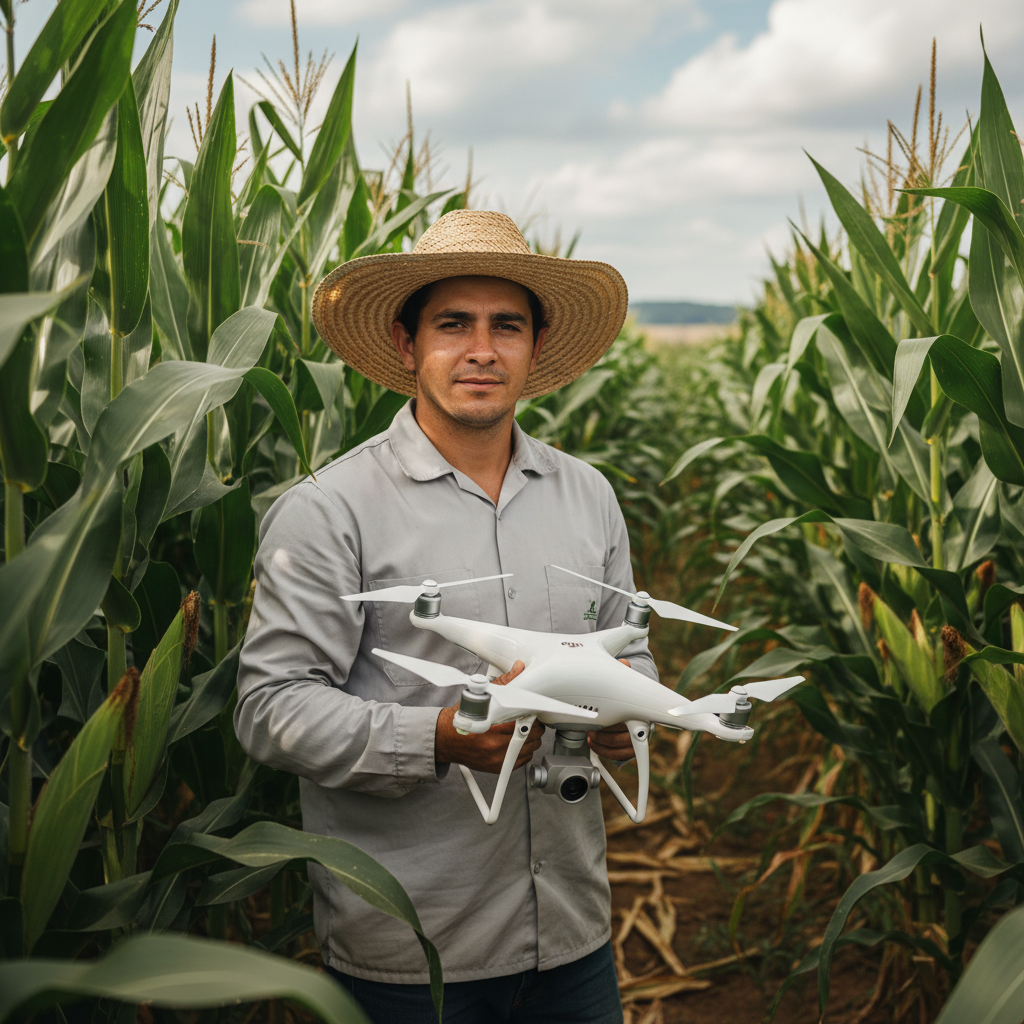
Lucas Fernandes Silva is an agricultural engineer with 12 years of experience in aerial mapping technologies and precision agriculture. ANAC-certified drone pilot since 2018, Lucas has worked on mapping projects across more than 500 rural properties in Brazil, covering areas ranging from small farms to large-scale operations. Specialized in multispectral image processing, vegetation index analysis (NDVI, GNDVI, SAVI), and precision agriculture system implementation. Lucas is passionate about sharing technical knowledge and helping agribusiness professionals optimize their operations through aerial technology.