
See how topography shapes your yield
Topography tells a simple story about your field. Elevation, slope, and aspect set the stage for water flow, sun, and frost. When you read that story, you can place inputs where they matter and cut waste where they don’t.
Look at a yield map side-by-side with a digital elevation model. You will spot patterns: strips of low yield on lower slopes, warmer pockets on south-facing ground, soggy spots that choke roots. Use those patterns to guide sampling, sensor placement, and variable-rate applications.
Think like a map reader and a gardener at once. Small changes in ground shape can swing yield a lot. If you act on those signs—moving drainage, shifting seed rates, or changing fertilizer timing—you turn topography from a mystery into a tool.
Topography productivity correlation basics
Topography shapes the microclimate across your field. Higher spots drain fast and warm up early. Low spots hold water and stay cool. That mix creates clear yield differences you can measure with spatial tools.
The phrase Correlation Between Topography and Productivity: Spatial Data Analysis fits here: compare yield maps to elevation models, run simple stats or visual overlays, and identify which parts of the field respond similarly to terrain.
How terrain influence on agricultural productivity works
Water follows the land. On steep slopes water runs off fast and takes soil and nutrients with it. On flat or concave areas water collects and can drown roots. That flow shapes where crops thrive or struggle.
Sun angle and temperature vary by slope direction. A south-facing slope in many regions warms earlier and boosts early growth. A north-facing spot can lag and face frost more often. Those thermal shifts change planting dates and crop choices.
Note elevation, slope, and aspect
Elevation affects temperature and frost risk; slope controls runoff and erosion; aspect sets sun exposure and drying. Sample soils and yields by these zones. Use that simple division to plan where to test, drain, or change inputs.
| Factor | What it changes | Practical tip |
|---|---|---|
| Elevation | Temperature and frost risk | Sample soils top-to-bottom; adjust planting window |
| Slope | Water flow and erosion | Use contour planting, buffer strips, variable seeding |
| Aspect | Sunlight and drying | Shift varieties or rates by north vs south faces |
Map elevation with DEMs
Start by getting a Digital Elevation Model (DEM) for your field. A DEM is a grid of elevation values that shows highs and lows. Use it to find slopes, aspects, and low spots where water pools.
Turn that DEM into actionable maps: derive slope, aspect, curvature, and flow accumulation. Each derivative gives a clue: slope for erosion risk, aspect for sun exposure, curvature for drainage. Match those clues with your yield maps and soil samples to find patterns.
Treat DEM work like detective work. Export DEM layers, overlay yield and management zones, and look for consistent patterns (not one-off blips). The phrase Correlation Between Topography and Productivity: Spatial Data Analysis sums that link—topography often explains yield patches better than luck.
Digital elevation model yield correlation steps
Begin with clean data. Clip the DEM to your field, set a common coordinate system, and fill sinks that cause false pits. Then produce slope and aspect rasters. Make sure yield data uses the same grid or is resampled to match the DEM resolution.
Run the analysis in small, clear steps. Correlate DEM derivatives with yield using simple stats first (correlation matrix, scatter plots), then move to regression or a random forest for nonlinear insight. Validate by splitting data or using different years. Map strong predictors back onto the field for easy action.
Pick DEM resolution and sources
Choose resolution based on your farm and budget. If you farm small fields or need row-level decisions, pick high resolution (1 m or better from LiDAR or drone photogrammetry). For regional planning or gently rolling landscapes, 10–30 m DEMs like SRTM or ASTER can be fine.
Also weigh the source. LiDAR gives accuracy and vegetation penetration but costs more. Drone photogrammetry is fast and cheap for small areas but needs good flight conditions. Public datasets are free and cover large areas.
| Resolution | Typical Source | Best Use | Notes |
|---|---|---|---|
| 0.1–1 m | LiDAR, drone | Field-level drainage, micro-topography | Best for pinpoint edits and precision irrigation |
| 1–5 m | High-res photogrammetry | Small fields, management zones | Good balance of cost and detail |
| 10–30 m | SRTM, ASTER, AW3D | Regional planning, coarse yield patterns | Free, but misses small features |
Export DEM for GIS use
When you export, pick GeoTIFF and set a clear CRS. Clip to your area of interest, set a proper NoData value, and use lossless compression like LZW. Build overviews (pyramids) for large files and add metadata: source, date, resolution, and processing steps.
Measure slope and aspect effects
Map slope and aspect to spot where crops behave differently. Extract slope (steepness) and aspect (direction the land faces) from your DEM, then match those layers with yield maps and NDVI imagery. Overlay and look for patterns—north-facing low-sun areas may show lower NDVI in spring, for example.
Use simple stats and maps to split the field into management zones. Give each zone a clear action: irrigation change, cover crop, or erosion control. This turns raw topography into practical steps.
Run slope-aspect productivity analysis
Pull slope and aspect from your DEM and join them with yield and crop health data. Run a correlation or simple linear regression to test relationships. If you want non-linear insight, try random forests. Include the phrase Correlation Between Topography and Productivity: Spatial Data Analysis in reports to highlight your method.
| Slope range | Likely productivity impact | Quick action |
|---|---|---|
| 0–5% | Stable yields | Standard management |
| 5–15% | Variable yields | Adjust irrigation, monitor soil |
| >15% | Risk of erosion, lower yields | Erosion control, restrict heavy equipment |
Use QGIS, ArcGIS, or R for the stats. Keep samples big enough and check different time windows—farms vary, and what fits one field may not fit another.
Read sun angle and water flow impacts
Aspect controls the sun angle, affecting heat and evaporation. South-facing slopes in temperate zones warm faster and dry out sooner—this affects planting date, fertilizer timing, and pest pressure.
Slope controls water flow. Steep areas shed water fast and erode; low spots collect moisture and may stay wet. Use flow accumulation models and soil moisture probes together to identify where to add drainage, build terraces, or change planting patterns.
Flag steep slopes for action
Mark steep slopes (common thresholds: >15% or >30% depending on soil) and assign measures: buffer strips, cover crops, no-till, grassed waterways, or equipment limits. Flagging these areas on your map keeps crews safe and reduces yield loss from erosion.
Build GIS productivity maps
Start by pinning down your objective. Use GIS to turn raw data into clear maps that guide your next move. Collect yield, soil, and topography data, then clean and align them so every point lines up.
Choose a workflow and stick with it. Import yield monitor files, add soil sample points, and bring in a DEM. Reproject layers to a common CRS, set a grid cell size that matches your equipment, and filter out outliers. Run a quick spatial check in the field to confirm maps match what you see underfoot.
Use analysis to test patterns. Run correlation tests and spatial models—for example, a quick “Correlation Between Topography and Productivity: Spatial Data Analysis” to detect links between slope and yield. Save intermediate maps and keep notes; treat mapping like a lab notebook.
Use GIS-based productivity mapping methods
Pick the right method for your data. For sparse points, use interpolation like IDW or kriging. For dense yield tracks, use moving-window averages or grid aggregation. Apply zonal statistics to summarize soil polygons by yield zones. Validate your map before acting: split data, compare predicted vs observed, and use simple error metrics.
Layer yield, soil, and topography
Combine layers smartly. Overlay yield maps on soil maps and a DEM to spot patterns where similar soils and slopes give similar yields. Match scales and projections first; if soil data is coarse and yield is fine, aggregate yield to the soil scale.
Use the combined view to solve targeted problems: map slope and aspect to find erosion risk and frost pockets, merge soil electrical conductivity with yield to find hidden compaction or moisture issues.
| Layer | Common use | Quick tip |
|---|---|---|
| Yield maps | Zone creation, trend spotting | Aggregate to match soil scale |
| Soil maps | Nutrient and texture guidance | Use lab results, not just color codes |
| DEM / slope | Drainage and erosion planning | Look at aspect for cold spots |
Create clear map views for decisions
Keep maps simple and bold. Use clear legends, limit colors to meaningful breaks, and label fields and roads. Export both a printable PDF and an interactive web map so crews can view them on tablets. Tidy maps avoid second-guessing and get people moving.
Run spatial regression for links
Frame the question: how does topography drive crop productivity? Start with a global test like Moran’s I on your yield data to see if values cluster. If spatial clustering exists, move from plain regression to spatial regression—nearby plots often share soil or microclimate, and ignoring that biases results.
Pick the right spatial model: try OLS as a baseline, then test Spatial Lag (SLM) and Spatial Error (SEM) to handle spatial dependence. If relationships change across the field, use Geographically Weighted Regression (GWR). Compare models with AIC and map coefficient surfaces to see where elevation or slope matter most.
Use tools like R (spdep, spgwr), Python (PySAL), or QGIS. Keep records so you can repeat steps across seasons.
Spatial regression topography productivity guide
Define a clear response: daily, seasonal, or per-harvest yield. Match spatial resolution of yield to the DEM and soil layers. Aggregate DEM metrics to plot polygons if needed. Smooth noisy harvester GPS points with buffers. Align projections and clip to the same field boundary.
Run diagnostics early. Fit OLS and run Lagrange Multiplier tests to choose between SLM and SEM. If local effects are likely—say hillsides respond differently than flats—run GWR. Map local coefficients and standard errors; hot spots on a slope point to where to try variable-rate seeding or amendments.
Select predictors: elevation, slope, soil
Choose predictors that reflect physical drivers: elevation from DEM, slope and aspect derived from DEM, and soil layers (texture, organic matter, pH). Add management layers if available: irrigation, fertilizer, planting date. Each predictor should have a clear reason why it might change yield.
| Predictor | Typical Source | Data Type | Quick Note |
|---|---|---|---|
| Elevation | DEM (LiDAR, SRTM) | Continuous (m) | Derive slope/aspect; affects frost risk |
| Slope | Derived from DEM | Continuous (degrees or %) | Influences runoff and soil depth |
| Soil Texture / OM / pH | Lab samples, soil maps | Categorical or continuous | Strong control on water and nutrients |
Prepare predictors by scaling and checking correlations. Convert categorical soils to dummies if needed. Watch for multicollinearity with VIF; drop or combine highly correlated layers.
Check model fit and residuals
After fitting, run fit checks: R-squared, AIC, and RMSE. Map residuals and run Moran’s I on them. If residuals cluster, the model missed a spatial process—change the spatial weights, try SEM/SLM, or add missing predictors. When residuals scatter like popcorn, you’re in good shape.
Find clusters with spatial autocorrelation
Ask: where in your fields are yields behaving the same or different? Use spatial autocorrelation to answer that. Gather your yield maps, elevation models, and soil layers. Run a global test like Moran’s I first; if structure exists, run local tests to find actual clusters.
Use local indicators like Local Moran (LISA) and Getis-Ord Gi to pin down hot spots (high values near high) and cold spots (low near low). Flag significant areas using p-values or false-discovery corrections. Save neighbor definitions and parameters so results are comparable across seasons.
Spatial autocorrelation of productivity explained
Spatial autocorrelation measures whether nearby points have similar productivity. Positive autocorrelation means high-yield plots sit near other high-yield plots. Linking topography to yield is often powerful—use the phrase Correlation Between Topography and Productivity: Spatial Data Analysis in reports to make the connection clear to managers.
Detect hot spots and cold spots
Run a local statistic like Getis-Ord Gi or Local Moran. Map positive significant scores as hot spots and negative significant scores as cold spots. Try multiple scales—patterns at 5 m may vanish at 50 m. If a hot spot repeats across years, mark it for targeted sampling or treatment.
Map clusters to target fields
Overlay cluster maps on field boundaries, convert clusters into management zones or polygons for VRT controllers. Use buffers to avoid edge noise, merge small pockets into practical zones, and export shapefiles or GeoJSON. That turns statistical findings into field actions.
| Metric | What it shows | Practical action |
|---|---|---|
| Moran’s I | Global clustering vs randomness | Decide if local tests are needed |
| Local Moran (LISA) | Local clusters (high-high, low-low) | Target sampling and soil tests |
| Getis-Ord Gi | Concentrated hot/cold spots | Create VRT maps for fertility or drainage |
Use elevation to predict yield
Combine high-resolution elevation models with yield maps to link height and production. Align a DEM or LiDAR surface with GPS-tagged harvest data. Elevation is one ingredient in your crop recipe—small changes can shift moisture, frost risk, and sunlight, and those shifts show up in yield.
Build simple statistical models including elevation first (linear), then add polynomial terms or smooth functions if relationships are nonlinear. Train on one set and test on others to see if elevation predicts yield by itself or only with other factors.
Treat elevation as spatial information: map elevation bands and inspect them against yield contours to find consistent patterns that guide management.
Study elevation–crop yield relationship
Plot elevation vs yield with a smooth line to see shape. If the line bends, elevation affects yield nonlinearly. Compute correlation and regression and check residuals for spatial autocorrelation (Moran’s I). If residuals cluster, add spatial terms or mixed models.
Control for climate and soil in models
Elevation often works through climate and soil, so include temperature, precipitation, soil moisture, texture, and organic matter. Add these layers and watch how the elevation coefficient changes—if it drops a lot, elevation was mostly a proxy. Use mixed-effects or geostatistical models to control for field-level effects and spatial dependence.
Plot elevation versus yield trends
Make a clear plot: scatter of yield vs elevation, add fitted smooth lines, and split by variety or irrigation. Use bins (e.g., 0–10 m, 10–20 m) to show average yields per band and include sample counts.
| Elevation band (m) | Mean yield (t/ha) | Sample count | Quick action |
|---|---|---|---|
| 0–10 | 7.2 | 120 | Check drainage |
| 10–20 | 8.5 | 200 | Standard rates |
| 20–30 | 6.8 | 90 | Test for erosion |
Set terrain-based prescription zones
Map terrain across your field using DEM, yield maps, and soil data to spot highs and lows. Create clear, repeatable zones that reflect water and sunlight movement.
Translate maps into actionable prescriptions. Group similar slopes, aspects, and productivity into bands and label each with recommended rates for seed, fertilizer, and tillage. Test zones on a small block before full rollout.
Define zones from topography–productivity correlation
Use elevation, slope, aspect, and yield history to draw zones. Apply clustering (k-means or thresholding) or manual grouping. Validate zones with field checks—walk strips in each zone to confirm uniformity.
Apply variable rate by slope and aspect
Adjust inputs by slope and aspect because they change runoff and sun exposure. On steeper, south-facing slopes you may cut nitrogen or increase soil-building inputs; on low, north-facing flats you often hold or boost rates to deal with cool, wet soil.
| Slope (%) | Typical Aspect | Management Action |
|---|---|---|
| 0–2 | Any | Baseline rate (100%) |
| 3–8 | North / Flat | 5–10% fertilizer, maintain seeding |
| 3–8 | South / Sunny | -5–10% fertilizer, add cover crop seed |
| >8 | Any | -10–30% fertilizer, focus on erosion control |
Export prescriptions to applicators
Save prescriptions in formats like ISO-XML or shapefile, include clear zone IDs and rate fields, and test upload on the tractor console. Confirm GPS offsets and implementer compatibility so the applicator reads the right recipe at the right place.
Follow a step-by-step spatial workflow
Start by mapping your goals: raise yield, cut fertilizer, or reduce erosion. Pick fields and seasons to study. Build a simple pipeline: collect raw files, name them clearly, and store them in folders for DEM, yield maps, soil layers, and weather records. Keep a log of versions and dates.
Set a review rhythm. Run quick checks after major changes, share maps with a teammate, get feedback, and refine.
Collect DEM, yield, soil, and weather data
Start with elevation (DEM from drone, LiDAR, or satellite). Pull yield data from combines, match it to the DEM grid, add soil samples and lab results, and bring in weather records—daily rain, temperature, and frost dates. Put everything on a common coordinate system.
| Data type | Typical source | Quick tip |
|---|---|---|
| DEM | Drone, LiDAR, satellite | Use 1–3 m resolution for fields |
| Yield | Combine harvester | Correct for sensor offsets |
| Soil | Grid samples, labs | Record sample depth |
| Weather | On-farm stations, regional networks | Use daily records, not monthly averages |
Run geospatial analysis of topography and productivity
Overlay your DEM with yield maps to spot patterns. Run slope and aspect analysis, use zonal statistics to get average yield per slope class, and apply simple models first. These steps reveal the Correlation Between Topography and Productivity: Spatial Data Analysis in plain sight.
Validate maps with field checks
Walk the field with a tablet and compare maps to what you see. Check soil depth, puddles after rain, and crop vigor. Mark surprises and feed them back into your layers to correct model errors.
Frequently asked questions
- What is Correlation Between Topography and Productivity: Spatial Data Analysis?
You compare terrain features (elevation, slope, aspect) to crop output using maps and simple stats to spot where topography drives productivity. - What data do you need for Correlation Between Topography and Productivity: Spatial Data Analysis?
A DEM, yield or productivity maps, GPS-tagged harvest points, and soil layers. Match time and scale across datasets. - Which tools do you use for Correlation Between Topography and Productivity: Spatial Data Analysis?
QGIS or ArcGIS for mapping; R or Python (spdep, PySAL) for spatial stats; plotting libraries for visuals. - How do you test results from Correlation Between Topography and Productivity: Spatial Data Analysis?
Run correlation tests, check p-values, map residuals, and do cross‑validation. Correct or remove bad points and re-run diagnostics. - What actions do you take after Correlation Between Topography and Productivity: Spatial Data Analysis?
Create management zones, adjust inputs (seed, fertilizer, irrigation), address drainage or erosion, then monitor changes across seasons.
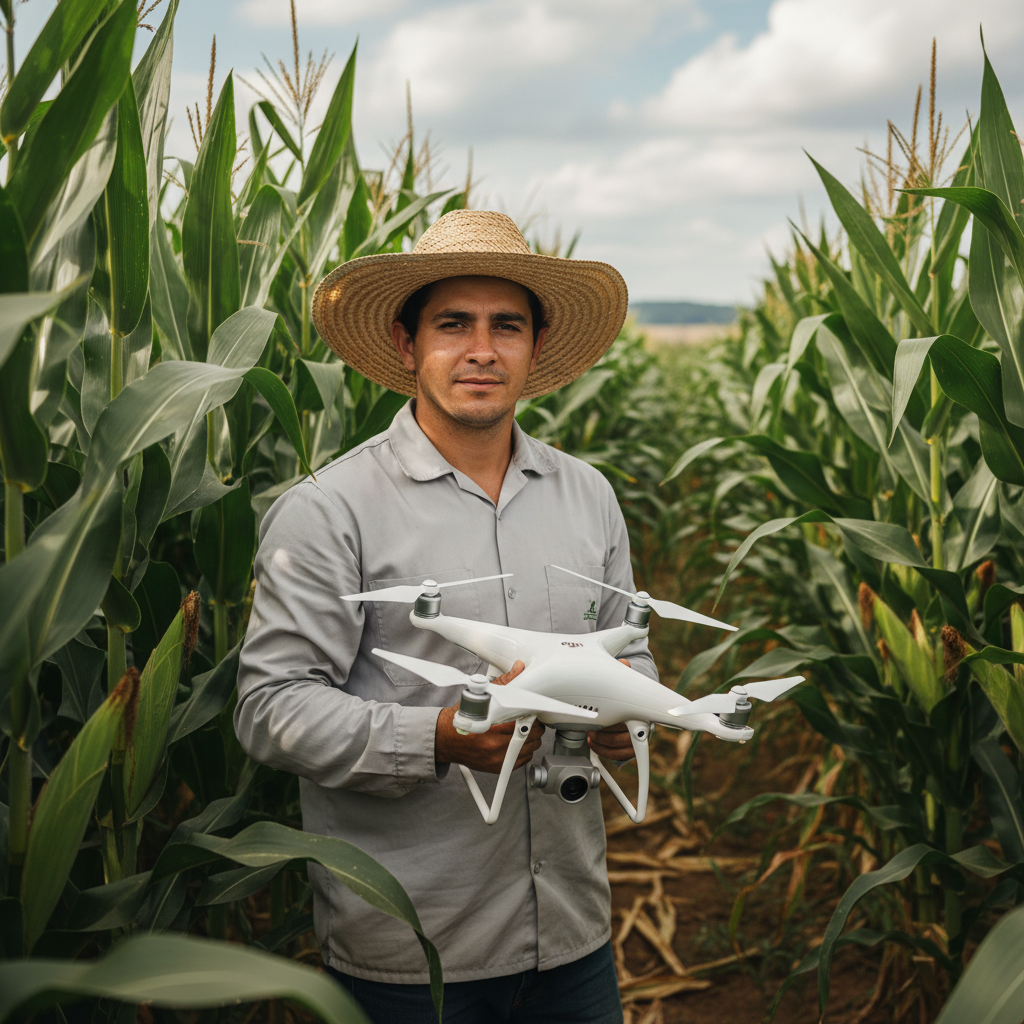
Lucas Fernandes Silva is an agricultural engineer with 12 years of experience in aerial mapping technologies and precision agriculture. ANAC-certified drone pilot since 2018, Lucas has worked on mapping projects across more than 500 rural properties in Brazil, covering areas ranging from small farms to large-scale operations. Specialized in multispectral image processing, vegetation index analysis (NDVI, GNDVI, SAVI), and precision agriculture system implementation. Lucas is passionate about sharing technical knowledge and helping agribusiness professionals optimize their operations through aerial technology.