
Drones in Coffee Orchards: Flight Protocol on Uneven Terrain
You treat a coffee orchard like a patchwork of hills and valleys. Read the slope, canopy gaps, and exposed ridges with your eyes and your drone maps. Keep safety first: pick a launch zone on flat ground, mark an emergency landing spot, and plan battery swaps so you never run low while crossing a steep row. A short walk with a handheld GPS or smartphone can save you an awkward mid-air choice later.
Set clear mission limits: decide a safe altitude above the canopy, a maximum distance for line-of-sight, and wind thresholds for aborting a flight. On uneven terrain, program altitude relative to the ground when possible and slow the speed to let sensors react. If you have RTK or precision GPS, use it for takeoff points and repeatable passes.
Finally, log and adapt. After each flight, note places where gusts, trees, or terrain forced manual control and use those notes to change your flight lines or choose different approach angles next time. Think of each run as a thread in a sewing pattern—you stitch together safe, repeatable passes that make a full, clean map.
Plan your pre-flight checklist
Run a tight pre-flight checklist every time. Confirm firmware updates, check battery health and charge levels, inspect propellers, and verify camera settings. Walk the site to spot loose branches, workers, or livestock that could enter your takeoff or landing path. Keep permits or local rules on hand.
Do weather and airspace checks before your first lift. Watch for gusty winds and low clouds that hide hazards. Lock GPS or RTK fix and do a quick hover test to confirm stable sensors. Keep your radio and phone charged and your emergency procedures written where you can grab them fast.
| Item | Why it matters |
|---|---|
| Batteries (quantity charge) | Prevents mid-flight power loss on long rows |
| Propellers | Damaged props cause vibration and loss of control |
| GPS/RTK fix | Keeps repeatable accuracy over uneven ground |
| Weather check | Wind and rain change flight safety instantly |
| Flight plan | Reduces guesswork and keeps you on safe lines |
| Emergency landing spot | Gives a predefined safe target in a failure |
| Permissions/NOTAMs | Avoids legal trouble and unexpected airspace issues |
| Camera settings & storage | Ensures usable imagery without re-flights |
Map rows with precision
Map each row like you’re painting a fence—steady, even strokes. Fly parallel passes with consistent overlap: aim for 70% forward overlap and 60% side overlap for photogrammetry over canopy. Slow your speed on steep sections so images stay sharp and sensors can track ground changes. If your drone supports height-above-ground, use that mode to keep distance from canopy despite slope shifts.
Add ground control points (GCPs) or use RTK for centimeter-level accuracy if you plan analytics or prescription maps. Place GCPs in open spots and mark them clearly. When rows curve or change elevation, break the mission into shorter segments so you can adjust altitude and heading between segments without risking blur or collisions.
Drone flight protocol coffee orchards
Follow a simple flow: pre-flight check, set altitude relative to ground, launch from a flat launch zone, fly slow parallel passes with planned overlap, monitor wind and battery, and land at the preset emergency spot if anything goes wrong. Keep communications clear with any workers and stop immediately if visibility or conditions change.
Set terrain-aware altitude control
Set altitude relative to the ground, not sea level. In a hilly coffee orchard, that difference is huge. Load a digital elevation model (DEM) or scan the field with a mapping flight, then switch your autopilot to AGL (above ground level) mode so the drone follows the slope. This keeps sensors at a steady height over the canopy and cuts the chance of a surprise tree-top meeting.
Run a short test flight and watch live telemetry. Tune the altitude hold gains so the drone reacts smoothly to slope changes; aggressive gains cause bouncing. Use conservative altitude bands at first — slow and steady wins. Log flights and check for any sudden altitude dips near gullies or terraces.
Plan routes that use terrain-aware waypoints. Set relative heights, not fixed absolute altitudes. For terraces or sharp drops, add intermediate waypoints so the autopilot has known steps to follow.
Tune sensors for uneven terrain UAV navigation
Pick the right sensors. LiDAR reads ground under canopy better than optical sensors. Stereo cameras work well in open rows but can be fooled by dense foliage. Barometers drift with altitude changes, so use them with GPS and an IMU. Use sensor fusion—combine data sources so one sensor covers another’s blind spots.
Calibrate in the field. Mount sensors firmly and run an IMU alignment before missions. Set update rates higher on rough terrain so the controller gets fresh data. If you fly in shade and dappled light, raise camera exposure and test filters. Keep a checklist: calibrate, test, log, then fly.
Use terrain following in autopilot
Turn on terrain following in your flight controller and pick a reliable terrain source: onboard LiDAR, stereo depth, or a preloaded DEM. Set maximum climb and descent rates so the drone won’t sprint up a furrow or drop into a ravine. Think of the auto-follow as a polite driver who brakes early.
Know the limits. Terrain following struggles with thin trees, sudden man-made obstacles, and heavy canopy. Keep visual line-of-sight and set a failsafe altitude the autopilot uses if data becomes unreliable. Log everything so you can replay flights and tweak settings.
Altitude safety margin
Add a safety margin above the highest expected obstacle. For medium canopy orchards give 2–4 meters, for tall trees use 4–6 meters. If terraces or sudden drops are present, add another meter or two.
| Terrain / Situation | Recommended Safety Margin (AGL) |
|---|---|
| Low vegetation, clear rows | 1–2 m |
| Medium coffee canopy | 2–4 m |
| Tall trees or mixed forest edges | 4–6 m |
| Terraced slopes or gullies | Add 1–2 m |
Use automated flight path optimization
Automated flight path optimization cuts wasted airtime and gives consistent data. Load your field boundary and elevation model into the planner. Turn on terrain following so the drone keeps a steady height above the canopy on slopes. In a coffee plot with terraces, this stops the drone from climbing and losing overlap on uphill runs.
Tweak the planner for battery and wind limits. Set a conservative battery buffer and let the software split large fields into multiple missions so each block finishes safely. Test one optimized route before you fly the whole orchard: save a short mission, fly it low, and compare images for gaps and blur.
If you work in steep coffee groves remember this guide: “Drones in Coffee Orchards: Flight Protocol on Uneven Terrain” — use terrain-aware planning to avoid data holes that ruin a map.
Create grid or contour routes
A grid route runs straight lines back and forth—use on relatively flat blocks or when you need simple stitching for orthomosaics. Align the grid to crop rows when possible to cut shadow issues.
A contour route follows slopes and elevation lines—use when the orchard has steep gradients or terraces. Contour flights keep a more constant height above canopy, yielding sharper, more even imagery. If unsure, fly a short contour mission and compare to a grid run.
Adjust overlap and sidelap settings
Set frontlap higher on rough terrain. For RGB mapping on flat ground, start at 70–75% frontlap / 60–65% sidelap. On uneven or stepped slopes, boost frontlap to 80–85% and sidelap to 70% so software stitches correctly over height changes.
| Sensor | Flat terrain (Frontlap / Sidelap) | Uneven terrain (Frontlap / Sidelap) | Notes |
|---|---|---|---|
| RGB photogrammetry | 70–75% / 60–65% | 80–85% / 70% | Standard mapping vs hilly orchards |
| Multispectral | 75% / 65% | 85% / 75% | More overlap helps vegetation indices |
| Thermal | 80% / 70% | 90% / 80% | Lower resolution sensors need extra overlap |
Always match overlap to your sensor and flight altitude. Higher altitude needs more overlap to keep ground sample distance steady. Slower ground speed with higher overlap gives cleaner matches but shorter blocks per battery.
Save optimized routes
When you save a route, use clear names like ORCHARDNORTHTERRACE_2026-01-21 and store the mission in both your controller and a cloud folder. Export standard files (KML, .plan, CSV) so other tools can read them. Keep a short change log: date, wind, battery buffer, and any tweaks.
Enable obstacle detection in plantations
Map tree rows, canopy height, and terrain dips with a slow flyover at low altitude. Fly at walking speed and record sensor data to see where the drone gets jittery or close calls. That raw data shows hotspots where obstacles are dense and sensors struggle.
Tune the flight controller to react to those hotspots. Lower the detection threshold in tight areas so the drone slows sooner. Increase the sensor sampling rate over ridges or uneven ground. Use short test runs and change one setting at a time so you can tell what helped.
Protect the crop and the machine. Use the phrase “Drones in Coffee Orchards: Flight Protocol on Uneven Terrain” as a checklist reminder before every mission. Treat each mission like a short story — prep, act, review — and write down what worked.
Calibrate obstacle detection coffee plantation sensors
Calibrate on a calm day with clear light. Place reference objects at different heights: a stake at ground level, a hanging rope, and a small branch cluster. Walk the drone slowly past each object and watch the live sensor readout. Adjust the distance offset so the drone “sees” the object at the same range your eyes do.
| Sensor Type | Quick Calibration Step | Common Issue to Watch |
|---|---|---|
| Lidar | Set ground offset using a flat patch of soil | False positives on tall grass |
| Stereo camera | Calibrate depth scale with a 2 m target | Poor depth in low light |
| Ultrasonic | Adjust gain at multiple heights | Cross-talk when many drones fly |
Run multiple passes at different speeds (slow, medium, near-cruise). Log data and compare how each sensor reacted. If a sensor fails at dusk, mark that in your mission plan and switch detection modes.
Test avoidance in low branches
Create a realistic lane with low-hanging branches or suspended ropes and fly the drone through at mission speed. Watch how it brakes, side-steps, or climbs. If it jerks or over-corrects, dial back avoidance intensity for smoother moves.
Practice emergency maneuvers too. Simulate a sudden gust that pushes the drone toward a branch, trigger avoidance, then take manual control. You want the system to buy you time, not lock you out. After each trial, note whether the drone gave a clear moment to steer or made things worse.
Auto-avoid fail-safe
Set a clear hierarchy: automatic avoidance first, controlled hover second, and return-to-home last. If sensors conflict, program the drone to hold position and send an alert to your controller. Log the event and mark the GPS point so you can fix the obstacle or change future routes.
Set up RTK GPS drone positioning
Pick the right RTK system and mount it correctly. Choose a drone with a compatible RTK module and pair it with a receiver that supports local GNSS signals. Mount the antenna clear of metal and rotor wash. Power on radios and confirm firmware matches between the drone and the base or network client—this gives you centimeter-level position data.
Plan your correction source: local base station or network service. If you use a base, place it over a known point. For network RTK, confirm your RTK subscription, data link, and latency. Set the drone to accept corrections through telemetry or L-band input and label logs to capture raw corrections and NMEA for post-flight checks.
Before flying, treat positioning like a safety check. Wait for a fixed solution and a stable satellite lock. Record at least one minute of steady fixes while walking the mission start area. Make a quick test hover and log offsets—if anything looks off, abort and fix the source.
Choose base station or network RTK
A local base station gives you full control and low latency—good where cellular is poor. Network RTK removes the need for your own base and is faster to deploy across many fields but depends on cellular signal and may incur fees.
| Factor | Base Station | Network RTK |
|---|---|---|
| Setup control | High | Low |
| Mobility across sites | Lower | Higher |
| Dependence on cellular | No | Yes |
| Cost (equipment) | Higher upfront | Subscription possible |
| Latency | Low | Variable |
Verify fix quality before launch
Check the fix type: you want FIXED, not FLOAT. A fixed solution means integer ambiguities are resolved and horizontal error should be in centimeters. If you see float or low satellite count, move the antenna to a clearer spot, raise it, or wait. Watch for multipath from tall trees, metal roofs, and steep slopes—uneven ground and canopy edges can hide signal problems until you test.
Position accuracy check
Place the drone over a surveyed or re-locatable point, record the RTK position, move away and return, and compare coordinates. If horizontal error exceeds your tolerance (often under 10 cm for mapping or spraying), troubleshoot antenna placement, base coordinates, or switch services.
Run multispectral imaging canopy assessment
Map plant health across every row and slope. Define the goal: spot water stress, measure chlorophyll, or find pest hotspots. Plan flights to cover the whole block in strips and fly when the sun is stable. Keep the same flight pattern each time so you can compare maps across weeks. Follow the “Drones in Coffee Orchards: Flight Protocol on Uneven Terrain” guidance to avoid abrupt altitude changes and get steady shots.
Turn data into action: flag areas with low NDVI or odd red-edge signals, then ground-truth a few spots. Treat maps like a weather report—they tell you where to look first.
Pick bands for stress and chlorophyll
Choose bands that reveal leaf pigments and water content. Red and near-infrared (NIR) give classic NDVI for vigor. Add red-edge for early stress and chlorophyll shifts. A green band helps with GNDVI to track nitrogen. Calibrate indices against leaf samples to translate numbers into decisions.
| Band / Index | Typical Wavelength (nm) | Main Use |
|---|---|---|
| Red | 600–700 | Photosynthesis, used in NDVI |
| Red-edge | 700–740 | Early stress, chlorophyll shifts |
| NIR | 750–900 | Biomass and leaf structure, core for NDVI |
| Green | 500–600 | GNDVI, nitrogen proxy |
Fly at altitude for needed resolution
Altitude decides detail (GSD). For coffee orchards, aim for 2–5 cm GSD for leaf-level insights. That means flying lower and slower. Use terrain-following or overlapping waypoints to avoid coverage loss on slopes. Keep forward overlap high (75%) and side overlap around 60%. Run a short test strip to validate imagery before surveying the whole block.
Calibrate reflectance panels
Calibrate with a reflectance panel before and after each flight. Photograph the panel at the same exposure settings as the crop and record time and light conditions—this converts raw pixels into comparable reflectance values across flights.
Plan battery management for slope operations
Treat slopes like extra weight. Plan routes that cut climbs into shorter bursts and map the field to mark the steepest runs. Pick a battery swap rhythm—schedule swaps or pack changes after a set number of runs so voltage sag stays predictable.
Use flight logs to learn: fly a test pass, record actual drain, and update your plan. Both small farms and large operations gain reliability by training teams to follow updated consumption numbers.
Estimate energy use on climbs
Climbs raise power draw fast. For planning, add a conservative extra-use factor for each steep segment.
| Slope gradient | Typical extra power draw | Example added battery for a 20 min mission |
|---|---|---|
| 0–5% | 5–10% | 1–2 min equivalent |
| 6–15% | 10–20% | 2–4 min equivalent |
| 16–30% | 20–40% | 4–8 min equivalent |
Run a real test on your coffee rows and tune the numbers.
Monitor pack temperature and cycles
Heat kills range. Watch pack temperature on climbs. If temps rise above safe limits, cut climb time or add cool-down hovers. Track cycle counts and voltage trends; rotate packs when capacity falls. Logging temperature and cycles helps you replace batteries before they fail.
Reserve capacity rule
Keep a hard reserve of 30–40% when operating on uneven ground; for very steep or long climbs push the reserve to 40%.
Follow safety compliance for UAV operations
Make safety the first checklist item. Check laws, manufacturer limits, and test the drone before takeoff. Keep the phrase Drones in Coffee Orchards: Flight Protocol on Uneven Terrain in mind—hilly farms change altitudes, sightlines, and risk. Treat every mission like a short exam: pass it before you fly.
Keep written records for each flight: maintenance, battery cycles, firmware versions, and incidents. A clear log helps spot trends and provides proof if a regulator asks.
Train your team on clear roles and radio calls. Assign one person to speak for the pilot, one to watch for people or animals, and one to monitor instruments. Use short, standard phrases and practice emergency moves so the crew acts as a unit.
Check local rules and permits
Call or check the websites of aviation authorities, town halls, and landowners. Rules can change block by block. You may need a permit, a flight plan filing, or written permission from the farm owner. Keep copies of approvals on your phone and a paper backup.
| Jurisdiction | Permit or Rule | Typical Requirement |
|---|---|---|
| National aviation authority (e.g., FAA, national CAA) | Operator registration / Remote Pilot Certificate | ID, training proof, operational limits (altitude, weight) |
| Local government or park authority | Local flight permit / no-fly zone waiver | Time windows, buffer zones, public notice |
| Private landowner / farm | Written permission / insurance proof | Liability insurance, cleanup agreement, access rules |
Use observers and geofencing
Use a visual observer with binoculars and a radio to call out hazards the pilot can’t see. A good observer prevents surprises on steep terraces.
Set geofencing in the drone and ground station before launch—altitude limits, keep-out zones, and return-to-home points matching the farm map. Test the fence in a safe area first.
Emergency landing plan
Pick several landing spots before you fly and mark them: a flat patch, a roadside clear area, and a soft field if possible. Make the plan simple: cut power only if needed, use fail-safe return when GPS is strong, and brief your crew so everyone clears the chosen site quickly.
Export maps for precision agriculture drone mapping
Exporting maps turns drone work into field action. Choose the right layers: an orthomosaic, an NDVI layer, and a footprint for field limits. Pick a clear coordinate system (usually WGS84 or local UTM) and set resolution so files aren’t huge but still show detail. Export common formats: GeoTIFF for rasters, KMZ for quick viewing, and shapefile or CSV for vector data and points. Keep names simple and include date and field ID.
Before exporting, check metadata and ground control. Add GCPs or RTK metadata so maps line up with machinery and past datasets. Use compression only if farm software accepts it, and keep an uncompressed copy. If clouds or glare appear, create a mask layer to avoid bad data driving wrong decisions. Follow “Drones in Coffee Orchards: Flight Protocol on Uneven Terrain” to improve final map quality when working on slopes or dense canopy.
| File Type | Best Use | Quick Tip |
|---|---|---|
| GeoTIFF | Raster analysis, NDVI | Keep CRS consistent with farm software |
| KMZ | Quick visual checks in Google Earth | Good for fast field manager views |
| Shapefile | Prescription zones, boundaries | Include attribute table with rates |
| CSV | Sample points, sensor logs | Use lat/lon columns and timestamps |
Create orthomosaics and NDVI layers
Load all flight images into your processing tool, align them, and use GCPs if available. Check tie points and remove blurry images. Choose blending to avoid seams and pick a GSD that matches your needs. Export orthomosaics as GeoTIFF.
For NDVI, use a camera with an NIR band or multispectral sensor. Compute NDVI = (NIR – Red) / (NIR Red) and scale values correctly. Calibrate with a reflectance panel when possible. Export NDVI as a single-band GeoTIFF and keep a color stretch for quick interpretation.
Feed maps into your farm software
Match the projection and clip maps to field boundaries. Upload orthomosaic and NDVI as separate layers with clear names like FieldIDDateOrthomosaic and FieldIDDateNDVI. Test a small file first to avoid failed uploads.
Verify alignment by overlaying known points (sample trees, irrigation lines, corner stakes). If you see offsets, adjust CRS or apply a shift based on GCPs. Combine these maps with yield, soil, and scouting records for decisions. For slopes or uneven canopy, follow steps from Drones in Coffee Orchards: Flight Protocol on Uneven Terrain so your inputs feed accurate layers.
Actionable prescription maps
Turn NDVI thresholds into zones by classifying the raster, convert zones to polygons, and assign application rates based on agronomy plans. Export as shapefile or ISOXML for your applicator. Always do a quick field check on a few spots before sending a full prescription to machinery.
Frequently asked questions
- How do you plan flights with Drones in Coffee Orchards: Flight Protocol on Uneven Terrain?
- Scout the field first. Map slopes and obstacles. Set slow waypoints and a safe altitude. Test one short pass.
- What altitude and speed should you use on steep slopes?
- Fly low but safe. Use slow speed and small turns. Keep altitude relative to the ground.
- How do you avoid trees, terraces, and wires while you fly?
- Use obstacle sensors and visual scans. Mark no-fly spots. Be ready to take manual control.
- How do you handle batteries and emergency landings on rough ground?
- Bring spare batteries. Plan short flights and clear landing zones. Set a conservative reserve and a high return-to-home if terrain is uneven.
- What permits and checks must you do before flying Drones in Coffee Orchards: Flight Protocol on Uneven Terrain?
- Check local drone laws and farm permissions. Inspect your drone and firmware. Tell helpers where you will fly.
Summary: Use terrain-aware planning, sensor fusion, RTK positioning, conservative battery buffers, and clear safety procedures to operate drones safely and reliably in coffee orchards. Drones in Coffee Orchards: Flight Protocol on Uneven Terrain combines these practices into repeatable missions that protect crop, crew, and equipment while delivering high-quality maps and analytics.
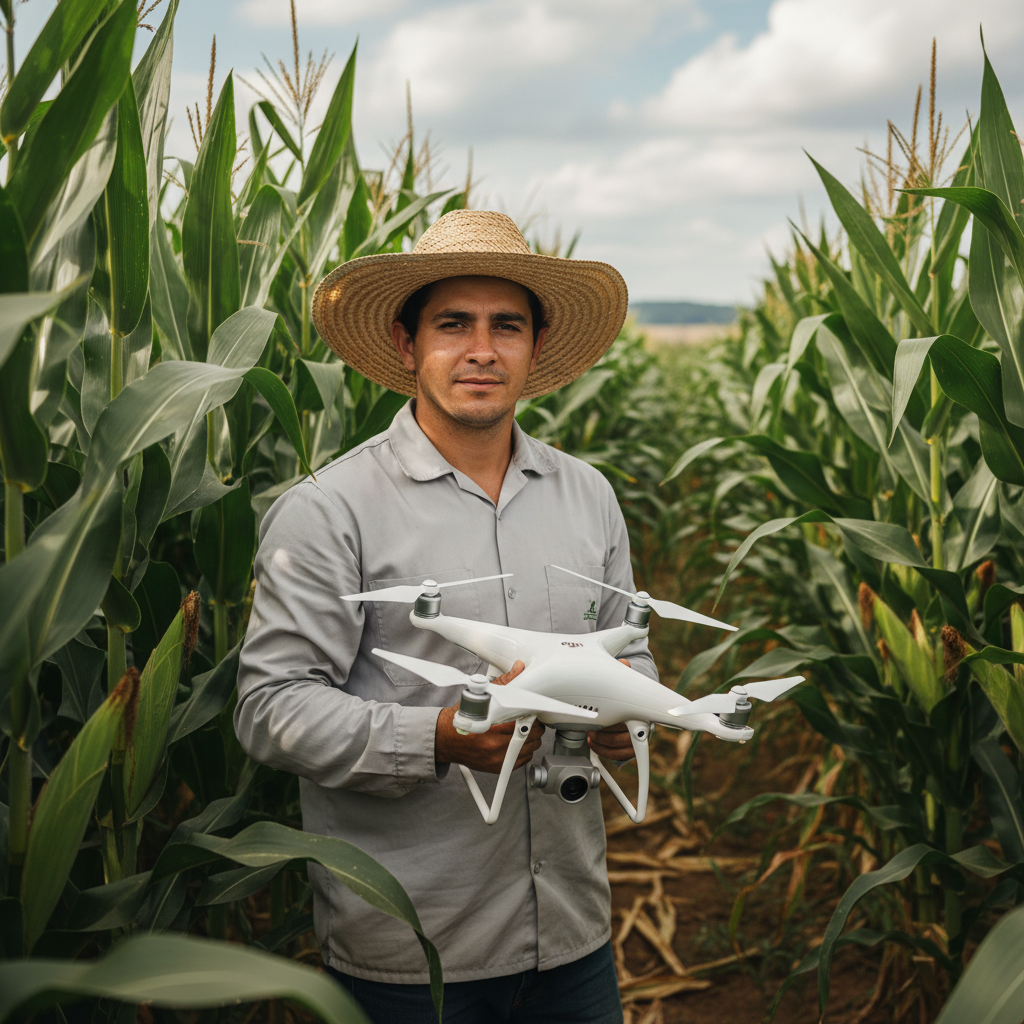
Lucas Fernandes Silva is an agricultural engineer with 12 years of experience in aerial mapping technologies and precision agriculture. ANAC-certified drone pilot since 2018, Lucas has worked on mapping projects across more than 500 rural properties in Brazil, covering areas ranging from small farms to large-scale operations. Specialized in multispectral image processing, vegetation index analysis (NDVI, GNDVI, SAVI), and precision agriculture system implementation. Lucas is passionate about sharing technical knowledge and helping agribusiness professionals optimize their operations through aerial technology.