
Set GSD Goals for Your Field
Decide what you want to spot before you fly. GSD (ground sample distance) tells you how big one pixel is on the ground. If you want to catch tiny leaf disease spots or individual seedlings, pick a small GSD. If you only need general plant counts or biomass zones, a larger GSD will save time and battery.
Think of GSD like a lens: a tighter lens (smaller GSD) shows fine detail but covers less ground per flight; a wider lens (larger GSD) covers more acres fast but misses small problems. Balance detail with how many acres you must scan and how often you can fly. Label missions as scouting, mapping, or detailed inspection and assign a GSD to each for consistent, comparable data.
Why ground sample distance matters
GSD controls the level of detail you can act on. A smaller GSD lets you find stressed plants, insect damage, or early disease — early warning that can save rows of crop. GSD also affects flight time, data size, and processing load. Flying lower for finer GSD uses more battery and creates more images to stitch. Pick a GSD that matches your action speed.
GSD recommendations by crop
Match GSD to crop scale and task. Smaller plants or high‑value crops get smaller GSD; big, dense crops can use larger GSD. Use this rule to start your plan and consult “Ideal Flight Height by Crop: Recommended GSD for Soybeans, Corn, Sugarcane, and Coffee” for baselines.
| Crop | Recommended GSD (cm/pixel) | Typical Flight Height (m) for common RGB sensors |
|---|---|---|
| Soybeans | 2–5 cm | 40–120 m |
| Corn | 2–4 cm (early) / 4–8 cm (late) | 30–100 m |
| Sugarcane | 5–10 cm | 100–200 m |
| Coffee | 1–3 cm | 20–60 m |
Quick rule of thumb:
- Inspect single plants/small spots: 1–3 cm GSD
- General field health/yield zoning: 4–8 cm GSD
- Wide-area surveys (speed matters): 8–10 cm GSD
Choose Optimal Flight Height for Soybeans
Pick a flight height to balance clear plant rows and fast coverage. Start with a target GSD and consult guides like Ideal Flight Height by Crop: Recommended GSD for Soybeans, Corn, Sugarcane, and Coffee. Young soybeans with visible rows need finer GSD than a dense canopy — run a short test pass to tweak height and overlap until rows look sharp.
Account for wind, battery life, and processing time. Use overlap and controlled speed to compensate for slightly higher altitudes; if data quality is poor, lower the height on the next pass.
Optimal flight heights to see rows
To see rows clearly, individual plants should span several pixels. For many setups, fly in the lower end of the operational envelope to capture row geometry and missing plants. Accept that lower altitudes produce more images and longer processing; plan smaller blocks or targeted low passes over problem zones.
| Flight Height (m) | Typical GSD (cm/pix) | Best use |
|---|---|---|
| 20–30 | ~1–3 | Row-level checks, missing plants, weed strips |
| 30–50 | ~3–5 | Plant vigor, early stress detection |
| 50–80 | >5 | Whole-field scouting, faster coverage |
Soybean GSD tradeoffs: plant-level scouting ≈ 1–3 cm/pix; general health maps 3–5 cm/pix; field‑scale checks >5 cm/pix. Combine targeted low-altitude strips with a higher-altitude whole-field pass to balance detail and efficiency.
Plan Recommended GSD for Corn Mapping
Set a clear GSD target before you fly. For corn:
- Stand counts: 2–3 cm/pixel (plant-level)
- Vigor mapping: 5–10 cm/pixel (NDVI/biomass patterns)
- Quick scouting: 10–15 cm/pixel
Match your camera/sensor and use higher overlap (e.g., 80% forward, 70% side) for plant‑level work. Remember: doubling altitude roughly doubles the GSD.
| Task | Recommended GSD (cm/pixel) | Typical action |
|---|---|---|
| Stand counts | 2–3 | Plant-level counting, replant decisions |
| Vigor mapping | 5–10 | Zone-based nitrogen, irrigation, scouting |
| Quick scouting | 10–15 | General checks, rapid overviews |
Set Sugarcane Drone Flight Altitude Right
Choose altitude to balance detail and coverage. For sugarcane:
- Spot pests/missing stools: aim 2–4 cm GSD
- Biomass/drainage patterns: 5–10 cm GSD (saves battery)
Tall cane (3–4 m) needs higher altitude to avoid occlusion and collision risk; start 50–80 m and adjust after a test flight. On sloping terrain raise altitude and increase overlap.
| Altitude (m AGL) | Approx. GSD (cm/pixel) | Typical use |
|---|---|---|
| 30 | ~2.0 | Spot pests, stem detail |
| 50 | ~3.5 | Early stress detection |
| 80 | ~5.5 | Biomass mapping, fast coverage |
| 120 | ~8.0 | Broad health trends, quick surveys |
Always run a short test and check images on a laptop, not only the controller screen.
Apply Coffee Plantation GSD Guidelines
Decide the flight purpose: scouting, disease detection, plant counting, or spray guidance. Match GSD to row spacing and tree age:
| Use / Row spacing | Typical GSD target | Typical flight goal |
|---|---|---|
| Narrow rows (<1.5 m) – detailed scouting | 1–2 cm/pixel | Low altitude, slower speed |
| Medium rows (1.5–2.5 m) – general monitoring | 2–4 cm/pixel | Moderate altitude |
| Wide rows (>2.5 m) – broad surveys | 4–6 cm/pixel | Higher altitude, faster coverage |
| Young plants – planting checks | 0.5–2 cm/pixel | Very low altitude, high detail |
| Disease detection – leaf level | 1–3 cm/pixel | Low altitude, controlled light |
For leaf-level disease detection fly low (1–3 cm/pixel, typically 20–40 m depending on camera). For general scouting 3–8 cm/pixel (50–120 m) is often enough. Test one block and review images; lighting and speed affect effective detail.
Pick Sensors to Match Your GSD Target
Set your GSD goal first; then pick a sensor that can achieve it at a safe altitude.
- RGB: high spatial detail, cost-effective; can reach 1–2 cm GSD at low altitude. Great for shape, pest spotting, canopy cover.
- Multispectral: adds NIR/other bands for plant‑health indices (NDVI) but often requires lower flights or higher-cost sensors to reach the same GSD.
Match camera specs (pixel size µm, focal length mm, MP) to your GSD and test with a single strip over a known-size object. Prefer global shutter for fast flight; account for lens distortion and radiometric needs.
| Crop | Recommended GSD | Best sensor | Typical flight height (m) |
|---|---|---|---|
| Soybeans | 2–3 cm | RGB / multispectral | 40–80 |
| Corn | 2–5 cm | Multispectral for VIs; RGB for structure | 50–120 |
| Sugarcane | 3–6 cm | Multispectral | 60–130 |
| Coffee | 1–3 cm | High-res RGB / multispectral | 30–70 |
Plan Flights with Safety and Rules
Build a flight plan that balances safety and data needs. Pick target GSD first, then altitude, overlap, and speed. Check airspace, local rules, and temporary restrictions. Get waivers/authorizations if needed.
Brief your team on safety zones, carry spare batteries/props, and use mission-planning software to preview photo cadence and battery drain. Log permits, pilot credentials, and a short checklist for each flight — record GSD, altitude, camera settings, and weather snapshot to reproduce results.
| Crop | Target GSD (cm/pixel) | Approx. AGL (m) | Notes |
|---|---|---|---|
| Soybeans | 2–5 | 30–70 | Biomass and disease scouting |
| Corn | 1.5–4 | 20–60 | Lower for early vigor checks |
| Sugarcane | 5–10 | 70–120 | Large fields, coarser GSD acceptable |
| Coffee | 1–3 | 15–40 | Plant-level health and yield |
Be mindful of regulations (common max 120 m / 400 ft AGL). If legal limits block your ideal altitude, use a higher-resolution sensor or targeted low passes.
Wind, visibility, and battery effects on GSD
Wind and gusts can blur images and force speed changes that reduce overlap. Reduce shutter time, increase overlap, or postpone missions in strong winds. Low light/haze reduces contrast even with small GSD — plan flights near solar noon for consistent light or use sensors/exposure settings suited to low-light. Battery life constrains pass length; bring spares or accept coarser GSD for longer surveys.
Preflight checklist: clean lens, set camera resolution and shutter speed, calibrate IMU/compass, verify GPS lock, check batteries and props, confirm firmware, test a hover shot, and add GCPs if survey-grade accuracy is needed.
Process Data to Keep GSD Accurate
Treat post‑processing as part of the mission. Load correct camera model and lens parameters into photogrammetry software. Apply RTK/PPK or metadata corrections, and run camera‑calibration to remove lens distortion. Verify output scale by measuring known objects in the orthomosaic; if off, revisit GCPs, calibration, or flight metadata.
Ground Control Points (GCPs): place 4–6 well distributed targets plus one near the center for scale control. High overlap (≈75% forward, 60% side) yields dense tie points and steadier geometry. Keep most imagery nadir to maintain consistent effective GSD.
Simple QA after processing: check GCP residuals, read reported GSD in export metadata, measure known distances on the orthomosaic, inspect seamlines and rows for alignment, and scan indices like NDVI for odd blotches.
Refer to Ideal Flight Height by Crop: Recommended GSD for Soybeans, Corn, Sugarcane, and Coffee for baselines, then validate with field checks.
Balance Cost, Time, and Image Detail
You have three levers: cost, time, and image detail. Higher altitude speeds coverage and cuts flight hours but reduces resolution. Reserve low-altitude, high-detail flights for problem areas and use higher, faster surveys for routine checks.
Staged approach: run a cheap, high-altitude survey to find hotspots, then follow up with focused low-altitude flights. Track time spent and data value to refine choices each season.
| Crop | Typical GSD target (cm/pixel) | Flight height note | Benefit vs budget |
|---|---|---|---|
| Soybeans | 5–10 | Mid-altitude; fast coverage | Good compromise for vigor maps |
| Corn | 5–8 | Mid-altitude early; lower later | Strong ROI for nitrogen/disease spots |
| Sugarcane | 10–20 | Higher altitude for biomass | Low-data load, good for large estates |
| Coffee | 2–5 | Low altitude for tree-level | Higher cost but needed for flower/pest detection |
Frequently Asked Questions
Q: What is the Ideal Flight Height by Crop: Recommended GSD for Soybeans, Corn, Sugarcane, and Coffee for clear maps?
A: Aim for crop-specific GSD:
- Soybeans: 3–5 cm (≈30–60 m)
- Corn: 2–4 cm (≈20–50 m)
- Sugarcane: 5–10 cm (≈60–120 m)
- Coffee: 1–3 cm (≈30–80 m)
Adjust for camera, overlap, and speed.
Q: How should you set flight height for soybeans vs corn?
A: Fly lower for fine detail. Soybeans typically 3–5 cm GSD; corn 2–4 cm GSD for early season. Use ~70% front and ~60% side overlap and slow speed to reduce blur.
Q: What height works best for sugarcane mapping?
A: Sugarcane usually needs higher flights: aim 5–10 cm GSD and fly ~60–120 m depending on camera and canopy height. Increase sidelap and avoid gusty conditions.
Q: Can you use one GSD for coffee and other crops?
A: Not if you want good results. Coffee often needs finer detail (1–3 cm) than broad crops. Adjust height by crop and task.
Q: How do you calculate flight height to reach a target GSD?
A: Use camera specs (pixel size and focal length) or a GSD calculator. Rule of thumb: doubling height roughly doubles GSD. Do a test flight and tweak height.
Remember to consult “Ideal Flight Height by Crop: Recommended GSD for Soybeans, Corn, Sugarcane, and Coffee” as a practical baseline, then validate with a short test pass, GCP checks, and field comparisons to make sure the chosen GSD answers your agronomic question.
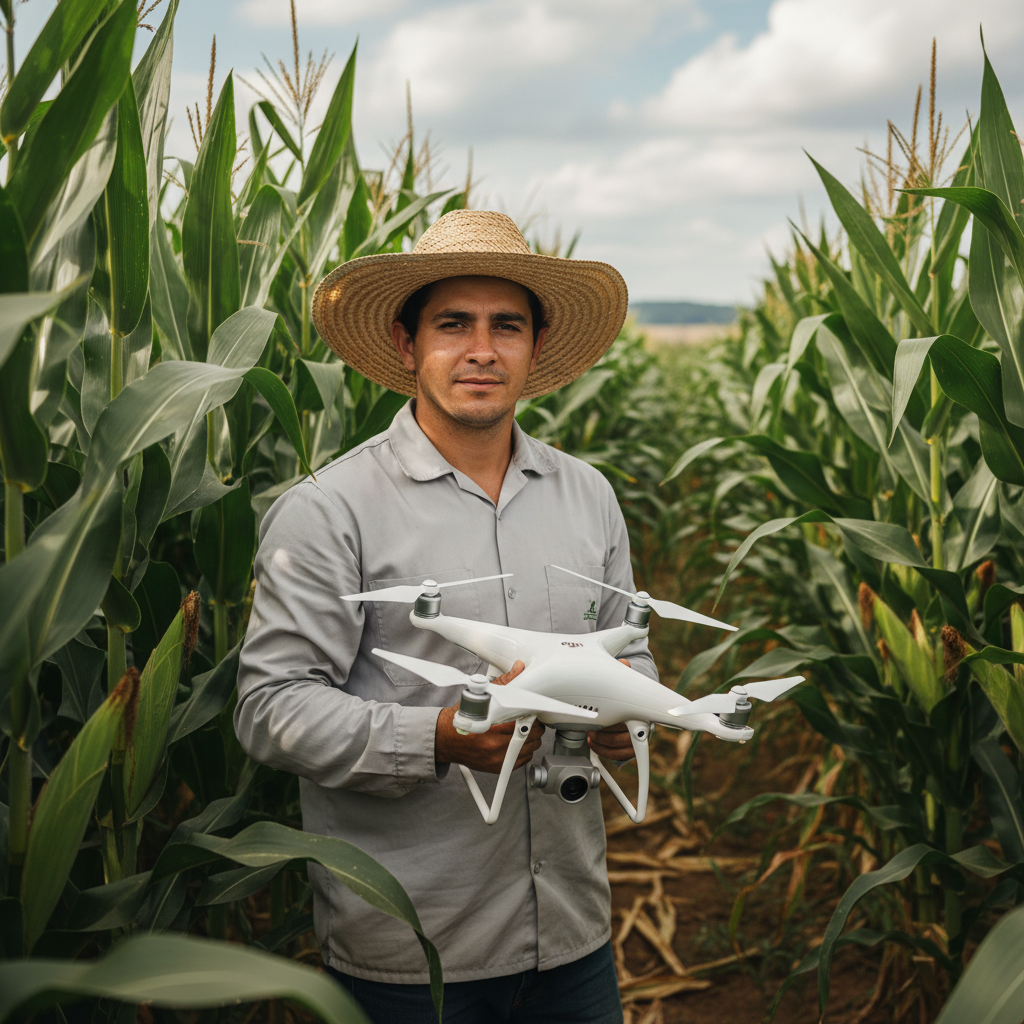
Lucas Fernandes Silva is an agricultural engineer with 12 years of experience in aerial mapping technologies and precision agriculture. ANAC-certified drone pilot since 2018, Lucas has worked on mapping projects across more than 500 rural properties in Brazil, covering areas ranging from small farms to large-scale operations. Specialized in multispectral image processing, vegetation index analysis (NDVI, GNDVI, SAVI), and precision agriculture system implementation. Lucas is passionate about sharing technical knowledge and helping agribusiness professionals optimize their operations through aerial technology.