
Regulatory compliance for image quality
You must treat Image Quality Verification: Blur, Distortion, and Exposure Detection as a legal and operational task, not optional housekeeping. Regulators expect clear proof that your imaging system meets exposure, blur, and distortion thresholds. Start with written standards, test plans, and pass/fail criteria. That gives you a defensible position during an audit and keeps your team focused on what matters.
Set up regular checks that match published test methods. Use test charts, controlled lighting, and repeatable camera settings. Record the algorithm version, camera firmware, and environmental conditions each time. If a test fails, log the failure, note corrective steps, and re-test until the system hits the target metrics.
Train staff to run checks and to read results. Automate what you can: scheduled image captures, software checks for blur metrics, and distortion maps. Use a clear escalation path so small problems don’t turn into compliance headaches.
| Standard | What it checks | Your action |
|---|---|---|
| Exposure assessment | Brightness range, highlights, shadows, histogram shape | Run chart tests, set pass/fail histograms, log results |
| Blur detection | Motion blur, focus blur, edge sharpness | Measure MTF or edge contrast, flag images outside limits |
| Lens distortion rules | Barrel/pincushion, geometric shift across frame | Use grid targets, record correction maps, test zoom positions |
| Records retention | Test logs, firmware, operator sign-off | Keep dated files, version control, retrieval plan |
Follow exposure assessment standards
Pick clear exposure targets. Use a neutral grey chart and scan histograms. Set pass/fail rules like no more than X% clipped highlights or median value between A and B. That turns opinion into a measurable check.
Run exposure tests after any change: new lighting, firmware, or lens swap. Keep a sample set of passing images for comparison. If readings drift, document calibration steps and the fix.
Meet lens distortion detection rules
Detect distortion with a grid target and software that maps pixel shifts. Measure radial and tangential distortion and state acceptable limits. Record correction parameters and show how corrected images fall within tolerance.
Test at different focus distances and zooms. Automate capture of calibration frames and include the correction routine in your pipeline so every image can be traced back to its distortion map.
Keep compliance records
Keep one clear file per test cycle with the date, test images, numeric results, operator name, firmware and algorithm versions, and corrective actions. Make retrieval fast so audits are quick and defensible.
Reduce safety risks from blur and distortion
Treat blur and distortion as safety hazards. Add automated checks to your video pipeline that run Image Quality Verification: Blur, Distortion, and Exposure Detection in real time so you catch problems before they cause harm. If a view is unusable, the system should flag it and fall back to a safe mode—alert staff or switch to an alternate camera.
Create clear thresholds and actions. Define what level of blur means “unusable” for each task — reading a gauge, spotting a person, scanning a barcode — and write those limits into alerts. Train your team on what each alert means and assign responsibility for response within set time frames.
Keep a simple log of incidents and fixes (time, camera ID, type of blur, steps taken) to spot patterns and prevent repeat failures.
Detect motion blur in live feeds
Motion blur arises from moving subjects or slow shutter settings. In live feeds, watch for drops in frame sharpness and streaking. Use frame-to-frame comparison or optical flow to spot streaks automatically. If motion blur exceeds threshold, trigger an alert.
Act fast: increase frame rate or shorten exposure, add lighting, or use cameras with better low-light performance. For expected fast motion, choose cameras/settings that match the speed.
| Blur Type | Symptom | Detection Method | Immediate Action |
|---|---|---|---|
| Motion blur | Streaks, smeared moving objects | Frame differencing, optical flow, motion vectors | Increase frame rate or lighting; alert operator |
| Defocus blur | Soft edges, low contrast | Edge detection, Laplacian variance | Recalibrate focus, clean lens, autofocus check |
Assess defocus blur impacts
Defocus blur hides detail across the entire image. Use contrast-based checks (e.g., Laplacian variance) to measure focus. If contrast falls below your safe limit, mark the feed as unreliable for fine tasks.
Decide which tasks can tolerate softness and which cannot. For life-safety views, demand high clarity and auto-fail to a human monitor if defocus appears. Schedule periodic focus calibration and lens cleaning.
Report safety issues promptly
When you spot a safety issue, report it with time, camera ID, image sample, and severity. Use a clear channel (app, pager, alarm) and name the responder. Fast, clear reports shorten time to fix.
Calibrate cameras for geometric accuracy
Treat calibration as a compass for your imaging system. Use a stable calibration chart, fix the camera, and capture multiple frames at different angles and distances with steady lighting. Take at least 10–20 shots covering the full frame so software can solve for intrinsic parameters, focal length, principal point, and distortion coefficients.
Run those images through your calibration tool and watch for low reprojection error and stable values across runs. If results vary, retake images with better edge coverage or tighten the mounting. Record camera settings for each run—aperture, focus, and zoom—so tests are reproducible.
Validate by shooting a scene with many straight lines and undistort using the computed parameters. If lines still bow, iterate with more frames or a different chart. Label successful calibration sets and archive them.
Correct geometric distortion with charts
Use calibration charts (checkerboard, circle-grid, dot array) to map lens warp. Place charts at different tilts and distances and cover the full image area. More coverage strengthens the correction model for radial and tangential distortion.
Choose the right chart: checkerboards for fast corner detection, circle grids for subpixel accuracy. Keep charts flat and well lit. Inspect residuals per corner—big residuals at edges mean you need more edge shots or a higher-order model.
| Chart type | Best for | Quick tip |
|---|---|---|
| Checkerboard | Fast corner detection | Tilt and rotate the chart across the frame |
| Circle grid | Subpixel center accuracy | Use uniform lighting |
| Dot array | High-precision mapping | Capture many distances and angles |
Identify radial distortion methods
Radial distortion bends straight lines into curves (barrel or pincushion). Photograph a grid or building edge to spot it. For proof, fit straight-line models and compute deviations. Use reprojection error and per-line residuals as metrics. If residuals concentrate at the edges, capture more corner data or increase polynomial order. Log distortion coefficients with the test set to track drift.
Store calibration files
Keep every calibration file with metadata: camera ID, lens, focus, zoom, capture date, and software version. Save in standard formats (YAML, XML, JSON) with versioned folders and backups.
Control exposure for clear images
Watch the histogram and camera’s clipping warnings. Adding Image Quality Verification: Blur, Distortion, and Exposure Detection to your workflow provides a clear pass/fail signal quickly.
Match exposure to the scene. In bright outdoor light, lower ISO and raise shutter speed. In low light, open aperture and watch for noise. Prioritize subject highlights, then preserve shadow detail.
Use a short checklist on every shoot: check histogram, enable clipping overlays, and take a test frame. Treat exposure like a safety check to avoid re-shoots.
Use overexposure detection tools
Check the histogram for a right-edge pileup and enable clipping warnings (zebra stripes) to see blown areas. Use automated flags (red overlays) in QC tools and set thresholds so small highlight losses trigger a flag before images go live.
Use underexposure detection checks
Watch the left side of the histogram. If data hugs the left wall, shadow detail is lost and noise will increase when you recover it. Use a waveform or RGB parade to spot uneven underexposure across channels.
Adjust exposure settings quickly
Act fast: lower ISO, open aperture, or slow shutter by one stop at a time. Use exposure compensation or manual override for tight scenes. For bright sun, add an ND filter; for moving subjects, raise shutter speed and compensate with aperture/ISO. Bracket shots when unsure.
| Situation | Detection Tool | Quick Fix |
|---|---|---|
| Bright sky blows highlights | Histogram clipping warnings | Lower ISO, faster shutter, use ND filter |
| Dark subject with noise | Histogram waveform | Open aperture, raise ISO moderately, expose to the right |
| Mixed light with color shift | RGB parade | Adjust per channel, use spot metering |
| Fast action underexposed | Clipping motion blur checks | Increase shutter speed and ISO, or add light |
Use automated blur and sharpness tools
Pick automated tools that check every image to catch problems fast. These act as a quality gate: failed images go to review or are rejected. Set clear pass/fail thresholds and keep logs to trace why images were blocked.
Combine checks in the pipeline and include Image Quality Verification: Blur, Distortion, and Exposure Detection so blur and exposure issues are handled together. Run quick scans first and deeper tests only when a file is suspect to save compute.
Train the team to read tool output, flag false alarms, tune thresholds, and feed curated examples back into the system to reduce reviews while keeping quality high.
Implement blur detection metrics
Choose a small set of metrics that match your use case: Variance of Laplacian, Tenengrad, or FFT-based energy. Each gives a score you compare to a threshold. Start conservatively, then loosen after reviewing real failures.
Calibrate metrics with sample images. Label images as acceptable, marginal, or fail and record scores. Use the labeled set to find thresholds and reduce false positives.
| Metric | What it measures | Action at low score |
|---|---|---|
| Variance of Laplacian | Edge presence / blur | Mark for review or reject |
| Tenengrad | Gradient strength | Re-scan at higher resolution |
| FFT energy | High-frequency content | Flag for manual check |
Run image sharpness evaluation routines
Automate multi-scale sharpness checks to catch blur at small and large scales. Use edge width, contrast across edges, and local SNR. Combine into a single sharpness index for a clear decision.
Make routines fast and modular: cheap first pass, deeper routine for borderlines. Log scores and thumbnails so reviewers see why a file failed.
Schedule automated scans
Plan scans by priority: critical feeds every few minutes, bulk archives nightly. Coordinate with peak hours to avoid slowdowns. Keep logs of runs, failures, and rechecks to spot trends.
Monitor image quality in real time
Watch images as they are captured. Run automated checks for blur, distortion, and exposure on each frame. Use the phrase Image Quality Verification: Blur, Distortion, and Exposure Detection in logs and reports so reviewers know what’s tracked. Think of this like a smoke alarm for your camera feed—it should warn you before a small blur becomes a blind spot.
Build a pipeline: grab frames, run fast metrics, push results to a live dashboard. Keep the cycle short—seconds, not minutes. Mark failing frames and save short clips for maintenance or compliance review.
Tie live checks into operations: who gets alerts, what actions follow, and how to log fixes. Raise alert levels for cameras in safety zones and keep written rules so teams act fast.
Set thresholds for motion blur detection
Pick a measurable metric (Laplacian variance or motion vector amplitude) and set a starting threshold. For many indoor cameras, a Laplacian value under 100 often indicates visible blur—use that as a trial point and adjust with real footage. Start safe (catch more events) then reduce noise by tuning.
Run tests across times of day and scenes. Save examples of true/false positives to refine thresholds and train ML filters. Document each change and approval.
| Metric | Example Threshold | Action |
|---|---|---|
| Motion blur (Laplacian) | < 100 | Flag for review |
| Geometric distortion | > 2% error | Recalibrate lens |
| Exposure (mean luminance) | < 30 or > 220 | Auto-adjust or alert |
Alert on exposure assessment failures
When exposure falls outside safe bands, send a clear alert: warning for minor drift, critical for complete under/over-exposure. For warnings, try auto-adjustment; for critical issues, notify an operator and lock the stream to prevent bad data from feeding decisions.
Make alerts useful: include a short clip, metric values, camera ID, and time. Route by priority: SMS for critical, email for warning, dashboard for trends. Test alert paths regularly—trigger simulated failures and verify the chain (alarm → people → logs) works reliably.
Train staff on good operating practices
Train with clear, repeatable steps focused on image quality. Start every session by naming the goal: Image Quality Verification: Blur, Distortion, and Exposure Detection. Use hands-on drills where each person practices focus, exposure, and framing until checks become second nature. Keep language simple and checklists short.
Run short, frequent sessions (10–15 minutes). Swap roles (shooter/reviewer) and use quick examples of bad images for diagnosis. Log failures and wins, follow up with targeted coaching, and reward improvements. Post bold reminders like check focus, confirm exposure, scan for distortion where teams can see them.
Teach image sharpness evaluation steps
Teach a one-minute check: zoom live view to 100%, inspect a key edge or text, and judge softness. If soft, mark as blur, check shutter settings, and note whether motion or focus caused it. Practice with printed text, resolution charts, or patterned cloth using role-play to build fast detection skills.
| Quick Sharpness Checks | What to look for | Fixes |
|---|---|---|
| Live view 100% | Soft edges, smeared detail | Re-focus, lower shutter, steady camera |
| Motion check | Directional blur streaks | Increase shutter speed, stabilize subject |
| Lens/ISO check | Grainy or glow around edges | Lower ISO, clean lens |
Train on lens distortion basics
Show how to spot barrel/pincushion with a grid at several focal lengths. Teach staff to name the distortion and note focal length. Explain acceptable limits and when to reshoot vs. correct in post. Give clear rules: if faces or measurements are warped, stop and re-shoot.
Log staff competency
Keep a simple competency log: date, skill, pass/fail, signer. Review monthly and trigger retraining after repeated failures. This keeps accountability and growth visible.
Define testing and acceptance criteria
List the metrics you will check: blur, distortion, and exposure. For each, state what counts as pass and fail in short, actionable rules.
Set tolerances and test conditions (exact camera/file settings, lighting, distance). Use plain numbers (e.g., “images shot at ISO 800 under 300 lux”) so testing is repeatable. Map outcomes to actions: pass → release, borderline → human review, fail → fix and retest.
Create pass/fail for blur detection
Make the blur rule measurable. Use a numeric sharpness score and a clear threshold. Example: pass at Laplacian variance > 100, borderline 60–100, fail < 60. Tie the rule to user impact: does the blur hide important details? Add a quick checklist: subject edges visible, text readable, fine patterns intact.
| Metric | Pass threshold | Borderline | Fail threshold | Notes |
|---|---|---|---|---|
| Blur (Laplacian) | > 100 | 60–100 | < 60 | Use center crop; human review for borderline |
| Distortion (elastic) | < 1.5% | 1.5–3% | > 3% | Measure corners and center |
| Exposure (EV) | -0.5 to 0.5 | -1.0 to -0.5 / 0.5 to 1.0 | 1.0 | Check highlights and shadows clipping |
Use standard test images for checks
Pick a small set of reference images and stick with them: a high-detail chart, a face close-up, and a mixed-light scene. Label each image with its purpose and version them in your CMS. When changing a reference, log the reason.
Publish acceptance reports
After testing, produce a short acceptance report: which images passed/failed, actions taken, raw metrics, and a one-line verdict. Keep it under one page for readability.
Log results and ensure traceability
Log every test result so you can trace back to the source. Record who ran the check, the timestamp, test settings, and raw metrics. Make logs readable and searchable with consistent names and tags. Store raw and processed results.
Include the full phrase Image Quality Verification: Blur, Distortion, and Exposure Detection in record summaries where relevant to tie logs to the type of check. Keep file hashes and algorithm versions with records.
| Field | Why it matters | Example |
|---|---|---|
| Timestamp | Shows when the test ran | 2026-01-20 09:15 |
| Operator ID | Who performed the test | jdoe |
| Exposure metrics | Quantifies brightness and motion | EV=0.7, ISO=200 |
| IQV check | Links to the type of verification | Image Quality Verification: Blur, Distortion, and Exposure Detection |
| Correction version | Which distortion fix was applied | DistCorr v2.1 |
| File hash | Proof the image did not change | sha256:abcd… |
Store exposure assessment data securely
Treat assessment files as evidence. Use role-based access, encrypt files at rest and in transit, rotate passwords, back up offsite, and test restores.
Record geometric distortion correction history
Save correction parameters, calibration images, dates, and hardware used. Keep pre- and post-correction images and version numbers of algorithms to trace changes over time.
Maintain secure audit trails
Log who accessed or edited files and when. Use immutable logs or write-once storage for critical events and store hashes/signatures to prove integrity.
Frequently asked questions
-
How do you detect blur in Image Quality Verification: Blur, Distortion, and Exposure Detection?
You run a sharpness test (edge checks, variance). Use Laplacian or contrast scores and set a pass/fail threshold.
-
How can you spot exposure problems fast?
Check the histogram and clipping warnings. Look for clipped highlights or crushed shadows and adjust exposure or retake.
-
How do you find geometric distortion quickly?
Use a grid or straight-line reference, measure barrel or pincushion shift, and apply lens correction if needed.
-
What thresholds should you set for Image Quality Verification: Blur, Distortion, and Exposure Detection?
Pick clear limits: sharpness score, max distortion %, and clipping %. Test on a sample set and tune for your use case.
- ### How do you automate Image Quality Verification: Blur, Distortion, and Exposure Detection in your workflow? Add checks to the upload/capture pipeline, run tests on each image, return pass/fail, and log results with prompts for retake when needed.
Why this matters: treating Image Quality Verification: Blur, Distortion, and Exposure Detection as a repeatable, documented, and automated process reduces safety risk, simplifies audits, and keeps image data useful for downstream decisions.
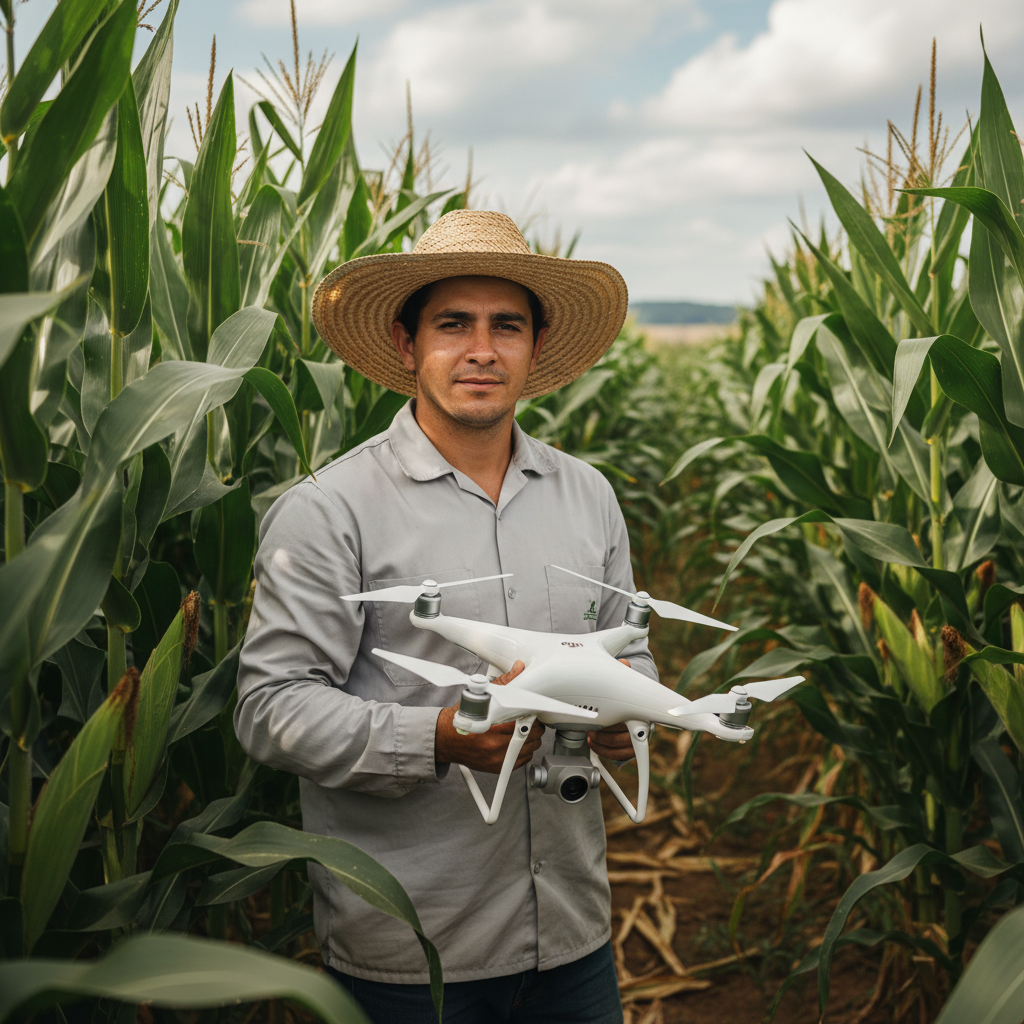
Lucas Fernandes Silva is an agricultural engineer with 12 years of experience in aerial mapping technologies and precision agriculture. ANAC-certified drone pilot since 2018, Lucas has worked on mapping projects across more than 500 rural properties in Brazil, covering areas ranging from small farms to large-scale operations. Specialized in multispectral image processing, vegetation index analysis (NDVI, GNDVI, SAVI), and precision agriculture system implementation. Lucas is passionate about sharing technical knowledge and helping agribusiness professionals optimize their operations through aerial technology.