
Why LAI matters for plant health
Leaf Area Index, or LAI, measures total leaf surface area per ground area — think of it as a roof of leaves that controls how much light and water plants capture. Monitoring LAI reads the crop’s or forest’s pulse: changes show growth, stress, or crowding.
LAI links directly to photosynthesis, transpiration, and biomass. Higher LAI usually means more leaf area to capture light and make food, while very high LAI can trap humidity and increase disease risk. Low LAI often signals water stress, nutrient shortage, or defoliation. Remote sensing (drones, planes, satellites) turns aerial reflectance into LAI maps so you can spot problems before yield drops. LAI (Leaf Area Index): Estimating Leaf Area from Aerial Images helps you see where to scout, irrigate, or fertilize without walking every row.
What leaf area index tells you
LAI indicates how much leaf surface is available to capture light. Rising LAI during the season usually means building canopy and increasing yield potential; stalling or falling LAI flags drought, pests, or nutrient limits. LAI also signals competition: very high LAI can mean dense shade and lower fruit quality; very low LAI means low photosynthetic capacity. Read LAI like a meter — low, healthy, or overloaded — and act accordingly.
Leaf area index estimation for crop and forest health
You can measure LAI several ways:
- Ground methods: leaf area meters, destructive samples.
- Optical tools: hemispherical photos, ceptometers.
- Remote sensing: multispectral drones, satellite indices, LiDAR 3D structure.
Each method trades cost, speed, and accuracy. To get useful LAI for decisions, pick the right tool and timing, and calibrate aerial estimates with a few ground checks. The table below shows common LAI ranges and typical meanings.
| LAI range | What it often means for crops | What it often means for forests |
|---|---|---|
| < 1.0 | Sparse cover, strong stress or early stage | Open understory, recent disturbance |
| 1.0–3.0 | Moderate growth, less shading, harvest may be low | Young or thinning stands |
| 3.0–6.0 | Healthy canopy, good yield potential | Mature canopy, strong carbon uptake |
| > 6.0 | Very dense, possible disease risk | Very dense, low understory light |
Key LAI uses in management
Use LAI maps to:
- Schedule irrigation where LAI drops
- Target fertilizer to low-leaf-area zones
- Focus pest scouting where canopy is dense
- Forecast yield in high-LAI zones
LAI helps allocate time and inputs where they matter most.
LAI (Leaf Area Index): Estimating Leaf Area from Aerial Images basics
If you want a clear, fast way to measure leaf area over acres, LAI (Leaf Area Index): Estimating Leaf Area from Aerial Images converts drone or plane photos into numbers that describe canopy density. LAI is the ratio of leaf surface to ground area; it links directly to water use, photosynthesis, and yield. Images estimate it by measuring reflectance in visible and near-infrared bands and feeding those into models or empirical equations.
Practical steps before mapping:
- Plan steady flights near solar noon to reduce shadows.
- Apply radiometric correction and choose models appropriate for crop and season.
- Calibrate aerial estimates with ground samples to keep maps actionable.
LAI from aerial images explained
Aerial pixels record reflectance; vegetation indices like NDVI or GNDVI translate those signals into metrics correlated with LAI. Models relating indices to LAI differ by crop, season, and sensor — from simple linear fits to radiative transfer approaches. Validate with ground LAI readings.
Estimating leaf area from drone imagery — steps
- Fly for consistent lighting; capture images with adequate overlap to build a clean orthomosaic. Higher spatial resolution helps with small plants and mixed canopies.
- Use multispectral sensors where possible for better LAI sensitivity.
- Process: stitch images, apply radiometric correction, compute indices (NDVI, GNDVI), convert indices to LAI with local models or regressions, and export maps.
- Validate with field samples and update models for different crops or growth stages.
Image types used for LAI
| Image type | Key data | Strengths | Typical use |
|---|---|---|---|
| RGB | Red, Green, Blue | Low cost, high spatial detail | Quick surveys, general canopy cover |
| Multispectral | Adds NIR, Red-edge | Strong LAI sensitivity | Crop monitoring, precision ag |
| Hyperspectral | Many narrow bands | Detailed spectral signatures | Research, stress detection |
| LiDAR | Point clouds, elevation | Direct canopy structure, gaps | Forests, layered canopies |
Choose sensors: multispectral UAV LAI estimation
Choose sensors based on the question and the scale. For LAI mapping across fields or orchards, multispectral UAVs with Red, NIR, and RedEdge bands give strong correlations with leaf area. Fly lower for finer detail but balance coverage and flight time.
Calibration and ground truth matter as much as the sensor. Use ground LAI measurements and reflectance panels to convert imagery into quantitative LAI. Balance data volume and processing time with your timeline: higher resolution means larger files and longer processing.
Multispectral vs RGB — pros and cons
- RGB: cheap, light, good for photogrammetry and structure mapping but limited for quantitative LAI.
- Multispectral: costlier, needs calibration, but provides bands for NDVI/NDRE and better LAI correlation.
- LiDAR: best for 3D structure and biomass but heavy and expensive.
High-resolution canopy structure estimation with LiDAR
LiDAR provides direct 3D structure — point clouds that reveal canopy height, gap fraction, and vertical leaf distribution. For forests and mixed canopies, combine LiDAR (structure) with multispectral (leaf physiology) for the clearest LAI estimates. Tradeoffs: payload, cost, and big-data processing.
Sensor tradeoffs for LAI
Balance spatial resolution, spectral sensitivity, and structural detail against budget and workflow: RGB for low cost, multispectral for LAI sensitivity, LiDAR for 3D structure.
Vegetation index to LAI conversion
Turn vegetation indices from aerial images into LAI (Leaf Area Index): Estimating Leaf Area from Aerial Images by treating indices as proxies for leaf area. They correlate with leaf cover because denser canopies reflect red and NIR differently.
Be mindful of sensor differences, flight time, and atmosphere: the same NDVI from two sensors can mean different LAI if lighting or calibration changes. Record metadata and keep flight settings consistent. Validate early with field LAI samples to build and test your conversion model.
Common indices: NDVI and GNDVI
- NDVI: NIR and Red — general biomass, works across many multispectral sensors.
- GNDVI: NIR and Green — sensitive to chlorophyll and dense canopies; useful for nitrogen and pigment tracking.
| Index | Bands used | Good for | Notes |
|---|---|---|---|
| NDVI | NIR, Red | General biomass, low–moderate LAI | Works with most multispectral sensors |
| GNDVI | NIR, Green | Chlorophyll, dense canopies | Sensitive to leaf pigment; watch green-band quality |
Conversion methods
- Empirical regressions (linear, exponential, segmented): fast and easy but site- and season-specific.
- Machine learning (random forest, SVR): handles multiple inputs like indices and texture.
- Radiative transfer models: physics-based, more generalizable but require expertise.
Calibrate indices with field LAI
Collect field LAI (LAI-2000, ceptometer, or destructive sampling), match points to image pixels, fit models with several dozen samples across canopy states, and report RMSE, bias, and R².
Preprocess images for aerial-image-based LAI mapping
Treat images carefully: check EXIF metadata and flight logs, remove blurred frames, and note sun angle. Work from RAW or high-quality TIFF when possible and back up raw data before corrections.
Plan corrections: separate radiometric from geometric fixes, and flag frames needing special care. Proper prep reduces downstream errors in LAI (Leaf Area Index): Estimating Leaf Area from Aerial Images.
Radiometric correction and reflectance
Convert raw sensor values to surface reflectance using reference panels or a downwelling light sensor. Run dark-frame subtraction, flat-field correction, and apply calibration coefficients. Correct vignetting and sensor drift using tools like Pix4D, Agisoft, or SNAP.
Build orthomosaics and DEMs for canopy metrics
Create an orthomosaic and DEM to get spatial and height data. From dense point clouds produce DSM and DTM, then canopy height model (DSM − DTM). Use GCPs or RTK/PPK for accuracy and choose resolution matched to canopy scale.
Mask non-vegetation and shadows
Mask roads, buildings, bare soil, and shadows so LAI comes only from plants. Use NDVI or color thresholds (ExG for visible-only) and apply morphological cleaning. Good masks keep LAI maps honest.
| Step | Purpose | Common Tools |
|---|---|---|
| Radiometric correction | Convert to reflectance | Pix4D, Agisoft, SNAP |
| Orthomosaic DEM | Georeferenced image and height | Agisoft/Metashape, Pix4D |
| Masking | Remove non-vegetation and shadows | QGIS, ENVI, NDVI stacks |
Apply deep learning for LAI estimation
Deep learning can turn aerial photos into LAI maps quickly. Start with high-quality aerial images (visible NIR), label canopy vs ground on a subset, crop images into patches, normalize bands, and augment data. Train models to predict canopy pixels or LAI directly, using cross-validation and metrics like MAE and RMSE. Convert predicted canopy maps to LAI via physics (Beer’s law) or regression and validate with ground measurements.
Deep learning with CNNs
Use CNN backbones (ResNet, EfficientNet) fine-tuned on labeled patches. For direct LAI prediction use MSE/MAE loss; for segmentation use Dice BCE. Add multispectral bands or NDVI as channels and monitor overfitting with visual tools like Grad-CAM.
Semantic segmentation for canopy mapping
Models like U-Net or DeepLab produce pixel-level canopy masks. Workflow: stitch orthomosaic → label training set → train segmentation → post-process (remove specks, fill holes). For orchards you’ll get crowns; for forests, continuous canopy cover.
From segmentation maps to LAI values
Convert a canopy mask to canopy fraction (fraction of canopy pixels), compute gap fraction = 1 − canopy fraction, then use Beer’s law:
LAI = −ln(gap fraction) / k
where k (extinction coefficient) is ~0.5 for broadleaf canopies but should be calibrated.
Example (k = 0.5):
| Canopy fraction | Gap | LAI |
|---|---|---|
| 0.70 | 0.30 | ≈ 2.41 |
| 0.85 | 0.15 | ≈ 3.79 |
| 0.40 | 0.60 | ≈ 1.02 |
Validate LAI with field data and sensors
Pair remote LAI estimates with field data and sensors. Plan where and when to collect field points, pick representative plots, record date/time/weather, and match plot size to image pixel size. Combine ceptometers, spectral radiometers, and leaf sampling to capture ground truth that aligns with aerial definitions.
Remote sensing LAI retrieval vs ground truth
Remote sensing: fast, wall-to-wall coverage but affected by soil background, canopy structure, and mixed pixels. Ground truth: local, detailed measurements used for calibration and validation. Expect scatter; look for patterns and correct systematic biases.
| Aspect | Remote sensing | Ground truth |
|---|---|---|
| Coverage | Large areas quickly | Local, detailed |
| Typical errors | Mixed pixels, atmosphere | Sampling error, small-scale variability |
| Best use | Wall-to-wall maps | Calibration & validation |
Use LAI meters and sample plots
Use LAI meters or optical instruments for repeatable field measurements. Take multiple readings, design plots to reflect map classes (random or stratified), and replicate to measure variability. Record metadata consistently.
Report RMSE and bias for accuracy
When comparing remote and ground LAI, compute RMSE and bias and report sample size. Example: RMSE = 0.35 m2/m2, bias = −0.10 m2/m2, n = 30.
Map results and integrate in GIS
Export results in GeoTIFF or Cloud-Optimized GeoTIFF (COG) to load LAI rasters into desktop or cloud GIS. Add CRS metadata and pyramids for performance. Share via WMS/WMTS or XYZ tiles and provide vector summaries (GeoJSON/Shapefile) with attributes like mean LAI, standard deviation, and processing date.
Aerial-image-based LAI mapping tiles and layers
Separate outputs into tiles for delivery and layers for analysis (raw LAI, smoothed LAI, quality masks). Provide metadata (date, sensor, flight altitude, processing method) so users know what they’re viewing.
| Output | Purpose | GIS action |
|---|---|---|
| LAI GeoTIFF (COG) | Full-resolution analysis | Add as raster; calculate zonal stats |
| XYZ/WMTS tiles | Fast web visualization | Serve in web map |
| Vector summaries (GeoJSON) | Reports & dashboards | Join to fields; style by LAI class |
Visualize temporal LAI change for decisions
Create time-series layers or charts per field showing LAI rise/fall. Map deltas with clear color ramps (green = growth, brown/red = loss). Use sliders or animated maps for date navigation and provide summary stats (weekly averages, cumulative increase) for managers.
Export LAI maps for stakeholders
Provide both visual (PNG/PDF) and numeric (CSV/GeoJSON) products, plus a short metadata sheet listing date, sensor, processing steps, and confidence.
Best practices and limits for LAI (Leaf Area Index): Estimating Leaf Area from Aerial Images
To be reliable and repeatable:
- Plan flights (consistent GSD), pick sensors with visible NIR bands, and perform radiometric calibration every flight.
- Design validation plots across canopy densities and species; record canopy height and cover.
- Report uncertainty: aerial methods saturate at high leaf densities and can miss understory leaves under closed canopies.
Plan flights and sampling to reduce error
Fly during stable lighting (solar noon ± 2 hours), use consistent altitude and speed, and plan 60–80% forward overlap and 60% side overlap. Match plot size to GSD and use 5–8 well-distributed GCPs or survey-grade GPS.
Known limitations of LAI from aerial images
- Saturation in dense canopies: spectral indices stop increasing with more leaf area.
- Mixed pixels: species, branches, and ground can bias values.
- Atmospheric effects and sun angle change reflectance. Report these limits with maps and avoid overclaiming precision.
Checklist for reliable LAI mapping
| Checklist item | Why it matters | Target/action |
|---|---|---|
| Sensor & bands | Separates leaf signal | Use NIR visible; match GSD to canopy |
| Flight timing & overlap | Reduces shadows/gaps | Fly near midday; 60–80% forward overlap |
| GCPs & GPS | Fixes geometric error | 5–8 GCPs; survey-grade if possible |
| Validation plots | Quantifies bias/error | Sample across densities & species |
| Radiometric calibration | Compares flights | Use targets or vicarious methods |
| Metadata logging | Enables repeatability | Record time, weather, sensor settings |
Frequently asked questions
- What is LAI (Leaf Area Index): Estimating Leaf Area from Aerial Images?
LAI is leaf area per ground area. Using aerial photos, LAI (Leaf Area Index): Estimating Leaf Area from Aerial Images converts pictures into numeric maps you can use for management. - How do you prepare aerial images for LAI estimation?
Fly at steady height near midday, capture high overlap, calibrate radiometrically, remove bad frames, and crop to the study area. - Which tools can you use to estimate LAI from aerial images?
Pix4D, Agisoft/Metashape, QGIS, ArcGIS, SNAP, and machine learning frameworks. Use NDVI and other indices or ML models depending on skill and budget. - How accurate is LAI (Leaf Area Index): Estimating Leaf Area from Aerial Images using drones?
Useful results commonly show ~10–30% error depending on canopy, lighting, sensor, and method. Always ground-check a sample. - How do you validate LAI results on the ground?
Measure with LAI meters or leaf sampling, match ground points to image pixels, compare values, and adjust models. Repeat validation across seasons.
Quick summary
LAI (Leaf Area Index): Estimating Leaf Area from Aerial Images provides a fast, scalable way to map canopy density and support decisions on irrigation, fertilization, pest management, and yield forecasting. Success depends on sensor choice (multispectral or LiDAR where needed), radiometric calibration, representative ground truth, and honest reporting of uncertainty. Follow the checklist, validate often, and use maps as decision aids rather than absolute truth.
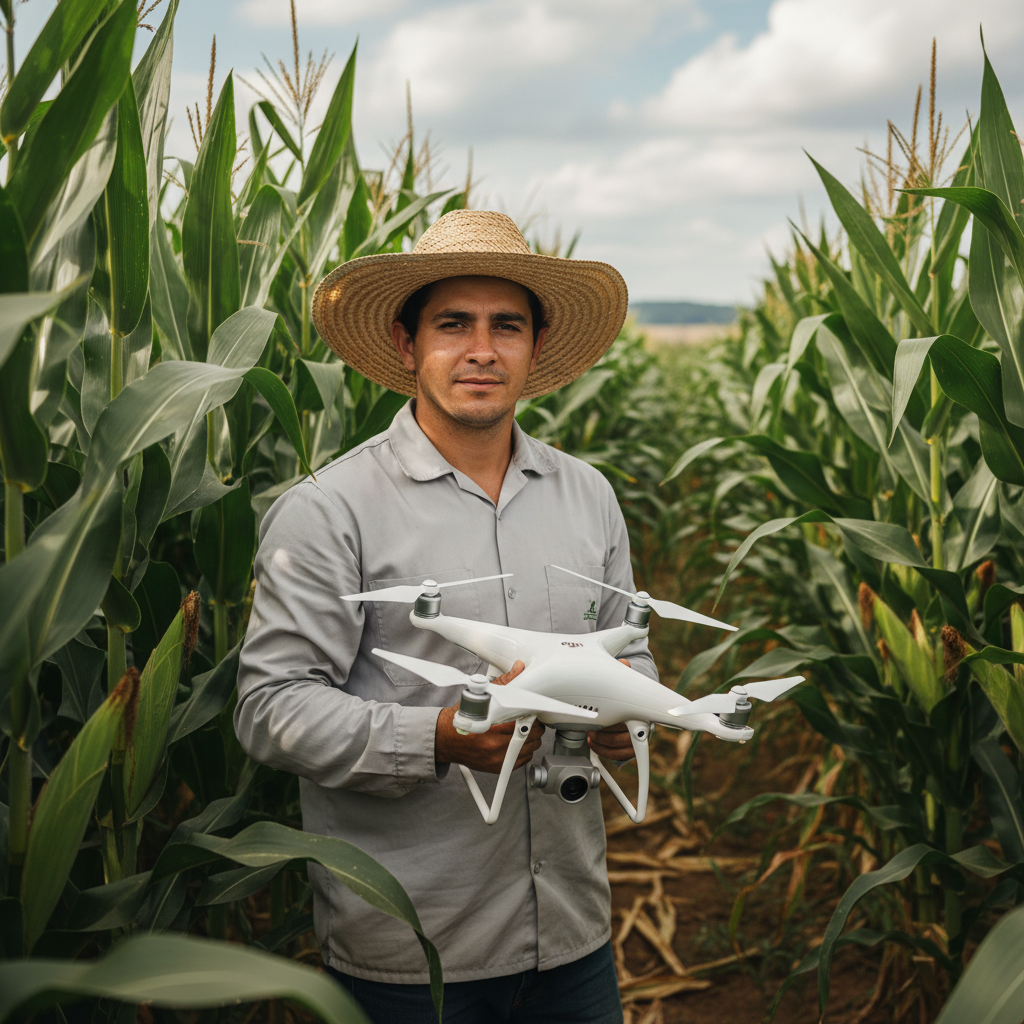
Lucas Fernandes Silva is an agricultural engineer with 12 years of experience in aerial mapping technologies and precision agriculture. ANAC-certified drone pilot since 2018, Lucas has worked on mapping projects across more than 500 rural properties in Brazil, covering areas ranging from small farms to large-scale operations. Specialized in multispectral image processing, vegetation index analysis (NDVI, GNDVI, SAVI), and precision agriculture system implementation. Lucas is passionate about sharing technical knowledge and helping agribusiness professionals optimize their operations through aerial technology.