
Multispectral camera spectral bands overview
You’ll think of spectral bands as separate color filters the camera uses to see different slices of light. Each band captures a specific wavelength range, producing a stack of images where each layer shows different material traits. That stack is the raw material for maps, reports, and indices you will make. This guide — Multispectral Cameras: Spectral Bands and Calculation of Customized Indices — ties band choices to the math and results you’ll trust.
Bands let you pull out signals plants, water, and soil hide. For example, combining red and near‑infrared (NIR) bands gives vegetation vigor. Choose bands with your goal in mind: more bands can catch subtle stress, but you may trade off spatial resolution or flight time. Look at band centers, bandwidths, and sensor noise before you buy or fly.
How the sensor records wavelengths
Sensors use filters or optical elements to split light so each pixel measures a narrow slice of the spectrum. Light hits the lens, then the filter/sensor passes only certain wavelengths to the detector. The detector converts photons into digital numbers (DNs) that you later convert to reflectance.
Handle calibration and exposure to get usable data: use a white reference panel, log metadata, and apply radiometric calibration to translate DNs into physical reflectance. Keep good flight logs and sensor settings so your bands line up across flights.
Typical visible, NIR, red‑edge bands
Use this cheat sheet to pick bands for standard or custom indices.
| Band name | Typical center (nm) | Typical use |
|---|---|---|
| Blue | 450 | Water, haze correction |
| Green | 550 | Vegetation vigor, chlorophyll proxy |
| Red | 660 | Photosynthetic absorption, NDVI numerator |
| Red‑edge | 700–740 | Early stress detection |
| NIR | 800–900 | Biomass, canopy structure, NDVI denominator |
Those centers are rough; band widths vary by sensor. If you compare sensors, look at the exact center and full width at half maximum (FWHM) to match indices. Red and NIR make classic indices like NDVI, while red‑edge bands let you spot stress before leaves yellow.
Sensor spectral response basics
The spectral response shows how much each sensor band reacts across wavelengths. Overlap between bands and shape of these curves change index values. Use manufacturer curves and fit them to reflectance data if you want precise, repeatable indices.
Spectral band selection for vegetation indices
Pick bands to get the signal that matters—focus on where plants absorb and reflect light: red, NIR, and often red‑edge. Check your sensor’s band centers, bandwidth, and signal‑to‑noise ratio so you don’t chase noisy or off‑target data. Start with the sensor spec sheet and map those numbers to the indices you plan to run.
For simple indices like NDVI, match red and NIR to classic centers (around ~660 nm and ~800–850 nm). For stress or chlorophyll estimates, add a red‑edge band (around 710–740 nm). Balance spectral resolution and spatial coverage: narrower bands give spectral discrimination, wider bands raise signal strength but can mix features.
Test and document everything: run a field check with a reflectance panel, compare results across flights or dates, and keep a log of sensor settings, illumination, and processing steps. Make band choice a repeatable step in your workflow.
Choose bands for NDVI and others
For NDVI, pick a red band near 660 nm and an NIR band near 800–850 nm. You want strong chlorophyll absorption in red and strong leaf‑structure reflectance in NIR. If your sensor’s red is shifted toward orange or the NIR is narrow, NDVI values will change—check center and bandwidth before computing indices.
For other indices, add or swap bands: green for GNDVI, red‑edge for early stress, and shortwave infrared (SWIR) for water content. When you craft a custom index, align the formula with the physical signal you target. Keep math simple: ratios, normalized differences, or simple differences are robust.
Red, NIR, and red‑edge roles
The red band shows chlorophyll absorption—healthy leaves have low red reflectance. NIR reflects leaf internal structure; higher NIR means more leaf area. The red‑edge sits between red and NIR and shifts with chlorophyll changes, making it an early‑warning sign before NDVI drops. Watch sensor noise in narrow red‑edge bands; if noise is high, average or smooth before computing indices.
Band selection checklist
Check sensor band centers and bandwidth, confirm SNR at target bands, pick red/NIR for NDVI, add green or red‑edge for specific indices, validate with a reflectance panel, and record settings and environmental conditions for each flight.
Normalized Difference Vegetation Index (NDVI) calculation
NDVI is a simple, powerful index that shows vegetation greenness by comparing reflectance in near‑infrared (NIR) and red wavelengths. It’s a quick health check: healthy leaves reflect much NIR and absorb red, so NDVI increases.
Use reflectance inputs (not raw DNs) so values are comparable across times and sensors. NDVI typically ranges from -1 to 1; most live vegetation sits above 0.2 to 0.5. If you use drones or satellites, pick sensors with clear NIR and red bands. Keep track of calibration, sun angle, and masks for clouds or water so NDVI reflects true conditions, as emphasized in Multispectral Cameras: Spectral Bands and Calculation of Customized Indices.
NDVI formula and inputs
NDVI = (NIR − Red) / (NIR Red)
Plug in pixel‑level reflectance for NIR and Red. Handle division issues where NIR Red ≈ 0 by setting those pixels to no data or using a safe filler. Note whether your bands are at‑sensor reflectance, top‑of‑atmosphere, or surface reflectance—this affects comparability.
| Input Band | Typical Wavelength (nm) | Notes |
|---|---|---|
| Red | 600–700 | Strong absorption in healthy leaves |
| NIR | 700–900 | Strong reflectance in healthy leaves |
| Output | -1 to 1 | Vegetation index; higher = greener |
How you compute NDVI in software
Load your red and NIR bands, convert DN to reflectance if needed using radiometric calibration or sensor metadata, then run the pixel‑wise formula in a raster calculator, Python script, or GIS tool. Use floating point datatypes to preserve decimals. Mask clouds, shadows, and water; clip to your area of interest; export a georeferenced float raster or scale to 8/16‑bit if needed. Automate the steps for batch repeats.
NDVI quick steps
Get Red and NIR bands → convert to reflectance → compute (NIR − Red)/(NIR Red) per pixel → mask clouds/water → export georeferenced NDVI raster.
Customized index calculation & multispectral workflows
Start by naming the trait you want to see from the sky (chlorophyll, canopy cover, water stress, etc.). Then pick bands that react to that trait—NIR and red for biomass; red‑edge for chlorophyll. Multispectral Cameras: Spectral Bands and Calculation of Customized Indices links sensor specs to which spectral bands matter for your trait.
Build a simple repeatable pipeline: radiometrically correct images, align them in time and space, compute candidate indices using simple formulas (ratios or normalized differences), and validate with ground data. Loop and refine: run indices, check correlation with ground samples, drop weak ones, and tweak formulas. Save each version and its score; over time you’ll have a short list of robust indices for your crop, site, and season.
Define your target crop trait
Ask what exact trait you want to measure: leaf chlorophyll, biomass, stomatal closure, canopy cover, etc. The trait decides which bands matter—chlorophyll often lights up in red edge and NIR, while water stress may show in SWIR or simple NIR/green contrasts.
Set the scale and timing: plant‑level detail vs. field averages, weekly changes vs. single events. If you need plant‑level stress, fly lower and use more bands; for seasonal trends, focus on regular flights and stable preprocessing.
Validate indices with ground data
Test indices with real samples: SPAD for chlorophyll, clipped biomass, or yield. Match ground points to pixels or averaged pixel blocks. Record date, time, and sun angle.
Use simple stats: correlation, mean error, and scatter plots. If correlation is high and errors low, the index is ready. If not, change bands, formula (ratio vs. normalized difference), or remove noisy bands. Use a holdout set to avoid overfitting.
Custom index design rules
Pick bands with a clear signal for the trait, normalize to remove light changes, favor simple math (ratios or normalized differences), avoid dividing by near‑zero values, and test across seasons or fields. Keep formulas short so they run fast and are easy to explain.
| Use case | Typical bands | Simple formula | When to pick it |
|---|---|---|---|
| Biomass / vigor | NIR, Red | (NIR − Red) / (NIR Red) | Early season green‑up |
| Chlorophyll | Red edge, NIR | (RedEdge − Red)/(RedEdge Red) | Detect nutrient issues |
| Water stress | SWIR or NIR, Green | NIR / Green | Stress during dry spells |
Multispectral band math techniques for mapping
Think of each spectral band as a colored lens on your data. Mix lenses with simple math to reveal patterns you can’t see by eye. Use band math to spot vegetation health, water, soil moisture, and man‑made materials. Start by choosing the right bands, check alignment and resolution, then combine them with ratios, differences, or normalized indices.
Band math is fast and cheap: ratio NIR/Red highlights vigor; difference NIR − Red shows contrast; normalized (NIR − Red)/(NIR Red) keeps values between −1 and 1. Before mapping, apply scaling, offsets, or atmospheric correction as needed; clip clouds and shadows first.
Use ratios, differences, and normalization
Use ratios for relative strength (e.g., NIR/Red). Use differences when absolute contrast matters (e.g., NIR − Red). Normalize with (A − B)/(A B) for consistent scales across dates, sensors, or fields.
Implement band math in GIS or Python
In GIS, use the Raster Calculator or map algebra. In Python, load bands with rasterio or GDAL and compute with NumPy: read arrays, convert to float, apply formula, mask division by zero, and write outputs. Process in blocks if memory is tight.
Band math tips
Always align and resample bands to the same grid, convert to the correct data type, mask clouds and edges, and apply scaling or calibration first. Avoid division by zero by adding a tiny constant or masking. Test formulas on small tiles before batch processing.
| Operation | Formula example | Typical use |
|---|---|---|
| Ratio | NIR / Red | Emphasize vegetation vigor |
| Difference | NIR − Red | Contrast in brightness |
| Normalized index | (NIR − Red) / (NIR Red) | Scaled index for comparison |
Converting raw DN to reflectance
Start with Digital Numbers (DN) from the sensor. Convert DN → radiance → reflectance so measurements are comparable across flights. In Multispectral Cameras: Spectral Bands and Calculation of Customized Indices, this conversion is the step that lets you compare bands and build custom indices.
Begin with a calibration plan: capture dark frames, use reflectance panels, and log camera settings and sun angle. Dark frames remove sensor bias, panels give a reference for actual light, and gain ties counts to energy.
After calibration you can compute indices, classify surfaces, or map soil moisture with confidence. Keep records for every flight: panel values, gains, and processing steps.
Apply dark offset and gain
Remove the dark offset by subtracting per‑band median/mean dark values from each pixel. Then apply gain: Radiance = (DN − dark_offset) × gain. Check linearity across exposures; if the sensor clamps, correct settings before flying.
Use reflectance panels and coefficients
Place a calibrated reflectance panel in the scene under the same sun and camera settings. Measure panel DN after dark offset and gain. Compute coefficient = knownreflectance ÷ panelradiance, then multiply every pixel’s radiance by that coefficient to get reflectance. Watch for changing light—re‑capture panels if conditions shift.
DN to reflectance steps
- Capture dark frames and panels
- Subtract dark offset from raw DN
- Multiply by gain to get radiance
- Compute per‑band calibration coefficients from panels
- Apply coefficients to get reflectance
- Validate with an independent panel or ground truth
| Step | Operation | Formula / Note |
|---|---|---|
| 1 | Dark subtraction | DNcorr = DNraw − darkoffset |
| 2 | Radiance scaling | Radiance = DNcorr × gain |
| 3 | Panel coeff. | coeff = panelknownreflectance ÷ panelradiance |
| 4 | Final reflectance | Reflectance = Radiance × coeff |
Sensor radiometric calibration for multispectral cameras
Radiometric calibration converts raw pixel values to physical units. Measure dark current, gain, and offset per band, then apply per‑band scaling so readings match a known reflectance target. Small errors in one band can wreck a custom index, so use reference panels, log exposure, and record ambient light and firmware.
Calibration is routine: capture dark frames, capture panels before and after flight, note temperature, and run the same script to apply corrections so results are consistent.
Lab calibration vs. field calibration
- Lab calibration: high control, good for spectral response, non‑linearity, cross‑talk, and baseline gain/offset. Use integrating spheres or calibrated light sources.
- Field calibration: measures scene‑level reflectance and irradiance under real conditions. Use reflectance panels and a reference irradiance sensor. Do this every flight or as light changes.
| Aspect | Lab calibration | Field calibration |
|---|---|---|
| Control over light | High — stable sources | Low — sun and clouds vary |
| What you measure | Spectral response, gain, offset | Scene‑level reflectance, irradiance |
| Best for | Sensor characterization | Operational corrections |
| Frequency | Once per sensor update | Every flight or as light changes |
Correct for vignetting and temperature
Measure lens falloff with a uniform target or sky dome and create per‑band vignetting correction maps. Log sensor temperature and build temperature‑dependent corrections if you see drift. Apply these corrections before computing indices.
Calibration routine checklist
Capture dark frames → record sensor temperature → photograph reference panels before & after flight → apply vignetting map → correct for gain/offset per band → save all metadata (exposure, ISO, firmware).
Multispectral band combinations for crop monitoring
Think of bands as colors on a painter’s palette. Combine Red, Green, NIR, and sometimes Red Edge or SWIR to compute indices highlighting leaf area, chlorophyll, water content, or stress. Multispectral Cameras: Spectral Bands and Calculation of Customized Indices links sensor specs to what you can calculate.
Small math yields big payoff: NDVI (NIR − Red)/(NIR Red) tracks biomass; swap Red for Green to get GNDVI for chlorophyll; add Red Edge to get NDRE for nitrogen and early stress. If your camera lacks a band, pick the best available index for your sensor.
Best band mixes for biomass and stress
For biomass: NIR Red (NDVI). Add Green for GNDVI to focus on chlorophyll. If you have Red Edge, use NDRE for early detection. For stress: include Red Edge and SWIR for water content. Tune thresholds with field checks.
| Band mix | Typical index | What it highlights | When to use |
|---|---|---|---|
| NIR Red | NDVI | Biomass / green cover | Routine vigor mapping |
| NIR Green | GNDVI | Chlorophyll / leaf nitrogen | Mid‑season nutrient checks |
| NIR Red Edge | NDRE | Early stress / nitrogen | Early detection, pre‑visual stress |
| NIR SWIR | NDWI | Water content | Drought and irrigation monitoring |
Use time series for trend detection
A single image is a snapshot; a time series is the movie. Collect repeat images on a schedule (weekly or bi‑weekly) and plot index values over time. Align images, apply consistent masks/calibrations, smooth curves with a moving average, and mark events like fertilization or irrigation. When a trend breaks, check the field.
Crop monitoring combos
Quick combos: NIRRed (NDVI) for biomass, NIRGreen (GNDVI) for chlorophyll/nitrogen, NIRRed Edge (NDRE) for early stress, and NIRSWIR (NDWI) for water monitoring. Pair indices with ground checks and a threshold plan.
Spectral response function and index optimization
Know the Spectral Response Function (SRF) because it tells you how each camera band reacts across wavelengths. SRF is the camera’s fingerprint for color; it changes how index formulas behave in the real world. Optimize indices by comparing SRF to index bands and adjusting coefficients or choosing different bands so outputs match the signal you want, not sensor quirks.
Measure SRF and match your bands
Obtain published SRF curves or measure them with a spectrometer and a uniform light source. Plot curves and mark central wavelength and bandwidth. Compare SRF to target band centers—look for overlap, gaps, and shifts. If bands overlap too much, the index loses contrast; if peaks are shifted, apply wavelength‑shift correction or choose another band.
| SRF issue | What to check | Action |
|---|---|---|
| Overlap between bands | Degree of overlap area | Change formula to reduce shared contribution or use deconvolution |
| Shifted peak wavelength | Difference from target center | Apply wavelength‑shift correction or choose another band |
| Narrow/wide bandwidth | FWHM vs expected | Modify weighting in index or use synthetic band integration |
Optimize indices using SRF data
Rewrite index coefficients or build weighted sums using SRF. Compute synthetic bands by integrating SRF × target spectral radiance; this reflects what the sensor actually senses. Test on simple targets (green vegetation, bare soil, water) and compare histograms. If class separation improves, save SRF‑corrected presets.
SRF optimization steps
Measure/obtain SRF curves → compare to index band centers → compute synthetic bands (SRF × spectral radiance) → adjust index weights/coefficients → validate with ground or reference targets → save corrected formulas.
Frequently asked questions
- What are the main spectral bands in Multispectral Cameras: Spectral Bands and Calculation of Customized Indices?
Blue, Green, Red, Red‑edge, and Near‑Infrared (NIR). These let you spot vegetation and water.
- How do you pick bands for a custom index?
Pick bands that highlight your target trait. Test simple combos like NIR Red first and keep formulas interpretable.
- How do you calculate a simple custom index?
Convert images to reflectance, use a formula such as (NIR − Red)/(NIR Red), and run it on aligned, calibrated bands.
- How do you handle calibration and alignment?
Use reflectance panels for calibration, correct lens vignetting, match band pixels (alignment/resampling), and verify with ground truth samples.
- What tools help create indices?
QGIS, SNAP, Pix4D, or Python (rasterio, GDAL, NumPy). Start with GUI tools, then script for repeatable pipelines.
This guide — Multispectral Cameras: Spectral Bands and Calculation of Customized Indices — is designed to help you pick bands, calibrate your sensor, compute robust indices, and build repeatable workflows so your maps support real decisions.
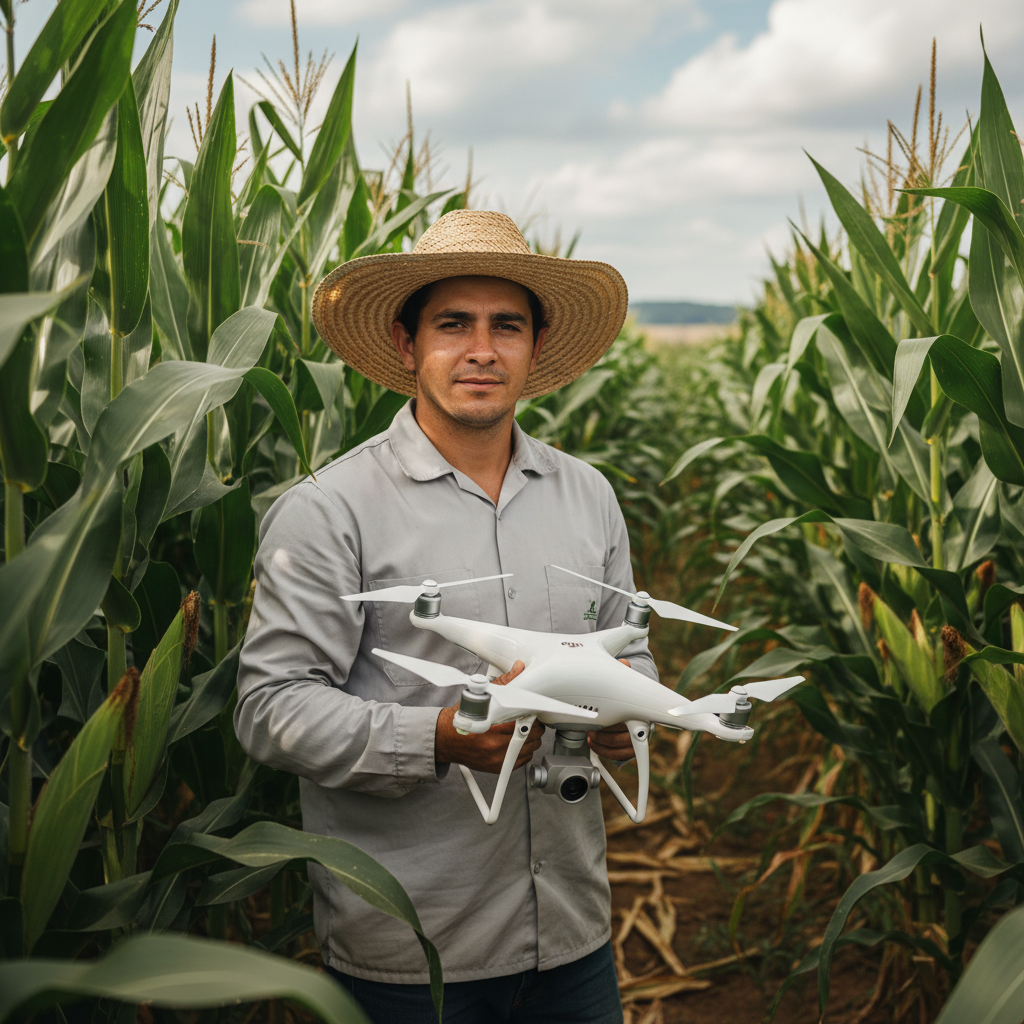
Lucas Fernandes Silva is an agricultural engineer with 12 years of experience in aerial mapping technologies and precision agriculture. ANAC-certified drone pilot since 2018, Lucas has worked on mapping projects across more than 500 rural properties in Brazil, covering areas ranging from small farms to large-scale operations. Specialized in multispectral image processing, vegetation index analysis (NDVI, GNDVI, SAVI), and precision agriculture system implementation. Lucas is passionate about sharing technical knowledge and helping agribusiness professionals optimize their operations through aerial technology.