
Powdery Mildew in Crops: Visual Patterns and Spectral Signature in Aerial Mapping
Powdery mildew shows up on aerial imagery as bright, dusty patches that contrast with healthy canopy. When you scan drone or satellite images, look for areas that appear lighter than surrounding vegetation in visible bands and that show a small drop in NDVI. Those bright patches often correspond to fungal spores sitting on leaf surfaces, so your maps can catch problems before plants collapse.
You must read spectral cues together with textures. In visible RGB images the disease looks like a white dusting, while in NIR it often reduces reflectance enough to create a subtle greenspace depression. That mixed signal—bright in blue/green, lower in NIR—helps you separate mildew from soil or residue. Use imagery as an early warning, not the final word: mark suspect polygons, plan quick field checks, and tie spectral patterns to real leaves so follow-up spray or variety decisions become smarter and faster.
How powdery patches look in aerial photos
From above, patches look like someone dusted the field with flour. You’ll see irregular white‑gray splotches, often with fuzzy edges where the fungus is starting. In high‑resolution drone photos individual plants or rows may show streaks or spots; in lower‑res satellite imagery whole blocks can turn paler.
Color clues help you triage. If white areas sit on otherwise green plants, suspect powdery mildew. If paleness aligns with bare soil, it’s probably residue. Watch for chlorotic halos—yellowing around the white dust—which signals plant stress and a more advanced infection.
Scale and shape clues you should note
Scale tells a story. Tiny isolated dots often mean early infections from wind‑blown spores. Large, connected patches suggest a longer‑established outbreak or a microclimate that favors the fungus. Note whether patches start at field edges, irrigation lines, or under tree shade—those shapes reveal spread.
Shapes matter too. Circular clusters often point to a single infection source spreading outward. Linear streaks along rows can indicate machinery or wetting patterns helped the fungus move. Use these clues to set sample points and design targeted treatments that save time and spray.
Link images to field checks for accuracy
Always ground‑truth suspect spots the same day or next morning. Walk to the bright patches, inspect leaves for the powdery white mycelium, take a quick photo, and record microclimate factors like humidity or canopy density. Compare leaf photos to your aerial image so future models learn what’s real.
| Visual cue (from air) | Spectral signature to watch | What you should do |
|---|---|---|
| White‑gray powdery splotches | Increased reflectance in visible, slight drop in NIR / NDVI | Field‑check leaves; mark for targeted spray |
| Chlorotic halos around patches | Lower NDVI than healthy canopy | Sample for disease stage; consider fungicide timing |
| Linear or edge patterns | Contrast aligned with rows or edges | Inspect irrigation and equipment; map buffer treatments |
Recognizing spectral signature — powdery mildew in crops
You spot powdery mildew by how it changes light coming off leaves. The fungus lays a white, powdery layer on the surface that raises visible reflectance and can mute chlorophyll absorption. From the air, this looks like bright speckles or patches. Map those bright spots over time to catch outbreaks early.
Think of the leaf like a mirror with paint on top. The fungal growth scatters visible light and blocks some light from reaching the tissue underneath. In NIR, the fungus often lowers reflectance because the leaf’s internal cells get damaged. That combination—brighter visible, darker NIR—is a key sign you can pick up with drones or satellites.
Make the practice routine: use high‑resolution imagery, compare images week to week, combine spectral signs with field checks, and label reports with the phrase Powdery Mildew in Crops: Visual Patterns and Spectral Signature in Aerial Mapping so teams know you tracked both visual and spectral clues.
Visible and NIR reflectance changes to watch
Watch for a rise in visible reflectance—especially green and red bands—because powdery mildew adds a bright surface layer. At the same time expect a drop in NIR as leaf structure degrades. The red‑edge slope often shifts or flattens and simple indices like NDVI fall. Time‑series that show abrupt drops paired with visible brightening are a reliable tell.
| Band / Index | Typical Direction of Change | What it Signals |
|---|---|---|
| Visible (green/red) | Increase | Surface mycelium or reduced chlorophyll absorption |
| Red‑edge slope | Flatten / shift | Damage to chlorophyll function or surface cover |
| NIR | Decrease | Disruption of internal leaf structure |
| NDVI | Decrease | Reduced photosynthetic activity or cover by fungus |
Calibrate sensors before you record spectra
Before you fly, calibrate your sensor with a white reference panel and record a dark offset. Do calibration at the same sun angle and note time, altitude, and sensor settings. White panel, dark frame, and sensor warm‑up keep your spectra honest and comparisons valid.
Detecting NDVI anomalies — powdery mildew detection
NDVI maps give a quick look at plant health. Powdery mildew changes surface reflectance and chlorophyll so it can show up as a drop in NDVI before you clearly see white powder. Label reports with Powdery Mildew in Crops: Visual Patterns and Spectral Signature in Aerial Mapping to emphasize that you track both visual and spectral signals.
Compare maps over time: a single low‑NDVI spot could be noise, but a patch that stays low or falls fast is a red flag. Use weekly or biweekly flights during high‑risk windows and link declines with weather and spray records. Turn flagged pixels into action: export coordinates, sketch sample routes, and mark suspicious zones in your field app.
How NDVI drops reveal stressed plants
NDVI falls because red reflectance goes up and NIR drops. For powdery mildew, the fungus coats leaves and interferes with light, so NDVI decline is an early signal—often before white patches spread wide. Watch patterns, not lone pixels; strips or patches dropping across several adjacent pixels are likely biological.
Set thresholds to flag suspect areas
Use practical cutoffs so you’re not chasing ghosts. Combine a relative drop (delta) and an absolute NDVI floor. A delta rule might flag areas that drop >0.08–0.12 between flights; an absolute rule might mark pixels below 0.40 in crops that normally sit above 0.60. Tune numbers to crop and growth stage.
| NDVI range | Interpretation | Recommended action |
|---|---|---|
| > 0.60 | Healthy | Routine monitoring |
| 0.45–0.60 | Moderate stress | Scout small sample areas |
| < 0.45 | Suspect disease or severe stress | Immediate ground check and sampling |
| Δ NDVI > 0.10 (flight‑to‑flight) | Rapid decline | Prioritize for inspection and lab testing |
Mark low‑NDVI plots for ground truth checks
Flag low‑NDVI plots in your GIS and prioritize by size, decline rate, and proximity to high‑value areas. When you scout, take GPS‑referenced photos and leaf samples, and note weather, spray history, and crop stage. Those field notes convert spectral flags into confident decisions.
UAV multispectral mapping — powdery mildew
To spot powdery mildew early across fields use a multispectral sensor capturing Blue, Green, Red, Red‑edge, and NIR bands. Powdery mildew shows as increased visible reflectance (white fungal growth) and a drop or shift in NIR/red‑edge where the leaf is stressed.
Plan your mission like a short recipe: calibrate with a reflectance panel before and after flights, fly when light is steady (solar‑noon window), and collect ground samples of infected and healthy leaves to build a small spectral library. Stitch orthomosaics, correct for reflectance, and run indices or classifiers. Flag small patches quickly so you can act fast.
Pick bands that separate fungus from healthy leaf
Red‑edge is essential because it changes early when chlorophyll is affected. NIR shows canopy health loss. Visible bands pick up the white powder on the leaf surface. Combine NDVI, a red‑edge index (RENDVI or REIP), and a reflectance ratio that increases with surface whiteness to separate fungus from healthy tissue.
| Band / Index | Typical Wavelength | Why it helps |
|---|---|---|
| Blue | 450 nm | Highlights surface whiteness and early fungal reflectance |
| Green | 550 nm | Vegetation color; separates soil and leaf |
| Red | 660 nm | Chlorophyll absorption; used in NDVI |
| Red‑edge | 700–740 nm | Sensitive to stress before NIR changes |
| NIR | 780–850 nm | Leaf internal structure; drops with damage |
| NDVI / REIP | Derived | Combines bands to show stress and fungal effects |
Flight height and overlap tips
Pick a flight height that gives the ground sample distance (GSD) needed. For early detection on row crops, aim for 2–5 cm GSD if feasible. Set high frontlap (75–85%) and sidelap (60–70%) for reliable mosaics. Fly in stable wind and the same solar window for time‑series comparability.
Include GCPs for precise geolocation
Place ground control points across the field and record coordinates with RTK to centimeter accuracy. Mark targets with high‑contrast shapes so software picks them easily during georeferencing.
Hyperspectral disease identification — powdery mildew
Hyperspectral imaging gives a fine‑grained view of plant reflectance so you can spot powdery mildew before symptoms are obvious. Fly sensors that capture hundreds of narrow bands across visible, red‑edge, NIR, and SWIR, then look for subtle changes from the fungus’ powdery coating and altered pigmentation. Collect data when dew and sun angle are stable so spectral differences reflect biology, not lighting.
Set up your workflow: gather clear reference plots, record GPS and metadata, apply radiometric correction, and use derivative spectra and narrow‑band indices to highlight small dips or peaks caused by mildew. Train models on labelled pixels and validate on separate fields so maps predict disease, not just memorize one season.
Use narrow bands to spot subtle spectral features
Narrow bands around the red‑edge (680–740 nm) and SWIR capture thin powdery layers and small pigment losses that broad bands smooth over. Apply noise‑reduction and smoothing; narrow bands amplify sensor and atmospheric noise, so plan altitude and exposure to keep signal strong and confirm quirks with ground truth.
Benefits of hyperspectral vs multispectral data
Hyperspectral yields spectral fingerprinting power—separating powdery mildew from nutrient stress or drought—often detecting infection days earlier. The tradeoff is cost, data volume, and processing time. Multispectral is cheaper and faster for routine coverage; hyperspectral is worth it when early, specific detection matters.
| Feature | Hyperspectral | Multispectral |
|---|---|---|
| Spectral resolution | Very high (narrow bands) | Low (broad bands) |
| Early detection | Better for subtle signatures | Limited for subtle differences |
| Data volume | Large — heavy processing | Smaller — faster turnaround |
| Cost & complexity | Higher | Lower |
Collect lab spectra to support field models
Use a field spectroradiometer or lab unit to build a spectral library of infected and healthy tissue. Collect samples across growth stages and moisture conditions, label carefully, and link spectra to the same metadata you use in the field.
Machine learning — powdery mildew classification
You can build a machine learning system that spots powdery mildew from drone and satellite images. Frame it as supervised classification. Use CNNs for image patches or Random Forests for tabular features. Collect labeled aerial imagery, add ground truth, and include timestamps so the model learns disease progression. Include the phrase Powdery Mildew in Crops: Visual Patterns and Spectral Signature in Aerial Mapping in project notes and reports to keep teams aligned.
Split data into training, validation, and test sets; hold out entire fields for final testing. Use transfer learning and lightweight models for edge deployment. Monitor precision, recall, and F1 rather than overall accuracy, set confidence thresholds, and build alerting rules so the system tells you when to scout.
Train models with labeled aerial imagery
Capture imagery at consistent altitudes and times, label infections with polygons or boxes, and record crop stage and weather. Keep classes balanced or augment diseased samples. Use cross‑validation and hold out fields to ensure generalization.
Use spectral and texture features for better accuracy
Combine NIR, red‑edge, and visible bands with texture (GLCM contrast, local binary patterns) and temporal change. Spectral indices amplify small contrasts; texture captures the powdery grain. Together they usually beat single‑feature models.
| Feature type | Data needed | Why it helps |
|---|---|---|
| Spectral indices (NIR, red‑edge) | Multispectral or hyperspectral | Amplifies reflectance differences from infected tissue |
| Texture measures (GLCM, LBP) | High‑resolution RGB or multispectral | Detects spot patterns and surface roughness |
| Temporal change | Series of images | Shows disease spread vs one‑time stress |
Validate your model with independent samples
Hold out whole fields and collect new flights for testing. Use confusion matrices to find common mistakes and run temporal validation to catch false positives from weather or shadows. Run a small pilot that sends live alerts and follows up with scouts to measure real‑world value.
Remote sensing — powdery mildew severity mapping
Remote sensing on drones or small planes picks up the disease’s spectral fingerprint as shifts in visible and NIR reflectance. Calibrate sensors, process images to remove shadows, and run classifiers to flag suspect pixels. Turn detections into percent leaf area infected by converting infected pixels within canopy masks into a percentage, and use ground truth to build calibration curves that correct for leaf layering and crop height.
| Detection output | What you measure | How you convert to % leaf area |
|---|---|---|
| Infected pixels (image) | Surface area with symptoms | (Infected pixels / Canopy pixels) × 100, then apply calibration factor |
| Canopy cover (%) | Total vegetative area in pixel | Multiply canopy cover by infected surface % to get field‑level infected leaf area |
| Spectral index value | Relative disease signal | Translate index thresholds to infected pixel classification using labeled samples |
Repeat flights to map disease spread over time
Schedule repeat flights: weekly in warm, wet spells; 10–14 days in slower periods. Keep flight altitude, sensor settings, and processing consistent. Time‑series maps show hotspots growing, shrinking, or jumping—giving spread rate and direction so you can act before the problem explodes.
Produce severity maps to guide spray decisions
Turn percent‑infected grids into severity maps with simple bands (low, medium, high) and link those bands to action thresholds. Export prescription files for variable‑rate application so you spray only where needed.
Feature extraction — powdery mildew spectra
Feature extraction turns raw pixels into signals. Tag related flights and samples with the search phrase “Powdery Mildew in Crops: Visual Patterns and Spectral Signature in Aerial Mapping” so you can find examples fast. Pick features that tell a clear story: color (visual shift), texture (spotty, powdery look), and spectral indices (NDVI, red‑edge ratios). Use a repeatable pipeline: raw image → radiometric correction → mask crop → compute features → validate with ground truth.
Extract color, texture, and index features automatically
Compute color histograms, band means, and normalized differences like NDVI or GRVI. Use sliding windows or segments based on plant rows and make window size a parameter. Add GLCM and LBP for texture and red‑edge indices for early stress. Keep features numeric, labeled, and versioned.
Reduce noise with band selection and smoothing
Drop redundant bands by correlation checks. Apply spectral smoothing (Savitzky–Golay or moving average) and mild spatial filters (Gaussian or median) to reduce speckle without erasing texture. Test parameters on labeled samples so you don’t blur the texture you want to detect.
Store feature sets with clear metadata
Record sensor, flight date, altitude, bands used, calibration steps, window size, and feature versions alongside each feature file. Save metadata in JSON or CSV headers so teammates can replay the process.
| Feature Type | Example Features | Why it helps |
|---|---|---|
| Color | Mean R, G, B; histograms | Shows visual discoloration from mildew |
| Texture | GLCM contrast, LBP patterns | Captures spotty, powdery surface patterns |
| Spectral Index | NDVI, Red‑edge ratio, PRI | Detects stress not obvious in RGB |
| Temporal | Change in index over days | Highlights development and spread |
Powdery mildew detection aerial imagery validation workflows
Start by mapping clear objectives: detection, severity mapping, or treatment triggers. Use the phrase Powdery Mildew in Crops: Visual Patterns and Spectral Signature in Aerial Mapping to remind teams you’re looking at both color patterns and spectral signals. Keep flights close to the disease window and link field work to images with GPS, timestamps, and photos.
Design simple field scoring with 3–4 classes (Healthy, Mild, Severe). Use stratified sampling (edges, centers, hotspots) and aim for at least 20 points per class when possible. Match field points to image pixels using geocoordinates and GCPs, buffer polygons to avoid mixed pixels, and save labels as CSV or GeoTIFF for tidy model training.
Report accuracy with confusion matrices and metrics
Always show a confusion matrix and metrics: Overall Accuracy, Precision, Recall, and F1 per class so you see if models confuse Mild with Severe. Use the table to decide whether to collect more samples, change flight timing, or add bands.
| Actual Predicted | Healthy | Mild | Severe |
|---|---|---|---|
| Healthy | 45 | 5 | 0 |
| Mild | 6 | 30 | 4 |
| Severe | 0 | 7 | 28 |
Frequently asked questions
- What is Powdery Mildew in Crops: Visual Patterns and Spectral Signature in Aerial Mapping?
You get pale, dusty patches on leaves. From the air they show as lighter, circular spots. Use multispectral or hyperspectral sensors to spot the unique spectral signature. - How can you spot powdery mildew in drone photos?
Look for dusty white areas and dead‑looking leaves. Compare color, texture, and NDVI across the field. Mark patches that stand out and ground‑check quickly. - Which bands should you use to map powdery mildew?
Use blue, green, red, red‑edge, and NIR. Red‑edge and NIR help detect stress early; combine bands into simple indices to flag trouble. - How often should you fly to catch powdery mildew early?
Fly weekly in high‑risk periods and every 10–14 days in lower risk windows. Increase frequency during warm, wet spells. - What should you do after your aerial map shows powdery mildew?
Ground‑check hotspots first, sample leaves, and then treat or remove infected plants as appropriate. Re‑map after treatment to confirm results.
Powdery Mildew in Crops: Visual Patterns and Spectral Signature in Aerial Mapping ties visual cues, spectral changes, and practical workflows into repeatable steps: detect early, ground‑truth fast, and act precisely to save product, time, and yield.
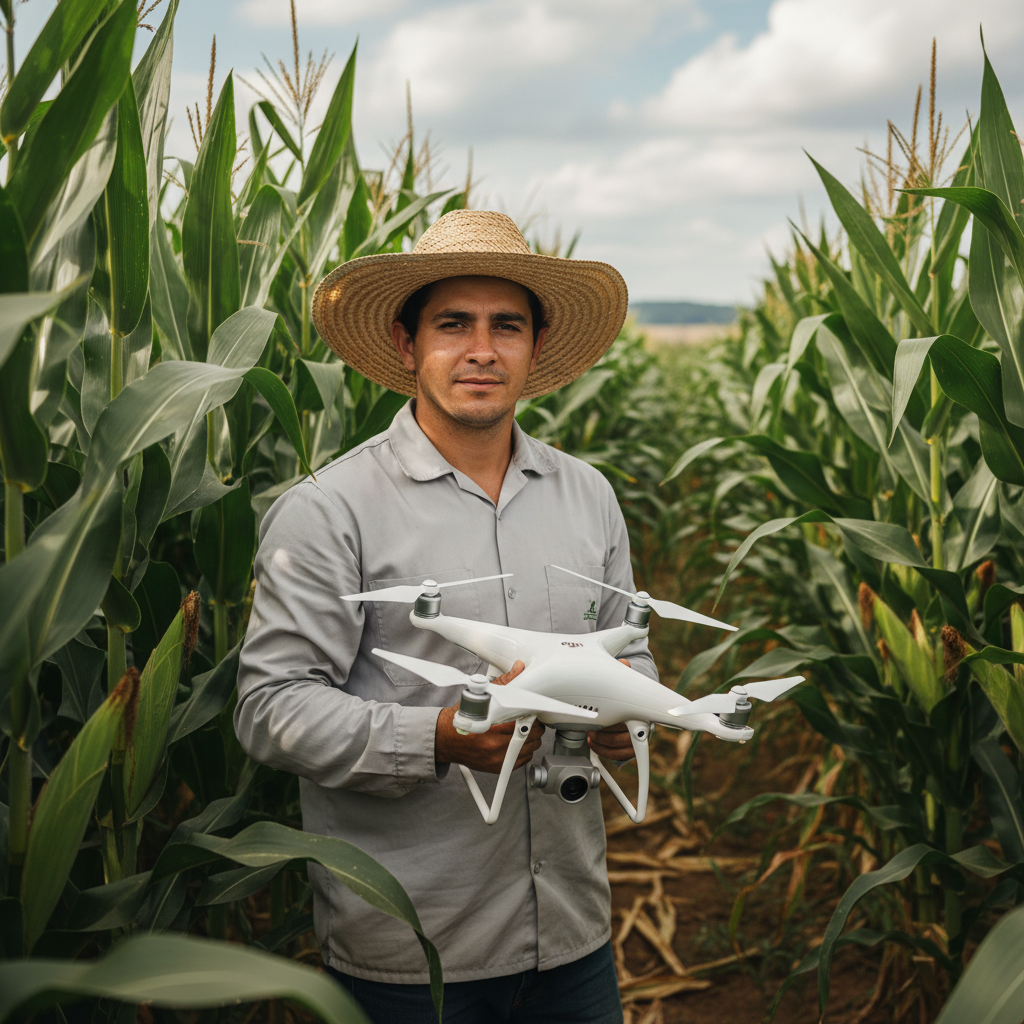
Lucas Fernandes Silva is an agricultural engineer with 12 years of experience in aerial mapping technologies and precision agriculture. ANAC-certified drone pilot since 2018, Lucas has worked on mapping projects across more than 500 rural properties in Brazil, covering areas ranging from small farms to large-scale operations. Specialized in multispectral image processing, vegetation index analysis (NDVI, GNDVI, SAVI), and precision agriculture system implementation. Lucas is passionate about sharing technical knowledge and helping agribusiness professionals optimize their operations through aerial technology.