RGB vs Multispectral Cameras: Which to Use for Agricultural Mapping?
Compare RGB vs multispectral cameras
RGB cameras capture the same red, green, and blue light your eyes see. That makes them great for true-color maps, visual checks, and 3D models. If you want clear pictures of rows, weeds, or irrigation lines, an RGB camera gives sharp detail and fast results.
Multispectral cameras record extra bands like near-infrared (NIR) and red edge. Those bands reveal plant health that the eye can’t see. You’ll get data you can turn into indices like NDVI to spot stress, disease, or water gaps before symptoms appear.
Pick the tool that matches your goal: do you need pretty maps and structure, or actionable plant-health data? The short answer to RGB vs Multispectral Cameras: Which to Use for Agricultural Mapping? is: it depends on whether your goal is visual scouting or precise crop monitoring.
What each sensor captures
An RGB sensor records visible light. Color dominates: you’ll see canopy cover, bare soil, roads, and obvious damage. RGB is also great for accurate orthomosaics and models because it often offers higher spatial resolution.
A multispectral sensor adds bands outside visible light, especially NIR and red edge. Healthy plants reflect more NIR and less visible red. With those bands you can compute indices like NDVI to quantify vigor, spot stress early, and separate different crop types.
Main benefits for maps
With RGB, you get crisp images and fast processing. Use it for detailed basemaps, 3D elevation models, and visual scouting. It’s cheaper to buy and easier to fly.
Multispectral gives measurements, not just pictures. That converts into field zones, variable-rate maps, and trend charts over time. It takes more setup and processing, but delivers data you can act on, like targeted spraying or irrigation fixes.
| Feature | RGB | Multispectral |
|---|---|---|
| Bands captured | Red, Green, Blue | Red, Green, Blue, NIR, Red Edge |
| Typical uses | Visual maps, 3D models, scouting | Vegetation indices, crop health, prescriptions |
| Vegetation indices | Limited (visual only) | NDVI, NDRE, others |
| Cost | Lower | Higher |
| Processing complexity | Low | Medium–High |
| Best for | Visual detail, quick maps | Actionable plant health data |
Decide sensor needs
If you want clear photos, lower cost, and fast workflows, go RGB. If you need to measure plant vigor, make prescriptions, or detect stress early, choose multispectral. If possible, run a short test flight with both and compare maps and indices to see which answers your questions.
How multispectral sensors work
Multispectral sensors capture light in several narrow bands beyond what your eye sees. Each band records reflectance at a specific slice of the spectrum, producing multiple aligned images of the same scene. You co-register those band images, correct for light and lens effects, and compute indices such as NDVI by comparing bands. That math turns raw light into signs of plant health, water stress, or soil differences.
On a flight you collect the band images, then co-register and calibrate them into usable maps. The pipeline moves from raw band files to orthomosaics and index maps you can use in the field.
Bands and filters explained
Common bands used for agriculture are Blue, Green, Red, Red Edge, and NIR. Blue and green help with color and chlorophyll; red picks up chlorophyll absorption; red edge is sensitive to early stress; NIR indicates leaf structure and vigor.
| Band | Typical Wavelength (nm) | Main Use |
|---|---|---|
| Blue | 450–500 | Color detail, water and haze detection |
| Green | 500–580 | Vegetation greenness, base color |
| Red | 620–700 | Chlorophyll absorption, crop index input |
| Red Edge | 700–740 | Early stress detection, chlorophyll shifts |
| NIR | 740–900 | Biomass, canopy structure, vigor (key for NDVI) |
Filters decide how narrow and clean each band is. Narrowband filters give clear separation but need more light; broadband filters gather more photons. Choose filter type based on lighting, flight speed, and index precision required.
Drone-based multispectral tips & calibration
Plan flights at stable light — near solar noon to reduce shadows. Use consistent altitude and overlap so each ground point is seen by many frames. Keep sensor settings steady, use a reflectance panel before and after flight, lock exposure if possible, clean lenses, and check mounts. Tag images with GPS or RTK data for accurate alignment with field rows and plots.
Sensor calibration steps:
- Capture a dark frame to measure sensor noise.
- Photograph a calibrated white reflectance panel before/after flight.
- Record panel readings and flight metadata (time, temperature, altitude).
- Apply vignetting and lens corrections, then normalize images to panel values so band-to-band comparisons reflect true field conditions.
When RGB imagery works best
Use RGB when you need clear, natural-color photos for visual inspection, mapping field edges, or showing damage after a storm. If your goal is high-detail maps for planning or to document crop stages in an intuitive way, RGB is often the fastest and cheapest choice.
RGB is ideal for quick scouting: consumer drones, overlapping photos, and stitched orthomosaics you can view on a phone. Low cost, easy workflows, and widely available software mean you can turn photos into maps in hours.
RGB shines where fine visual detail matters — plant color, leaf shape, small ground features. Fly lower for better GSD (ground sample distance) and use proper overlap for clean stitching. Images are standard JPEG/TIF files, simple to archive and share.
| Typical Task | RGB Best? | Why |
|---|---|---|
| Field boundary mapping | Yes | Clear natural color and high spatial detail |
| Quick scouting after weather events | Yes | Fast capture and easy review |
| Early plant stress detection | No | Lacks NIR/red-edge data needed for NDVI |
| Precision nutrient management | No | Requires spectral bands beyond RGB |
Low-cost mapping and scouting
When cost matters, RGB gets you in the game. Use a consumer drone and free/low-cost stitching software for field notes, yield overlays, or damage reports. Flight plan: ~70% front overlap and ~70% side overlap; fly mid-morning for stable light. Add a simple ground control point if you need better location accuracy.
RGB limitations in agriculture
RGB can’t see infrared. You’ll miss critical signals like early stress, water deficit, and nitrogen issues that appear in NIR/red-edge bands. Lighting and soil color can also fool RGB — shadows, wet soil, or bare patches can mimic stress. For reliable vegetative indices like NDVI, use multispectral sensors.
Quick field checks to back up RGB images: walk representative strips, take close-up shots of suspect plants, use a color card or smartphone histogram to check exposure, and mark ground-truth points to match photos to real conditions.
When multispectral imaging helps
Multispectral imaging helps when you need more than what your eye sees. Use it to detect plant stress, water issues, and nutrient gaps before symptoms appear. Pick multispectral when targeted decisions save money — e.g., applying fertilizer only where plants need it. Plan flights around crop stage and consistent times so maps are comparable across dates.
Multispectral imaging agriculture uses
Use multispectral for yield prediction, irrigation planning, and disease detection. Near-infrared shows leaf vigor, red edge highlights subtle stress, and green reflects chlorophyll. Combine these into indices like NDVI for actionable maps used in variable-rate seeding, targeted spraying, or prioritizing scouting routes.
Crop health monitoring with cameras
Mount multispectral cameras to survey fields quickly. They reveal early signs of pests, drought, and nutrient shortage days or weeks before visible symptoms, often changing how you manage a season. Compare sensors before buying: do you need detailed spectral info or just visual maps?
Best crops for multispectral
Crops that respond well to irrigation and fertilizer — corn, wheat, rice, vegetables — benefit greatly. Perennials like grapes and orchards also show clear stress patterns and reward regular monitoring.
| Crop type | Why multispectral helps | Typical useful bands |
|---|---|---|
| Corn & cereals | Early nitrogen and water stress detection; guides variable-rate inputs | Red, NIR, Red-edge |
| Vegetables | Spot disease and uneven irrigation quickly | Green, Red, NIR |
| Grapes & orchards | Monitor vine vigor and block-level issues over seasons | Red-edge, NIR |
Use NDVI and vegetation indices
Turn drone images into plant health maps using NDVI and other vegetation indices. NDVI compares reflected Red and NIR to show vigor. With a multispectral camera you get the right bands; with RGB you’re limited to approximations.
When you fly, plan shots for steady light and overlap. Cloud cover and time of day change reflections, so fly at similar sun angles and use a calibration panel when possible. That makes index maps reliable over time so you catch real changes, not light artifacts.
Use indices to guide action: map high/low areas, target irrigation, spot pest hotspots, and measure recovery after treatment.
What NDVI shows you
NDVI yields a value roughly from -1 to 1. Bare soil and water sit near zero or below; healthy green leaves reflect strongly in NIR and absorb Red, scoring high. NDVI helps track vigor across a season, compare fields, and point you where to walk and investigate.
Other useful vegetation indices
NDVI is the workhorse, but others help specific questions:
- EVI — reduces canopy background noise (good for dense canopies).
- GNDVI — uses green for chlorophyll and nitrogen sensitivity.
- SAVI — adjusts for soil brightness in sparse vegetation.
- NDRE — uses Red Edge for late-season biomass and canopy health.
| Index | Bands used | Best for |
|---|---|---|
| NDVI | NIR & Red | General vigor and stress detection |
| EVI | NIR, Red, Blue | Dense canopies, reduces background effects |
| GNDVI | NIR & Green | Chlorophyll and nitrogen monitoring |
| SAVI | NIR & Red (soil adjusted) | Sparse vegetation, high soil visibility |
| NDRE | NIR & Red Edge | Late season biomass and canopy health |
Read index maps by combining colors, values, and context. Pick a color ramp that makes differences clear, set thresholds for action, and always ground-truth suspicious spots. Keep a log of weather and farm activities to link changes to real events.
Plan flights for good data
Start by defining the flight goal: what data you need, required precision, and critical field areas. That drives altitude, overlap, and flight pattern. Build a simple map including no-fly zones, wind direction, and sun angle. Mark launch/recovery spots close to roads and shade for battery swaps.
Plan data handling: know how many images you’ll gather, where you’ll store them, and how you’ll back them up. Label flights with date, time, and mission goal.
Altitude and overlap rules
Altitude sets GSD (pixel size on the ground). Lower altitude = smaller GSD = more detail but longer flight time. Overlap helps processing: aim for ~70–80% front overlap and ~60–70% side overlap for agricultural work. Increase overlap for multiband sensors or windy conditions.
| Task | Altitude (m) | Front Overlap | Side Overlap | Notes |
|---|---|---|---|---|
| High-detail plant scouting | 20–50 | 80% | 70% | Low GSD, many images |
| Field-scale mapping | 60–120 | 75% | 65% | Balance detail and speed |
| Large-area quick survey | 120–200 | 70% | 60% | Less detail, faster coverage |
Precision agriculture remote-sensing tips
Pick the right sensor for the job. Ask: RGB vs Multispectral Cameras: Which to Use for Agricultural Mapping? RGB is cheap and fast for scouting; multispectral captures NIR and red-edge that reveal stress you can’t see. Calibrate sensors, fly at consistent times on clear days, use ground control points for centimeter-level accuracy, and keep a log of sunlight, clouds, and wind.
Checklist before flight: batteries charged, SD cards empty and labeled, props inspected, firmware updated, flight plan loaded, regulations checked, weather acceptable, safety gear on hand, and a backup plan for data storage.
Process imagery for maps
Collect consistent, well-overlapped images with a calibrated camera. Import into processing software for alignment: tie points, sparse 3D cloud, dense point cloud, DSM, and orthomosaic. Add GCPs or RTK/PPK logs to reach centimeter-level accuracy. Export with the correct coordinate system and file formats for farm tools.
Stitching and orthomosaic basics
Stitching blends many overlapping images into one flat picture. Inspect seamlines, check for ghosting, and confirm color balance. An orthomosaic corrects perspective so every part of the map is to-scale — use it for measuring areas, planning irrigation lines, and spotting pest patches.
Agricultural mapping sensor comparison
Match the camera to the question. RGB provides sharp color images for scouting, counting plants, and high-resolution maps. Multispectral captures narrow bands like NIR and red edge, enabling indices (NDVI, NDRE) and early stress detection.
If you need simple scouting and high detail at low cost, go RGB. If you need plant health data, early stress detection, or biomass estimates, pick multispectral. Often the best approach is both: RGB for structure and multispectral for health — two tools in your shed.
| Camera Type | Best For | Bands | Pros | Cons |
|---|---|---|---|---|
| RGB | High-detail maps, scouting, counting | Red, Green, Blue | Affordable, high resolution, simple workflow | No direct plant-health indices |
| Multispectral | Vegetation health, stress detection | Red, Green, Blue, Red Edge, NIR | Vegetation indices (NDVI), early stress signals | More expensive, needs calibration |
Export maps for your farm
Export formats: GeoTIFF for rasters (orthomosaic, NDVI), Shapefile/GeoJSON for boundaries/polygons, and KMZ for Google Earth. Export at practical resolution — very large files slow workflows — and always include the CRS so maps align with GPS machines and tractors.
Weigh spectral vs spatial resolution
Choose based on the question. If spotting small features matters, spatial resolution is king. If detecting plant health, stress, or nutrient issues matters, spectral resolution (extra bands) matters more.
Both matter together, but one will often dominate. RGB flights are fast and cover hectares; multispectral flights are slower but read plant physiology. Match mission to sensor: urgent scouting favors spatial detail; crop diagnostics favors spectral bands.
When higher spatial detail matters
High spatial detail is needed to spot single-plant problems, irrigation leaks, or small weed patches. That requires flying lower, faster shutter speeds, and handling larger datasets. For some tasks (e.g., vine dieback in vineyards), a high-res RGB may answer faster than a coarse multispectral mosaic.
When spectral bands matter more
Extra bands are necessary when color alone misleads. Disease, nitrogen shortage, and water deficit often show up in NIR or red edge before visible wilting. Multispectral cameras deliver early warning lights for plant health and help prioritize scouting and targeted interventions.
Balance cost and information: if you cover thousands of acres, RGB may suffice for routine monitoring; invest in multispectral for diagnosis and precision prescriptions. A mix often works best.
| Decision factor | Spatial-focused (High-res RGB) | Spectral-focused (Multispectral) |
|---|---|---|
| Best for | Spotting small objects, row-level detail | Detecting plant stress, physiology |
| Typical sensor | High-megapixel RGB | NIR, Red-edge, multispectral bands |
| Area cost | Lower per ha (faster flights) | Higher per ha (slower, more flights) |
| Action speed | Quick visual decisions | Early warning, targeted intervention |
Choose sensors for crop mapping
Pin down your goal: spot disease early, map yield zones, or guide fertilizer. RGB gives clear color images for scouting and counting. Multispectral powers indices like NDVI for stress detection and decision-making. Consider flight time, payload, and data workflow: multispectral gear usually means more files, calibration panels, and longer processing.
| Sensor | Best for | Key metric | Typical cost | Quick note |
|---|---|---|---|---|
| RGB | Visual scouting, plant counts, orthomosaics | High spatial resolution | Low–Medium | Cheap, easy to process |
| Multispectral | Stress detection, vigor mapping, fertigation | Vegetation indices (NDVI, NDRE) | Medium–High | Requires calibration, more actionable |
| Thermal | Water stress and irrigation mapping | Canopy temperature | Medium | Weather-dependent |
Sensor selection steps
- Define the management question (e.g., “Where do I need more water?”).
- Match sensor to the question: RGB for scouting, multispectral for health metrics.
- Shortlist sensors and compare weight, power needs, and software compatibility with your drone.
- Run a pilot: fly over a known field, compare results, and ground-truth with handheld meters or samples.
- Evaluate processing time and team capacity.
Estimate ROI before you buy
Count full costs: sensor, drone upgrades, software licenses, storage, training, maintenance, subscriptions, and replacements. Estimate savings from reduced inputs, fewer passes, and earlier detection of stress. If a sensor can cut 5–10% of input costs or prevent one crop-loss event, payback can be fast.
Simple ROI test: annual savings from smarter inputs minus annual operating costs = payback. Factor in time savings. Consider leasing or trials if initial cost is steep.
Make the final decision based on answering top questions, budget, and data workflow. Run a pilot, check vendor support and warranty, and plan for scaling. If in doubt, start with RGB for quick wins, then add multispectral for deeper insight.
Frequently asked questions
- RGB vs. Multispectral Cameras: Which to Use for Agricultural Mapping?
- Choose multispectral when you need plant health data and indices. Use RGB for simple maps, scouting, or tight budgets.
- Which camera should you use for routine crop scouting?
- Use RGB for fast visual checks. Switch to multispectral when you need stress detection or detailed maps.
- Can you get NDVI or plant indices from RGB images?
- You can only approximate NDVI from RGB. For accurate indices, use multispectral and a calibration panel.
- How do you pick based on budget and field size?
- Pick RGB if you’re small-scale or low-budget. Invest in multispectral for large farms or precision decisions.
- What steps should you follow to collect usable agricultural maps?
- Fly at consistent altitude and good light, use calibration targets, overlap images well, and run stitching and index software.
RGB vs Multispectral Cameras: Which to Use for Agricultural Mapping? Consider goals, budget, and the action you want from your maps. Use RGB for clear, fast visual maps and multispectral for early, actionable plant-health data. Often the best program uses both: RGB for structure and multispectral for diagnostic depth.
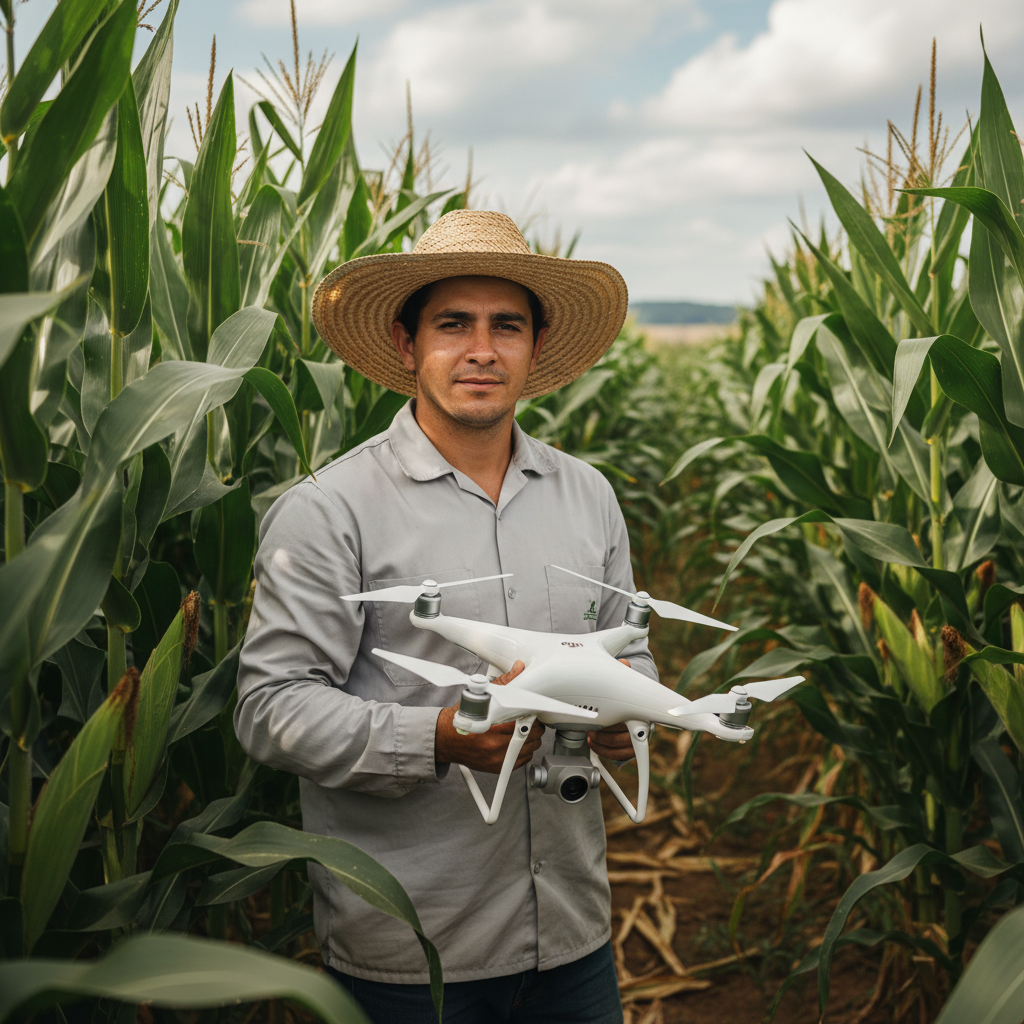
Lucas Fernandes Silva is an agricultural engineer with 12 years of experience in aerial mapping technologies and precision agriculture. ANAC-certified drone pilot since 2018, Lucas has worked on mapping projects across more than 500 rural properties in Brazil, covering areas ranging from small farms to large-scale operations. Specialized in multispectral image processing, vegetation index analysis (NDVI, GNDVI, SAVI), and precision agriculture system implementation. Lucas is passionate about sharing technical knowledge and helping agribusiness professionals optimize their operations through aerial technology.