Flight planning for soybean drone mapping
Start by deciding what you want to measure and when you need the answers. If your goal is plant health, yield gaps, or stand counts, choose the right sensor and resolution first. Think of the process as a short recipe: pick the sensor, set the altitude for the ground sample distance (GSD) you need, and schedule flights when light is stable. Use “Soybean Mapping with Drones: Ideal Flight Protocol and Data Interpretation” as your planning guide — it connects the flight plan to how you’ll interpret results.
Build a mission map that matches field shape and obstacles. Load or draw field boundaries, mark no-fly zones (tall trees, power lines), and set safe launch/recovery points near roads for quick battery swaps. Split large fields into blocks you can finish on one battery set. Plan file naming, backup, and metadata capture (flight altitude, sensor settings, timestamps) before you fly so your data stays usable.
Prepare your pre-flight checklist
- Confirm firmware versions, camera calibration, lens cleanliness, and memory card space.
- Inspect propellers, battery health, and GPS/RTK locks.
- Pack reflectance panels if needed and note panel readings.
- Bring spare batteries, chargers, extra SD cards, and a backup tablet/radio.
- Walk the takeoff area to scan for hazards and have an emergency plan and charged phone.
Set mission grid and overlap
Choose flight lines to suit crop rows and sensor footprint — flying parallel to rows often captures row-level differences better. Set front and side overlap by sensor: RGB tolerates lower overlap than multispectral or thermal. Slower speed and higher overlap reduce motion blur and improve stitching.
Altitude, overlap, and speed should match the detail you need:
| Altitude (m) | Approx. GSD (cm/px) | Front Overlap (%) | Side Overlap (%) | Typical Use |
|---|---|---|---|---|
| 30 | 1.0 | 80 | 70 | Stand counts, fine detail |
| 60 | 2.0 | 75 | 65 | NDVI, vigor mapping |
| 120 | 4.0 | 70 | 60 | Quick coverage, scouting |
Increase overlap on windy days or when you need plant-level metrics. Lower overlap speeds coverage but risks gaps.
Log weather and permissions
Record wind speed, temperature, cloud cover, and precipitation. Postpone if gusts exceed safe limits or cause motion blur. Confirm local airspace rules, NOTAMs, and landowner permission; keep a timestamped flight log.
Optimal flight altitude for clear maps
Altitude is the quickest way to control map clarity: lower = more detail, higher = more coverage. For “Soybean Mapping with Drones: Ideal Flight Protocol and Data Interpretation,” decide whether you need row-level detail or a field overview and pick altitude accordingly.
Match altitude to the sensor and desired GSD. For leaf- or pest-level observation target GSD under 2 cm/px and fly low. For NDVI or field-scale vigor maps a higher altitude is more efficient. Run a short test flight at your planned altitude and inspect images before committing.
| Altitude (m) | Typical Use | Resolution feel | Battery impact |
|---|---|---|---|
| 30–50 | Detailed scouting, row checks | Very high detail | Higher time per area |
| 60–90 | Plant-level health, management zones | High detail | Good balance |
| 100–120 | Field-scale maps, quick coverage | Moderate detail | Fewer passes, faster coverage |
Choose altitude for image resolution
Work backwards from the GSD you need. For leaf-level detail aim under 2 cm/px; for canopy health a coarser GSD suffices. Keep overlap and speed consistent — fast at low altitude causes blur. Lock settings once you validate them.
Balance altitude and battery life
Higher altitude covers more area per pass and reduces battery swaps, but may lose small details. Plan missions with safety margins and break large fields into smaller missions. If stretching battery life, raise altitude slightly and slow the drone to preserve image sharpness.
Adjust for canopy height
Set altitude above the canopy, not ground. Measure the tallest soybeans and add 10–20 m clearance depending on the drone and sensor to avoid prop wash and ensure consistent shots.
UAV flight protocol for soybeans
For clean, repeatable maps set a clear mission: sensor type, area, and time of day. Make “Soybean Mapping with Drones: Ideal Flight Protocol and Data Interpretation” your mantra — plan flights so images align the same way each time. Fly on days with steady light and wind under 10–15 mph. Keep batteries, memory, and a charged controller ready.
Use parallel flight lines, steady altitude, and consistent overlap and speed. Stagger battery swaps to maintain even image spacing. Capture raw files, save clear filenames with date and field ID, and log sensor settings.
| Parameter (multispectral) | Recommended |
|---|---|
| Altitude | 60–120 m AGL |
| Forward overlap | 75–85% |
| Side overlap | 65–75% |
| Ground Sample Distance | 2–5 cm/px (adjust altitude) |
| Speed | 3–6 m/s depending on sensor |
| Timing | Mid-morning to noon for stable light |
Follow local rules and VLOS
Keep the drone in Visual Line Of Sight (VLOS) and obey registration and authorization requirements. Check NOTAMs and temporary restrictions. Use a spotter for large fields or nearby people.
Plan emergency return actions
Set a Return-to-Home (RTH) altitude above the highest obstacle. Program conservative low-battery thresholds and rehearse lost-link and manual-landing drills. Assign roles for battery swaps, landing guidance, and emergency contacts.
Keep flight logs and insurance
Record date, time, weather, battery cycles, sensor settings, and anomalies. Store logs in a simple spreadsheet or app and carry proof of insurance during flights.
Multispectral imaging for soybeans
Multispectral sensors reveal light bands your eyes miss and let you detect stress, disease, or nutrient gaps early. Use indices like NDVI to guide sampling and targeted inputs.
Combine consistent capture (altitude, overlap) with proper processing of reflectance data to compare dates. Follow “Soybean Mapping with Drones: Ideal Flight Protocol and Data Interpretation” to get actionable maps.
Pick multispectral vs RGB cameras
| Feature | RGB Camera | Multispectral Camera |
|---|---|---|
| Bands captured | Red/Green/Blue | NIR, Red Edge, RGB |
| Best use | Visual scouting, canopy cover | Plant health, stress detection |
| Cost | Low | Medium–High |
| Decision value | Limited | High for targeted management |
Choose RGB for visual checks and mapping structure; choose multispectral (NIR red edge) for early stress detection and indices.
Capture NIR and red edge bands
NIR responds strongly to leaf structure/biomass; it falls before visible symptoms. Red edge is sensitive to chlorophyll changes and helps spot subtle nutrient or disease stress. Capture both on repeat flights to detect trends early.
Calibrate sensors before use
Calibrate with reflectance panels before each flight and after sensor warm-up. Capture white/gray references at the same exposure and log panel IDs and conditions. If supported, take dark frames. Proper calibration makes indices comparable across dates.
NDVI soybean mapping and plant health
NDVI turns images into a quick view of plant vigor. Use maps to prioritize scouting and treatment — patterns over time matter more than single snapshots.
Plan flights around NDVI routines: label hotspots, tie maps to field notes, and use “measure, compare, respond.” With practice you’ll know which NDVI ranges match healthy soybeans at each stage.
Use NDVI to spot stress
| NDVI range | What it likely means | Quick action |
|---|---|---|
| 0.70–0.85 | Healthy canopy at mid-season | Routine scouting |
| 0.45–0.69 | Moderate stress — nutrient or water | Targeted soil/plant tests |
| < 0.45 | Severe stress or bare soil | Immediate field check and intervention |
Fly weekly during high-risk periods (hot spells, post-heavy rain) to catch problems early. Use NDVI to narrow acres to a few rows for inspection.
Combine NDVI with other indices
Pair NDVI with NDRE, GNDVI, or thermal data for sharper diagnosis. NDRE/GNDVI hint at nitrogen status; thermal highlights water stress. Layer indices: NDVI for vigor, thermal for heat/drought, NDRE for foliar nitrogen — combined signals guide better decisions.
Time flights for best NDVI contrast
Fly mid-morning to early afternoon on clear days for consistent light and strong NDVI contrast. Match flights to growth stages — early vegetative and mid-canopy stages often show the clearest vigor differences.
Ground control points for soybeans
GCPs anchor your maps to real-world coordinates. For “Soybean Mapping with Drones: Ideal Flight Protocol and Data Interpretation,” GCPs reduce drift and improve absolute accuracy.
Place enough points to control the model without wasting setup time. Visibility matters: place markers where crops won’t hide them and where shadows won’t confuse image matching.
Place GCPs for accurate georeference
| Location | Recommendation | Why it helps |
|---|---|---|
| Corners | 4–6 markers | Controls edges and rotation |
| Center / Midfield | 1–3 per large block | Reduces warp across area |
| Long rows (100–200 m) | Add markers every 100–200 m | Keeps accuracy along length |
Use high-contrast targets (white/fluorescent panels with a dark cross), stake them down, and photograph each marker for matching.
Use RTK or PPK when possible
RTK gives real-time corrections; PPK records corrections for post-processing. Both reduce GCP needs. RTK is convenient for quick field decisions; PPK often yields highest absolute accuracy without live links. Practice flights before first operational use.
Mark and record GCP coordinates
ID each GCP, log coordinates in WGS84 (lat, lon, elevation) with a GNSS or RTK/PPK rover, take a photo of the marker, and note time and datum in the field log.
Orthomosaic soybean fields production
Aim for an orthomosaic that matches field reality: even lighting, no motion blur, and steady overlap so stitching software can lock images. Follow the protocol: plan flight lines, select conservative altitude, and pick a GSD that shows crop rows clearly.
Process flow: import images, sort by time, run quality checks, build tie points and a dense cloud, then generate the final orthomosaic. If tie points cluster or images are blurry, add GCPs or re-fly problem areas.
Ensure adequate overlap for stitching
| Parameter | Recommended value | Why it matters |
|---|---|---|
| Frontlap | 75% | Keeps forward matching strong for rows |
| Sidelap | 70% | Reduces seam lines between flight lines |
| Crosshatch | Optional | Use for tall vegetation or uneven terrain |
Higher overlap helps when wind or vibration causes some shots to blur.
Check tie points and image quality
Inspect tie point distribution and alignment reports. Tie points should be even across the field; if they cluster, the mosaic may warp. Exclude blurred or badly exposed frames; if many images fail, lower flight speed or adjust shutter settings next time.
Export GeoTIFF orthomosaics
Export GeoTIFF with the correct projection and pixel size matching your GSD. Embed coordinate system metadata so GIS or guidance systems read it immediately. Choose tiled output for web viewers or full-extent for heavy analysis.
Drone data processing soybean workflow
Start with high-overlap images, flight metadata, and GCPs or RTK/PPK. Process into orthomosaic, DSM, and vegetation-index layers using photogrammetry software that fits your skill level. Validate GSD and georeference accuracy before interpretation.
Run photogrammetry and mosaicking
Import images and metadata, set camera parameters, choose matching algorithms, and align images. Keep overlap at least 75% frontlap and 65% sidelap for soybeans. Build a dense point cloud, then DSM and orthomosaic. Validate with GCP residuals and ground truth; re-run if needed.
Classify canopy and weeds
Use NDVI/GNDVI for multispectral or ExG/texture for RGB to highlight vegetation. For quick jobs use thresholding; for complex mixes use supervised machine learning. Train classifiers with labeled field patches and validate with holdout samples.
Produce maps for field decisions
| Map type | What it shows | Typical use | Recommended export |
|---|---|---|---|
| Vigor map | Plant health across the field | Fertility and scouting | GeoTIFF |
| Weed map | Weed patch locations | Spot spraying | Shapefile / CSV |
| Prescription | Variable-rate inputs | Seeding/fertilizer/spray | ISO XML / Rx |
Export prescriptions with buffer zones and cutlines to match applicator logic.
Soybean yield estimation with drones
Drones can contribute to yield estimates when flown at key stages (R3–R5). Capture multispectral or high-res RGB, compute canopy metrics (cover, greenness), and use those as predictors in models linking image-derived metrics to harvest yield.
Keep a repeatable flight plan (altitude, overlap, time of day) and calibrate sensors with reflectance panels so indices are comparable. Document and store images with field names and dates for traceability.
Use canopy metrics and indices
| Metric | Source | What it shows |
|---|---|---|
| NDVI | Multispectral (NIR, Red) | Plant greenness; crop vigor |
| GNDVI | Multispectral (NIR, Green) | Early chlorophyll changes |
| Canopy cover | RGB orthomosaic | Fraction of ground covered by plants |
| Canopy height | SfM point cloud / LiDAR | Plant structure and biomass proxy |
Combine indices with structural measures (canopy height) to improve predictions. Keep processing consistent so values are comparable.
Combine drone data with ground samples
Collect biomass, pod counts, and harvest yield at geolocated sample points using a grid or stratified plan. Use ground truth to train and test models (start with linear regression, then ML as samples grow). Track model performance with RMSE and percent error.
Validate models with field checks
Harvest independent strips or plots to compare predicted vs actual yield. Compute RMSE, bias, and percent error; map error clusters and adjust sampling or inputs accordingly.
Frequently asked questions
- What is the best altitude for Soybean Mapping with Drones: Ideal Flight Protocol and Data Interpretation?
Fly for 2–5 cm GSD; typically 50–120 m depending on your camera. Validate with a short test flight and keep settings steady. - How much overlap should you set in your flight plan?
Use 75–85% front overlap and 60–75% side overlap for reliable mosaics and analytics. - Which sensors should you use for soybean health checks?
RGB is fine for structure and canopy cover; multispectral with NIR and red edge is needed for early stress detection and indices like NDVI/NDRE. - When and how often should you fly during the season?
Fly every 7–14 days during key growth stages, and more often during stress periods. Aim for mid-morning in calm wind and consistent light. - How do you turn images into useful crop advice?
Stitch images into orthomosaics, compute indices (NDVI, NDRE), classify canopy vs weeds, and produce vigor/weed/prescription maps. Ground-truth important zones and produce actionable prescription files for variable-rate controllers.
Use this guide as your operational baseline. Repeatability — consistent sensor settings, flight plan, calibration, and logging — is the single biggest factor in turning drone images into trusted field decisions for soybean mapping. Soybean Mapping with Drones: Ideal Flight Protocol and Data Interpretation links capture to confident action.
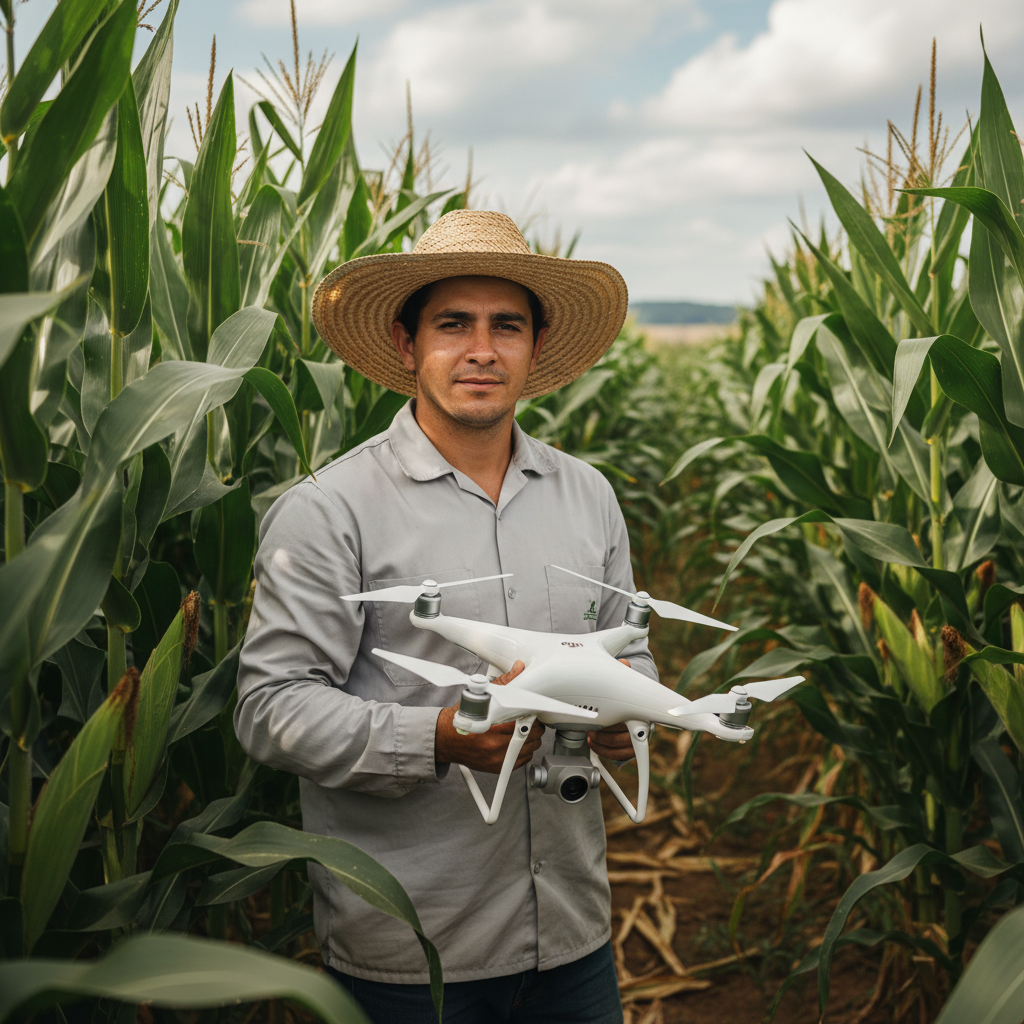
Lucas Fernandes Silva is an agricultural engineer with 12 years of experience in aerial mapping technologies and precision agriculture. ANAC-certified drone pilot since 2018, Lucas has worked on mapping projects across more than 500 rural properties in Brazil, covering areas ranging from small farms to large-scale operations. Specialized in multispectral image processing, vegetation index analysis (NDVI, GNDVI, SAVI), and precision agriculture system implementation. Lucas is passionate about sharing technical knowledge and helping agribusiness professionals optimize their operations through aerial technology.