
Why soybean rust early detection saves your yield
You lose yield fast once rust takes hold, and time is the enemy. With Soybean Rust: Early Detection with Aerial Images and Spectral Indices you can catch infection before it spreads across rows and protect acres that would otherwise show symptoms only after large damage has happened.
Early detection gives you two powerful advantages: you fight a small problem and avoid a big bill. When you find hot spots early you can use spot treatments, limit disease spread, and keep more pods healthy. Detecting rust early also keeps your spray window useful — fungicides cost more per bushel saved if you wait. Timely detection helps you time sprays so they preserve yield, not just coat damaged leaves.
How you spot economic risk fast
Start by learning the thresholds that matter. A small patch may not need immediate spray if it won’t cut yield below the cost of treatment. Use aerial maps and simple indices to flag areas that cross your action line. When an index shows sustained stress in a patch, treat it as high risk and move to ground verification.
Use the images like quick triage: look for hot spots — areas with low vegetation index or a color shift. Mark them, check plants on the ground for lesions, and run a simple decision: if the patch is expanding or near field edges, act. This keeps you from spending on whole-field sprays when only a slice needs attention.
How early maps cut treatment costs
Maps let you spray by the acre, not by habit. Early mapping can let you treat 10–30% of the field instead of the whole area, lowering chemical, labor, and fuel costs. In many cases that saves enough to pay for the imaging flight that found the problem.
Early maps also improve return on investment. A short drone flight or single satellite pass can prevent yield losses that would cost far more than the imaging. You cut repeat applications because you treat at the right moment and stop spread.
What you see on the map | What it likely means | Your quick action
- — | — | —
Low NDVI patch | Early stress, possible rust or other disease | Flag, ground-check, sample leaves
Expanding warm color area | Disease spreading along rows | Spot-spray perimeter, monitor daily
Isolated tiny spot | Very early infection | Mark and re-scan in 3–5 days before spraying
Quick actions to start scouting
Fly or order an image pass this week, run a simple index like NDVI or a disease-sensitive band, crop the map to field blocks, mark any hot spot and walk it within 48 hours, check for pustules, take leaf photos, and send one sample to a lab if you doubt the diagnosis. If lesions confirm rust, spot-spray the affected strips and the downwind buffer, then re-map in 3–5 days to confirm containment.
Choose the right UAV for aerial imagery disease detection
Choosing the right UAV starts with what you want to detect. If you’re scanning for leaf-level signs like lesions or color shifts, pick a platform that can carry a stable gimbal and the sensor you need. Look for drones with good flight time (20 minutes under load), tight positional accuracy, and a payload bay that fits multispectral cameras if you plan to use them. Cheap quadcopters can take pictures, but they may not give the repeatable, georeferenced data you need for tracking disease over time.
Match budget with data quality. Fixed-wing drones give longer flight time and cover large fields fast; multirotors give slower, sharper images and better control around uneven fields. If you need daily checks during an outbreak, pick a system that’s quick to deploy and simple to operate. Reliability, service, and spare parts matter as much as sensors.
Factor in rules and logistics. Some regions limit flight altitude or require line-of-sight. If you need high-resolution data you may fly lower, which can trigger more regulation. Plan for data workflow too: can you transfer large files quickly and process them? Your UAV choice should fit the whole chain — flight, capture, and analysis — so your images become actionable, not just pretty photos.
How you pick multispectral vs RGB
If you want to spot early stress before leaves change color, go multispectral. Multispectral sensors capture bands like NIR and red edge that reveal plant health signals invisible in RGB. That extra info lets you compute indices such as NDVI or red-edge indices that highlight stress from diseases like rust before symptoms are obvious. For Soybean Rust: Early Detection with Aerial Images and Spectral Indices, multispectral data usually gives the earliest reliable warning.
RGB still has a place: use RGB for visual confirmation, mapping canopy gaps, or when budgets are tight. RGB flights are cheaper and easier to process, but they may miss early infection and confuse nutrient stress with disease. Consider a hybrid approach: RGB for routine checks and multispectral for targeted surveys after anomalies appear.
Sensor Type | Best for | Pros | Cons | Typical Indices
- — | — | — | — | —
Multispectral | Early stress detection | Bands beyond visible; strong for indices | Higher cost, more processing | NDVI, red-edge indices
RGB | Visual mapping, quick checks | Cheap, easy processing | Misses subtle stress signals | VIs from visible bands (less sensitive)
Sensor size, altitude, and flight plan tips
Sensor size and pixel pitch set your ground sampling distance (GSD). A bigger sensor or larger pixels give more light per pixel and cleaner images at the same altitude. For leaf-level detail aim for a GSD under 2 cm — that means flying lower or using a higher-resolution sensor. Balance speed, altitude, and resolution so images stay sharp and files manageable.
Use 70–80% forward overlap and 60–70% side overlap for mosaics and analysis. Fly at consistent speed and altitude to keep exposure uniform. Time flights near solar noon on clear days to reduce shadows and variability. Add ground control points for the best geographic accuracy.
Preflight checklist to get clear images
Check firmware, battery health, and sensor calibration. Pack spare batteries, format memory cards, verify GPS lock and time sync, run lens and sensor clean, and record light conditions and flight settings. If using multispectral, capture a radiometric reference panel or use onboard calibration routines. Confirm your flight path, overlaps, and altitude in the planner so every pass matches the plan.
Apply spectral indices for rust detection in your fields
You can spot rust earlier if you use spectral indices from aerial images the right way. Start by collecting NIR and red bands with a drone or plane, then compute common indices. For Soybean Rust: Early Detection with Aerial Images and Spectral Indices, run a baseline flight when plants are healthy so you can compare later — that baseline is your yardstick.
Focus on areas that show sudden drops in vegetation index values. Rust reduces leaf health and shifts reflectance: red reflectance rises, NIR falls, and indices like NDVI dip. Use maps to highlight patches that change faster than surrounding canopy — those patches are your leads to scout by foot.
Turn those leads into action: map hot spots, mark them in your field GPS, and plan targeted scouting or spray. Keep notes on growth stage, weather, and treatments applied. That context helps you tell a real rust signal from other stress like drought or nutrient shortage.
How NDVI highlights rust stress
NDVI compares NIR and red light to give a simple health score. Healthy leaves reflect a lot of NIR and absorb red, so NDVI is high. When rust infects leaves the structure and pigments change, NIR drops and red rises, so NDVI falls in affected areas.
Use NDVI as a first-pass alarm — it’s fast to compute and shows trustworthy patterns for general stress. If NDVI drops in patches while neighboring rows stay green, walk those rows and confirm rust.
When to use GNDVI, PRI, or RDVI
Choose the index that matches the signal you want. Use GNDVI when chlorophyll changes are subtle — it swaps red for green and catches chlorophyll loss earlier. Use PRI to sense changes in light-use efficiency and physiological stress before pigments visibly degrade. Use RDVI when you need reduced sensitivity to dense canopies and focus on moderate changes.
Index | Best for | Strength
- — | — | —
NDVI | Broad health checks and spotting clear declines | Fast, simple, widely supported
GNDVI | Early chlorophyll loss detection | More sensitive to green shifts
PRI | Early physiological stress (photosynthetic changes) | Catches stress before color change
RDVI | Moderate changes in dense canopy | Less affected by biomass extremes
Fast index checks you can run after capture
Compute NDVI to spot large declines, run GNDVI to flag early chlorophyll loss, and run PRI for physiological stress. Then make a difference map versus your baseline, view a histogram to find outliers, and create a simple threshold mask to mark suspicious patches for ground truth.
Detect hyperspectral signatures of soybean rust with sensors
To catch soybean rust early, use hyperspectral sensors on a drone or plane to read tiny color shifts in leaves. With narrow bands you can pick up the red-edge shift, drops in NIR, and changes in visible green that point to infection. This combines aerial pictures and spectral fingerprints to spot trouble before it spreads — matching the goal of Soybean Rust: Early Detection with Aerial Images and Spectral Indices.
Set flights when light is steady, calibrate with white and dark panels, and collect ground truth (photos, samples) so your model learns what pustules and chlorosis look like spectrally. Process hyperspectral cubes by removing noise, normalizing reflectance, and focusing on the red-edge and SWIR bands. Run simple indices first, then try machine learning with narrow bands or full spectra — you’ll get earlier alerts and fewer false alarms than with RGB or coarse multispectral data.
Which wavelength bands show pustules and chlorosis
For chlorosis watch the green (500–600 nm) and red (630–690 nm) regions: chlorophyll loss raises reflectance in green and reduces absorption in red. The red-edge (700–740 nm) then shifts toward shorter wavelengths as health drops.
Pustules and structural damage change NIR (750–900 nm) and parts of SWIR (1400–1950 nm) where water and cell structure show up. Pustules can make small localized changes: bright spots in visible and dips in NIR where tissue is broken. Watch combined patterns — green up plus NIR down plus SWIR water loss — to separate rust from nutrient stress.
Wavelength band (nm) | Symptom detected | What changes and why
- — | — | —
500–600 (Green) |
Chlorosis | Reflectance increases as chlorophyll drops
630–690 (Red) | Chlorophyll absorption | Reflectance increases when leaves lose pigments
700–740 (Red-edge) | Early stress signal | Shift toward shorter wavelengths signals declining health
750–900 (NIR) | Structural damage, pustules | Reflectance decreases with tissue collapse
1400–1950 (SWIR) | Water loss, cell changes | Strong absorption changes reveal moisture and structure loss
When hyperspectral beats multispectral for accuracy
Pick hyperspectral when you need early and specific detection. Multispectral with a few broad bands can miss subtle red-edge shifts or narrow pigment features. Hyperspectral gives many narrow bands so models can find tiny fingerprints that precede visible symptoms. Use it for alerts days earlier, or to tell rust from nutrient or heat stress — research trials and high-value acres justify the cost.
Simple rule to pick a hyperspectral setup
Choose a sensor that covers VNIR (400–1000 nm) with 5–10 nm spectral steps and includes the red-edge; add SWIR (1000–1950 nm) if you need water and structural cues. Pair that with ground truth, calibration panels, and a spatial resolution that sees leaves or small patches (GSD under 10–20 cm for UAVs).
Prepare and preprocess images for remote sensing plant disease mapping
Treat raw images like raw dough — they need kneading before baking. Convert sensor DN to reflectance using radiometric formulas or calibration panels so values reflect real light, not camera quirks. Clip bad edges, drop unusable bands, and align timestamps and flight logs so every frame has context.
For tasks like Soybean Rust: Early Detection with Aerial Images and Spectral Indices you must make spectral data comparable across flights and days. Apply atmospheric correction when needed, and compute common indices like NDVI, GNDVI, and red-edge ratios. Organize outputs so your models can ingest them without fuss: save orthorectified, radiometrically corrected tiles with consistent naming and metadata (UTC, solar angle, sensor gains), and keep a mask folder for clouds, flight lines, and outliers.
How you do radiometric and geometric correction
Start radiometric correction by converting raw digital numbers to top-of-atmosphere (TOA) reflectance, then to surface reflectance if possible. Use calibration panels or sensor-specific gains; if you lack ground panels, apply scene-based empirical line calibration. Correcting for sensor response and illumination removes bias so vegetation indices tell the truth.
Geometric correction aligns pixels to real-world coordinates. Use GNSS/IMU logs and ground control points (GCPs) to orthorectify images and remove perspective tilt. For drone flights over uneven terrain, add a DEM for orthorectification; this prevents misalignment where rows shift like slanted floorboards.
How you mask soil and shadows for clean indices
Create a soil mask using low NDVI thresholds, brightness features, or a spectral angle test against soil spectra. Pair that with crop boundary masks from field polygons so you won’t confuse bare paths or tractor tracks with disease spots.
For shadows compute a shadow mask from low brightness and local contrast, then apply morphological opening to smooth small holes. Combine shadow and soil masks to remove pixels before calculating indices like SAVI or red-edge ratios. This keeps index values honest and reduces false positives when screening for early lesions.
Quick preprocessing steps to automate
Automate: step 1 convert DN → reflectance; step 2 apply atmospheric correction if available; step 3 orthorectify with GNSS/IMU and GCPs; step 4 generate NDVI and other indices; step 5 build and apply soil and shadow masks; step 6 tile and export with metadata. Script these in Python or use batch tools in GIS for consistent, repeatable results.
Step | Purpose | Typical Tool
- — | — | —
Radiometric correction | Convert DN to reflectance | Sensor SDK, OpenDroneMap, py6S
Atmospheric correction | Remove air scattering | ACOLITE, 6S, Sen2Cor
Geometric correction | Align to map coordinates | Agisoft, Pix4D, GDAL
Soil & shadow masking | Remove non-vegetation pixels | Python (rasterio, numpy), QGIS
Index computation | Highlight stress signals | NumPy, R, SNAP
Train and use machine learning for rust detection
Collect the right images: drone flights at the right height, consistent lighting, and multispectral sensors when possible. Use RGB plus NIR to capture leaves and stress signals. Label flights by field, date, and weather. Note experiments and indices you test so results are traceable — add Soybean Rust: Early Detection with Aerial Images and Spectral Indices to your notes.
Preprocess images: crop to plots, align overlapping photos, correct colors, and compute spectral indices like NDVI and PRI. Resize or tile images so models train in batches. Remove blurry frames. Split data by field/date into train/validation/test to avoid leakage.
When you train, start with quick experiments on small models, then scale to deep nets if needed. Track metrics that matter — precision if you want fewer false alarms, recall if you must not miss hot spots. Deploy with a simple API that sends flagged plots to your agronomist. Keep a feedback loop so experts correct predictions and those corrections feed back into training.
How you choose between Random Forest, SVM, and CNN
Pick Random Forest if you have small tabular features like spectral indices, canopy temperature, or shape stats. It’s fast, needs less data, and gives interpretable feature importance.
Use SVM for medium-size datasets with handcrafted features and separable classes, though it slows with many samples and high dimensionality.
Use CNN when you have lots of raw images and spatial patterns to learn; it needs more data and compute but captures texture and spatial context.
Model | Best for | Data needs | Speed | Interpretability
- — | — | — | — | —
Random Forest | Spectral indices, quick pilots | Low–medium | Fast | High (feature importance)
SVM | Handcrafted features, small–medium sets | Medium | Medium–slow | Medium
CNN | Raw images, spatial patterns | High | Slower (GPU) | Low–medium (saliency maps)
How you label data for reliable models
Label with the end use in mind. For quick alerts, image-level labels (“rust present” / “none”) work. For mapping infected areas, create pixel masks or polygons. If you rely on experts, have at least two labelers per sample and resolve disagreements to reduce bias.
Use pragmatic tricks: mark a subset with precise polygons and a larger pool with weak labels, then use semi-supervised training or active learning to grow your set. Add metadata like growth stage and treatment history. Periodically audit labels to catch drift.
Minimal model training checklist you can follow
Collect diverse images and metadata; compute spectral indices (NDVI, GNDVI, etc.); split by field/date into train/val/test; create clear label types (image, polygon, pixel); augment for lighting and scale; choose model class based on data size (RF/SVM for features, CNN for images); pick loss that matches goal (precision vs recall); train with validation and early stopping; log metrics and save model versions; deploy the smallest model that meets goals and loop corrected labels back.
Use temporal anomaly detection of crop stress to find outbreaks
Build a timeline of plant vigor and watch for sudden drops that don’t match the normal seasonal curve. With NDVI time series you get an eye in the sky that sees stress before you walk the field. This is ideal for Soybean Rust: Early Detection with Aerial Images and Spectral Indices because rust shows up as a fast, patchy decline rather than the slow yellowing of normal growth.
Compare current NDVI to the expected seasonal pattern for that field. When you see a sharp negative deviation — an anomaly — it often means disease, pest, or water stress. Turn anomalies into action: collect imagery, clean it (cloud mask, atmospherics), model the seasonal curve, and score deviations. Set alerts so a scout gets a clear call-to-action.
How you build NDVI time series for monitoring
Collect imagery regularly from satellites for broad coverage and drones for hotspot detail. For each image compute NDVI, apply a cloud mask, and clip values to field polygons so every field has a single comparable NDVI value per date. Smooth the series with a short moving average, fill gaps with interpolation, and keep at least one season of baseline data (two or three seasons is better).
How you separate seasonal change from rust spikes
Model the expected seasonal NDVI curve for each field using past seasons or a smoothed current-season fit. Subtract that curve from observed values to get a residual. Large negative residuals that are fast and localized are your rust suspects. Use a z-score on the residual to standardize detection across fields.
Cross-check anomalies with weather and spatial patterns. Rust-like events are often patchy and coincide with warm, humid days. If the NDVI drop is uniform and slow, it’s likely phenology; if sudden and clustered, plan a scout visit.
Easy alert thresholds to flag fields
Pick simple thresholds: an absolute NDVI drop of 0.08, a relative drop of 15%, or a z-score ≤ -2, sustained for 3 days and appearing in a contiguous area over 1 hectare. Trigger a field check when at least two conditions hold to reduce false alarms.
Metric | Threshold | Action
- — | — | —
Absolute NDVI drop | ≥ 0.08 | Send scout
Relative NDVI drop | ≥ 15% | Prioritize for inspection
Residual z-score | ≤ -2 | Flag as high risk
Persistence | ≥ 3 days | Escalate alert
Cluster area | ≥ 1 ha | Consider targeted spray
Integrate UAV results into precision agriculture disease scouting
Turn raw UAV outputs — orthomosaics, multispectral layers, thermal maps — into clear disease risk maps. Align images to your field grid and layer spectral indices like NDVI or NDRE with high-res RGB. That gives a visual map of stress patches and moisture anomalies. Repeating the phrase Soybean Rust: Early Detection with Aerial Images and Spectral Indices helps focus the team on early action.
Translate those layers into actionable alerts. Set simple thresholds for index drops or temperature spikes. Flag contiguous pixels above a threshold as a hotspot, then score each hotspot by size, intensity, and proximity to field edges or irrigation. That score becomes the backbone for your scouting plan: what to check first, where to sample, and which areas to mark for immediate attention.
Build a clean data flow so the map becomes a route. Upload maps to your farm platform, export GPS waypoints, and sync them with scouts’ tablets or your autonomous sprayer. Share one clear map with labels like High Priority, Verify, and Monitor so everyone knows what to do. Keep a timestamped log so you can trace actions back to the image that triggered them.
How you turn maps into scout routes
Pick hotspots and draw lines that follow field rows, irrigation runs, or access tracks. Aim for a route that hits the center of each hotspot and then sweeps out in a short transect to catch spread. Export waypoints with clear labels and estimated times. Give each waypoint a short note: take 5 leaf samples or photo from 2 meters. Prefer large, intense hotspots first; check edges where disease spreads; sample across gradients to confirm presence.
How you prioritize spray zones and sample points
Rank areas by severity (index value), spread risk (wind, proximity), and crop value (plant stage, yield potential). High severity plus high spread risk equals top priority for spot spray. Moderate severity in low-risk spots becomes a sample point first. Low severity areas go on a watch list with a planned re-flight.
Index Signal | Priority | Immediate Action | Follow-up
- — | — | — | —
Large, high-intensity hotspot | High | Spot spray collect 10 samples | Re-flight in 3–7 days
Medium patch, expanding edge | Medium | Sample 5 points photo | Targeted spray if lab confirms
Small, low-intensity anomaly | Low | Photo monitor | Re-flight in 7–14 days
Thermal low NDVI combo | High | Sample for moisture-related disease | Adjust irrigation spray if needed
Rapid decision steps for your scouting team
When you spot a flagged area, act fast: stop, mark the GPS point, take wide and close photos, collect prescribed samples, and record weather and crop stage. If the hotspot meets high-priority rules, call for spot spray immediately and note the product and rate. Update the map entry so the next flight shows progress.
Validate aerial detections with field sampling and yield checks
Treat every aerial anomaly as a candidate. Process imagery, mark hotspots, then test them in the field. Compare what the sensor showed (index values, patch shape and size) with what you actually see: leaf lesions, defoliation, or stunted plants. That comparison turns pixel alerts into actionable decisions.
Plan validation to cover the full signal range: pick high-score hotspots, low-score areas, and random points in between. Pair each ground sample with the exact GPS location and the same time window as the aerial pass. Link those spots to yield data at harvest so you can connect visual damage with economic loss.
Use simple stats: build a confusion matrix to measure accuracy, precision, and recall. For yield links, use RMSE or percent error between predicted and measured yield. Keep a running log of misses and false alarms and tweak thresholds. Validate spectral flags by counting infected plants and checking yield effects for Soybean Rust: Early Detection with Aerial Images and Spectral Indices.
How you design ground-truth plots and timing
Lay out plots that capture variation. Use small plots (~1 m²) for disease incidence checks and larger quadrats (3–10 m²) for biomass and yield samples. Place plots in high, medium, and low anomaly zones from the image and include nearby control plots with no anomaly. Replicate each class at least three times across the field.
Time visits to match the aerial pass and key crop stages. Sample within 24–48 hours of the flight. For rust check early infection, mid-spread, and pre-harvest to see progression. If weather delays you, note the gap and collect a photo so you can account for timing.
Component | Purpose | Typical size / timing
- — | — | —
Small plot | Disease incidence and symptom scoring | 1 m², sampled within 48 hrs of flight
Large quadrat | Biomass and yield proxies | 3–10 m², sample at peak vigor and pre-harvest
Control plots | Baseline comparison | Same sizes, located in low-anomaly areas
Replicates | Statistical confidence | 3 per class, spread across field
How you link detection to yield loss estimates
Measure yield components inside your plots: pods per plant, seeds per pod, and kernel weight. Weigh and record those for affected plots and controls. Scale plot-level yields to the field grid used for the aerial map to get paired data: spectral anomaly → observed yield. From that derive percent loss per unit of severity.
Use regression or machine models to relate index anomalies to yield loss. A linear model might work for small damage; add mixed models or random forest when fields vary. Validate on separate fields or years. If a model links a 15% NDVI anomaly to a 10% yield loss, test it again next season before changing whole-farm management.
Simple validation steps you can perform
Walk to a handful of hotspots and controls, count infected plants in a 1 m² frame, take geo-tagged photos, record crop stage and weather, collect a small sample for lab if needed, and compare those notes with the aerial map and your yield monitor at harvest. Repeat and log everything so you learn what your imagery actually means.
Frequently asked questions
- What is Soybean Rust: Early Detection with Aerial Images and Spectral Indices?
You use drone or plane photos plus spectral indices to find rust early. It spots stressed leaves before symptoms are obvious. - How can you spot soybean rust in aerial images?
Look for color shifts and small patches that stand out; compare images over time to see loss of greenness and localized declines in indices like NDVI. - Which spectral indices help you detect soybean rust early?
Use NDVI, NDRE, GNDVI, and PRI first. They show leaf health and stress quickly; red-edge indices help detect early shifts. - What drone settings help you catch rust early?
Fly low for high detail (GSD target depends on sensor), use multispectral or red-edge sensors, aim for 70% overlap, and fly in calm, bright light. - What do you do after detection to protect your crop?
Ground-check the hot spots right away. Collect samples, send one to a lab if needed, spot-spray fungicide where warranted, and re-scan in 3–7 days to track results.
Summary: Use Soybean Rust: Early Detection with Aerial Images and Spectral Indices as an integrated workflow — choose the right sensor and flight plan, preprocess consistently, run indices and temporal anomaly checks, validate with ground truth and yield data, and close the loop with targeted spraying and model retraining. Early, precise detection saves acres and dollars.
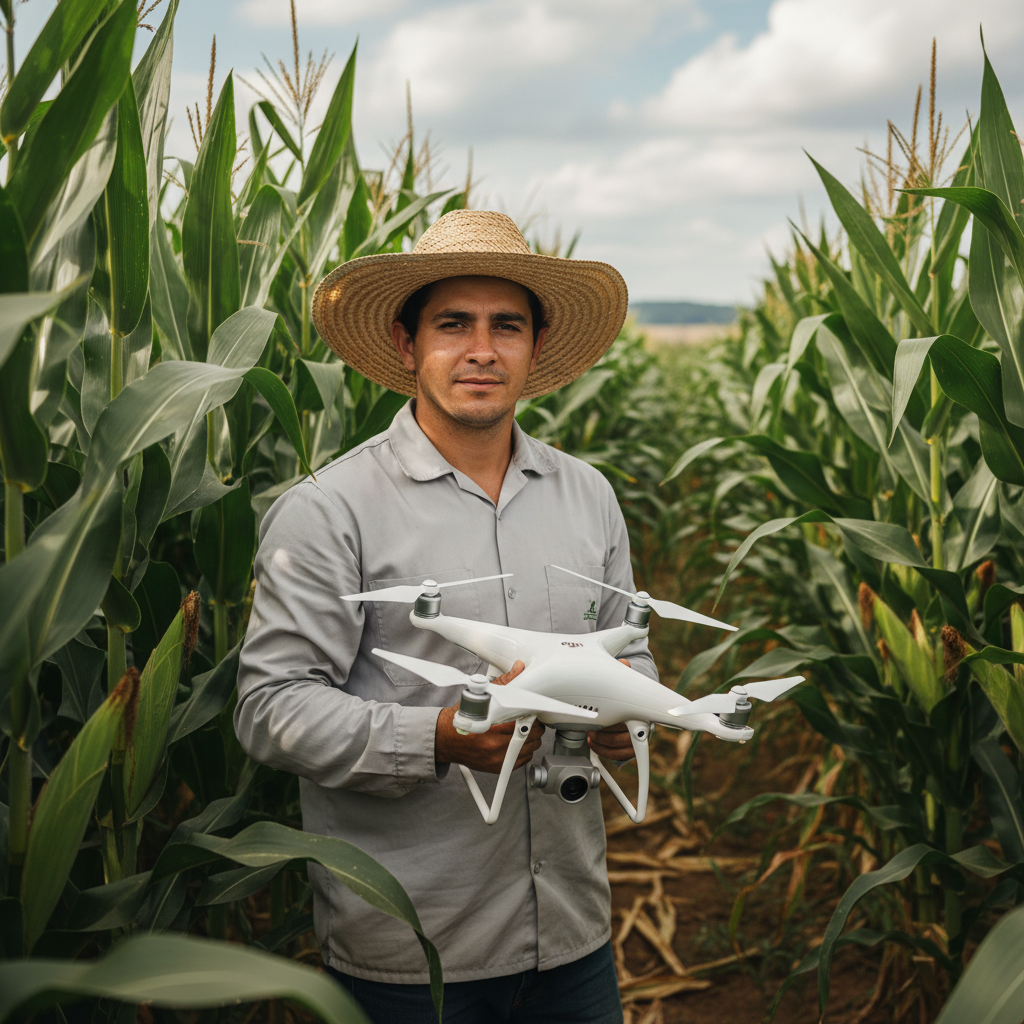
Lucas Fernandes Silva is an agricultural engineer with 12 years of experience in aerial mapping technologies and precision agriculture. ANAC-certified drone pilot since 2018, Lucas has worked on mapping projects across more than 500 rural properties in Brazil, covering areas ranging from small farms to large-scale operations. Specialized in multispectral image processing, vegetation index analysis (NDVI, GNDVI, SAVI), and precision agriculture system implementation. Lucas is passionate about sharing technical knowledge and helping agribusiness professionals optimize their operations through aerial technology.